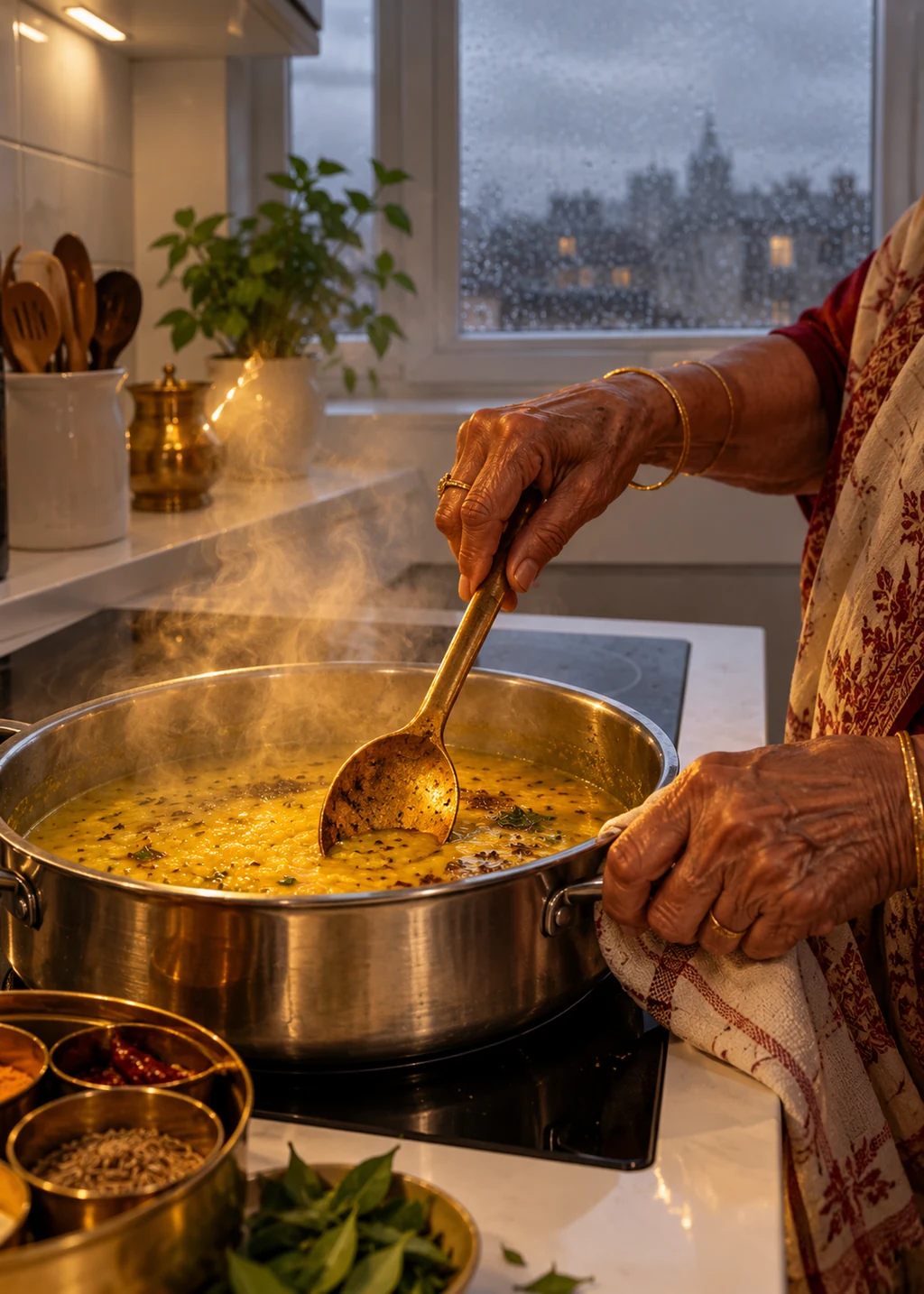
In the top drawer of my kitchen, beneath the stainless steel ladles and the silicone spatulas that came with the apartment, there is a single brass spoon.
It does not belong with the others.
The others are bright, uniform, and cold to the touch. They were made by machines that stamp out ten thousand identical shapes an hour.
The brass spoon was made by a hand that is no longer in the world.
Its handle is thick, tapering down to a bowl that has been worn so thin by decades of scraping the bottom of clay pots that you can almost see the shadow of your fingers through the metal. The brass has darkened in the crevices, holding the oil of a thousand meals, but the edge of the bowl is bright gold from friction.
It is heavier than it looks. It carries a specific gravity that has nothing to do with metal.
I first felt it in a city where the sky was the colour of wet slate and the tap water tasted sharply of chlorine.
I had arrived the night before with three suitcases and one cardboard box that smelled of aeroplane cabin, packing tape and nervous sweat.
The kitchen in the new apartment was pristine. White tiles. Induction stove. A refrigerator that hummed a low electronic note of absolute efficiency.
I unpacked the plates. I arranged the glasses. I placed the stainless steel cutlery in the drawer, aligning them perfectly, the way you arrange things when you are trying to convince a new space that you belong in it.
Then I reached into the bottom of the cardboard box and my hand closed around the brass spoon.
I pulled it out.
I stood in the centre of the white kitchen, holding it.
The silence of the apartment was immense. Outside, the city was making its low continuous roar — the sound of millions of people hurrying to places I did not yet know, in a language I was still learning to hear.
I looked at the spoon. And for the first time since the aeroplane doors closed, the reality of the distance reached me.
Not the miles. Miles are only numbers on a screen.
Distance is the sudden knowledge that if you drop a glass in this kitchen, the sound it makes will not be recognised by anyone who loves you.
The spoon had crossed a distance before I did.
When my grandmother was twenty-six, she moved with her husband and two small children from the town where they had built their first life to a city a night’s train away. My grandfather had found work there after the workshop that employed him closed. There was no catastrophe. No single dramatic moment. Just the ordinary upheaval by which millions of families change cities: a job disappears, another appears elsewhere, rent is calculated, relatives give advice, trunks are packed, and one morning the familiar street is no longer the street you wake up on.
My grandmother had lived in that house since she was a bride.
She knew which floorboard creaked. She knew exactly how the morning light hit the courtyard wall. She knew the name of the neem tree and the rhythm of monsoon rain on the terracotta roof.
For the week before they left, the house slowly became boxes.
My mother, still a child then, remembered adults moving from room to room with lists. Bedding tied with rope. Steel trunks labelled in chalk. Neighbours arriving with food because the kitchen had already begun to disappear.
On the last morning, my grandmother stood alone in that kitchen.
She did not take the silver serving bowls. They were too heavy and, she said, could be bought again.
She left the iron kadhai with her sister because someone would use it there.
Then she reached into the clay pot where the cooking utensils were kept and pulled out the brass spoon.
It had belonged to her mother before her.
She wrapped it in a square of cotton and slipped it into her handbag.
My mother saw her do it.
“Why that?” she asked. “We have spoons.”
My grandmother looked around the kitchen once more.
“Because when we reach,” she said, “the first thing we cook must taste like here.”
My mother laughed. “A spoon can do that?”
“The spoon remembers the salt,” my grandmother said. “It remembers the heat. Everything else can be bought.”
That night, on the train, the children slept across two seats while my grandparents sat upright beside the luggage. At every station, yellow light entered the compartment for a few seconds and disappeared again.
My grandmother kept the handbag on her lap.
Years later, when my mother told me the story, that was the detail she remembered most clearly.
Not the trunks.
Not the farewell.
My grandmother’s hand resting on the bag that held the spoon.
For the first three months in my new city, I ate from cardboard boxes.
Food arrived in plastic containers, cooked by people I would never meet, in kitchens I would never see. I ate it with the bright uniform stainless steel spoons from the drawer.
The food was fine. It was nourishing.
But it tasted of transit.
I ordered from the same three places because the menus were in English and the photographs looked like what I expected. I learned which restaurants delivered fastest. I saved the numbers. I stopped looking at what I was eating long enough to taste it.
The brass spoon stayed in the drawer.
I did not take it out once.
Then my grandmother came to visit.
She arrived with two suitcases and a small steel tin of spices that she had guarded carefully through airport security.
On her second evening, she walked into my white humming kitchen.
She did not ask for permission. She opened the drawer. She pushed aside the silicone spatulas. She found the brass spoon.
She took it out and held it in the light.
For a moment she said nothing.
Then she smiled — not at me, exactly, but at the distance the spoon had travelled and somehow survived.
She washed it. She dried it with a cotton cloth.
Then she took a bag of yellow lentils, a pot, and the steel tin of spices.
She stood at the induction stove, figuring out the unfamiliar dials with the quiet determination of someone who has moved through enough kitchens to know that every stove eventually reveals itself.
When the oil was hot, she dropped in the cumin seeds.
The sound was a sharp sudden crackle. The smell hit the air — earthy, bitter, ancient. It overpowered the chlorine. It overpowered the electronic hum of the refrigerator. It filled the white tiles with the memory of another kitchen.
She stirred the lentils with the brass spoon.
The sound of the worn metal scraping the bottom of the steel pot was a rhythm my body recognised before my mind did.
She tasted from the edge of the spoon. She closed her eyes.
She added a little salt.
Then she tasted again.
This time she nodded.
“Now,” she said. “We are here.”
Tonight, I am cooking for a friend who was born in this city of wet slate and grey skies.
He has never seen the town my grandmother left. He does not know the neem tree or the sound of monsoon rain on terracotta. He has never sat in the kitchen where the spoon first learned the proportions of salt and heat.
I open the drawer.
I bypass the stainless steel. I take out the brass spoon.
I measure the salt with it. I stir the tempering with it. I feel the weight of it in my hand — the thin worn edge of the bowl, the thick handle, the darkness in the crevices holding decades of meals I did not cook but somehow inherited.
I serve him the lentils.
He takes a bite.
He stops.
He looks at the bowl, and then he looks at me.
“This is...” He searches for the word. “This tastes like someone missed you very much.”
I smile.
And suddenly the spoon’s whole journey seems to be sitting between us.
A small town to another city.
My grandmother’s kitchen to my mother’s.
My mother’s to mine.
A train compartment. An aeroplane hold. A cardboard box. A white drawer in a country the spoon had no reason ever to know.
I understand now what a person carries when they cannot carry a whole place.
Not the land. The land stays where it is.
Not the house. Someone else may one day paint the walls, change the locks, cut down the tree.
What travels is smaller.
A recipe remembered without measurements.
The order in which spices enter hot oil.
The way a hand knows, without looking, when there is enough salt.
The stubborn alchemy of turning heat and spice into nourishment — into survival. The proof that a new room can begin to smell familiar before anything else in it does.
We speak of migration as distance.
Perhaps it is also continuity.
The things we carry are not always the things of greatest monetary value. Sometimes they are the things that know what to do when we arrive.
A key to a house that no longer exists.
A photograph whose edges have softened.
A word no one around us uses.
A brass spoon.
When the brass scrapes the bottom of the pot and the cumin cracks in the hot oil, the distance does not vanish. It becomes bearable.
The old place is not restored.
The new place is not made identical to it.
Something quieter happens.
For a few minutes, they recognise each other.
There is no away.
There is only here.
And we are eating.