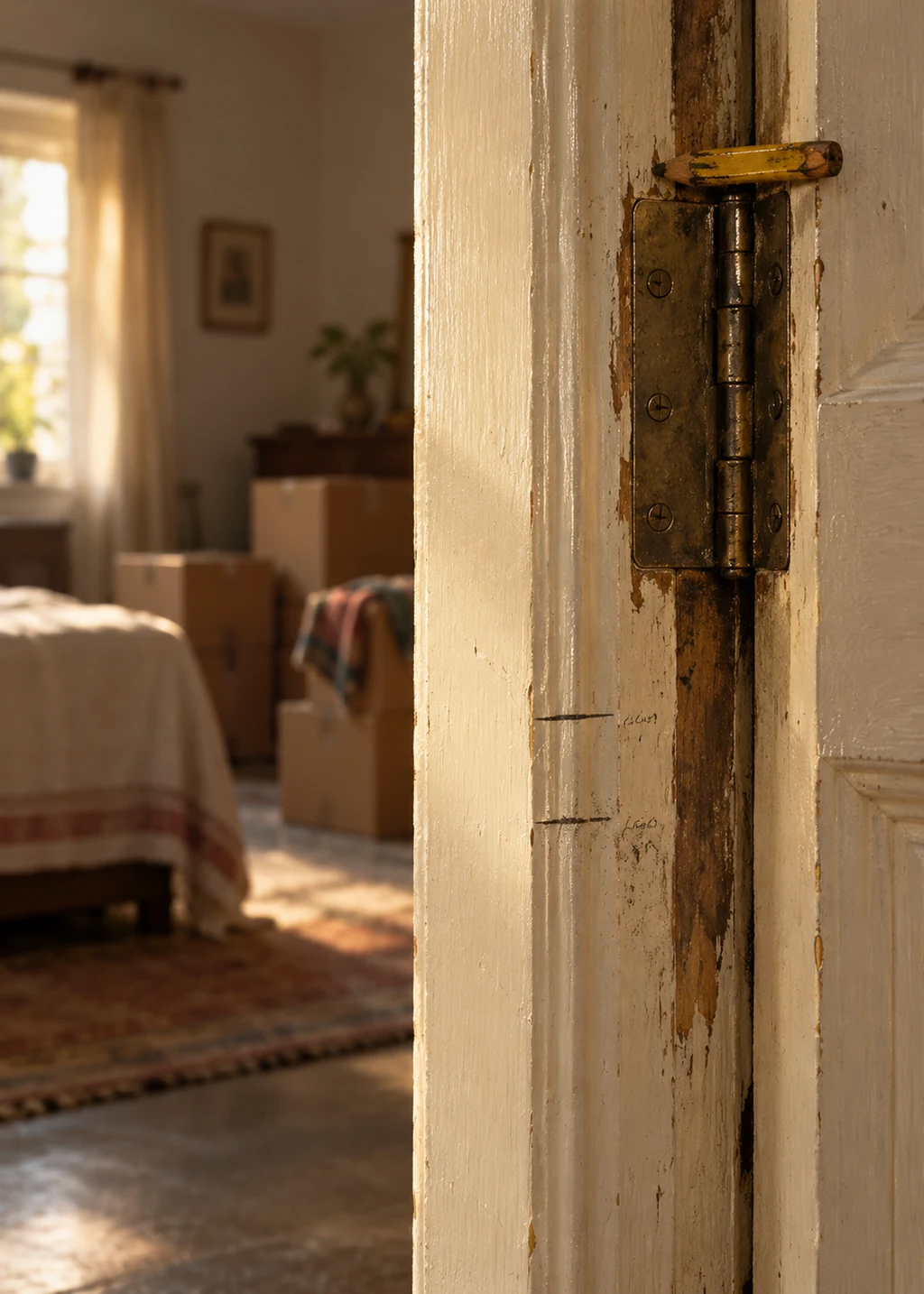
In the hallway of our house, between the kitchen and the bedroom that used to belong to my older brother, there is a doorframe.
It is painted the same cream as the walls, but if you look closely at the inner edge, near the top hinge, the paint is chipped. And beneath the paint, the wood is dark with age and the oil of human hands.
Resting on the top hinge, exactly where it has rested for the last four years, is a carpenter’s pencil.
It is not a round pencil. It is flat, wide, and yellow, though the yellow has faded to the colour of old mustard. The lead is thick and soft, meant for marking rough timber, not paper.
Nobody moves it. It is not forgotten. It is simply waiting.
This morning, the house is loud in a way it has not been for a long time.
My younger sister is moving into the room.
She is nineteen now. She has outgrown the small room she shared with our cousins, and the house has decided, in its quiet, unspoken way, that it is time.
There are boxes in the corridor. The smell of cardboard and the dry dust of things that have been stored in the attic — a smell that belongs to objects that have been waiting without knowing what they were waiting for. My father is carrying a mattress, his footsteps heavy and deliberate on the tiles. My mother is folding sheets, the cotton snapping in the air like small soft whips.
This is not a tragedy. It is a Tuesday. It is the ordinary, relentless forward motion of a household that has refused to stop breathing.
But as my sister carries her first box of books into the room, she stops.
She looks at the walls. She looks at the window. And then she looks at the doorframe.
The room goes quiet. The kind of quiet that happens when a space remembers who it used to belong to.
My father sets the mattress down. He does not look at my sister. He looks at the top hinge.
He reaches up and takes the carpenter’s pencil.
I was twenty when my brother left.
He did not leave in the way people leave for university or for jobs in other cities. He left in the way young men leave when the world outside the front door suddenly demands them — and the government sends a letter with a stamp that looks like a small red seal of finality.
The night before he went, the house was full of the hurried, careful noise of preparation. Boots being polished. A bag being packed with things that would not survive the mud but were packed anyway because a mother’s hands must do something.
My brother was not in the living room. He was in the hallway.
He was standing against this doorframe. He had a habit, when he was thinking, of pressing his back against the wood and sliding down slightly, as if testing the strength of the house to hold him.
My father came out of the bedroom with the carpenter’s pencil.
“Stand up straight,” he said.
My brother smiled. It was the smile he used when he knew he was being indulged but loved the indulgence anyway. He pressed his heels against the skirting board. He pulled his shoulders back.
My father placed a small flat piece of wood on top of my brother’s head. He took the pencil. He drew a line.
The sound of thick graphite on wood — soft, rough, deliberate.
The smell of cedar rising from the mark.
He wrote the date.
“Any taller?” my brother asked.
“No,” my father said. “You stopped growing at twenty-one. The wood knows.”
My brother ran his thumb over the soft graphite. It left a grey smudge on his skin. He did not wipe it off. He just looked at the line, then at my father, and then he picked up his bag.
He walked out the door.
The line stayed on the wood. The pencil stayed on the hinge.
A year passed.
The world outside did what the world does. It argued. It drew lines on maps. It sent young men to stand in fields that smelled of cordite and wet earth, and sometimes it brought them back, and sometimes it sent a man in a uniform to knock on a door at six in the morning, holding a hat in his hands.
The man in the uniform knocked on our door on a Thursday.
My mother did not cry when he spoke. She simply closed the door, walked to the hallway, and sat on the floor beneath the doorframe. She sat there until the sun moved across the tiles and the shadows grew long.
She did not touch the pencil.
Nobody did.
For three years, the room remained exactly as he left it. The bed made. The books aligned. The air holding the shape of a twenty-one-year-old boy who had stopped growing.
I am twenty-four now. I live in a city where the buildings are made of glass and the people move fast.
The walls of my apartment are white and unmarked.
I have a tape measure in a drawer. I have never taken it out. Not once, in three years of living there, have I stood against a wall and thought: measure this. Record this. Prove that someone was here and that they grew.
I tell myself it is because I am renting. That the walls are not mine.
But I know that is not the reason.
We live in a time when we measure everything — our steps, our sleep, our heart rates, the number of people who looked at our photographs for three seconds. We measure the things that can be counted.
We have forgotten how to measure the things that only leave a mark on wood.
Back in the hallway, my father is holding the carpenter’s pencil.
He is looking at my sister.
She is nineteen. She is taller than my mother. She is almost as tall as I am.
She is looking at the dark line my brother made four years ago. It sits just below the top of her head.
She reaches out and touches the graphite. Faint now, sealed under layers of dust and time — but there. Her fingertip comes away with the faintest grey.
“I can’t go in there, Papa,” she says softly. “It’s his room.”
My father does not argue. He does not offer the kind of comfort that tells her it will be alright, because they both know that some things do not become alright — they simply become part of the architecture.
Instead, he steps forward.
He places the flat piece of wood on top of her head.
“Stand up straight,” he says.
She blinks. She looks at him, confused for a second, and then she understands.
She presses her heels against the skirting board. She pulls her shoulders back. She closes her eyes.
My father takes the pencil.
He does not draw the line over my brother’s line.
He draws it above it.
An inch higher.
The sound of thick graphite on wood — soft, rough, the same sound it made four years ago and four years before that and in every hallway where someone has stood still long enough to be measured.
He writes today’s date.
My father steps back.
He looks at the two lines. The older one, dark and heavy, sealed in dust. The new one, bright and sharp.
“There,” he says. “The room is ready.”
My sister opens her eyes. She looks up at the new mark. She does not smile, but her shoulders drop — the release of a person who has just been given permission to continue.
She picks up her box of books.
She walks into the room.
Not as a guest. As the next chapter.
My father places the carpenter’s pencil back on the top hinge.
Exactly where it belongs.
He wipes the grey smudge of graphite from his thumb onto his trousers — the same gesture, I realise, my brother made on the last night. The same graphite. The same motion. The mark transferring from wood to hand to cloth and disappearing, the way things do when they have been properly received.
He turns and walks back toward the kitchen.
He does not look at me.
He does not need to.