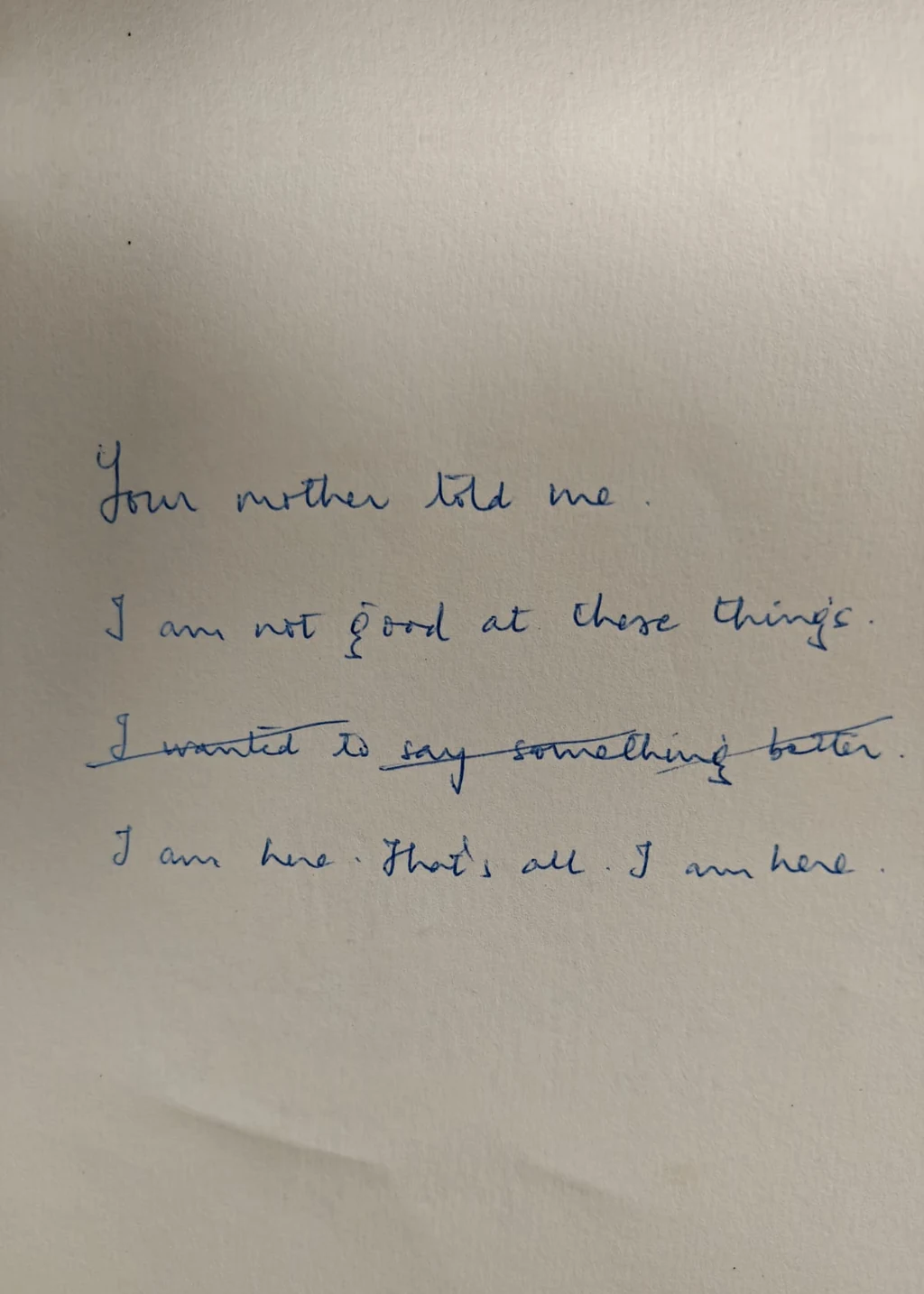
My father was not a man who wrote things down.
He kept numbers in his head: invoice totals, outstanding balances, the price of steel in three different cities on any given week. He kept appointments in a small diary whose pages he never read again after writing in them, as if the act of writing was itself the remembering. He kept promises as certain men of his generation kept promises: quietly, without announcement, and without ever mentioning them again until they were kept.
But letters — letters were not his language.
I understood this as a child, as children understand what nobody explains about their parents. Not as information. As atmosphere. The house was full of my mother’s words. Notes on the kitchen counter. Lists on the refrigerator. Cards for every occasion, written in her particular looping hand that leaned slightly to the right as if always in a gentle hurry.
My father’s handwriting appeared on almost nothing.
Once, on a birthday card when I turned eleven, he had written four words beneath my mother’s paragraph.
Proud of you always.
I kept that card for years in a drawer. Not because of what it said. Because of how much it must have cost him to say it.
The year I am thinking of, I was living in another city.
Not far. Four hours by train. But distance is not geography. Distance is how long it takes a person to reach you when something goes wrong.
Something had gone wrong.
Not the kind of wrong that announces itself at midnight with a phone call. The quiet kind, the kind that settles over a life like the change in light between September and October, gradual enough that you almost don’t notice until one morning you do, and you realise it has been like this for some time.
I was not well. Not in my body. In the way that has no precise name and therefore no precise solution: a heaviness, an absence of the feeling that makes ordinary things worth doing. I had told my mother a little of it, carefully, in the edited way we tell our mothers things we do not want them to worry about completely.
My mother had, of course, worried completely.
And she had told my father.
I do not know exactly how long he sat at the desk.
I know it was his desk in the room he used as an office at home, a room that smelled of old paper and the particular dry warmth of a space where someone has sat and thought for many years. His chair had its own creak. I had heard it my whole childhood through the wall of whatever room I was in.
My mother brought him tea twice. The second time, the first cup was still full and cold on the desk beside him. The faint bitterness of forgotten tea reached her before she saw the cup.
He had been trying to write to me.
He had begun several times. She could see it afterward: the notepad with lines started and crossed out. Not crossed out with the violence of frustration. Crossed out carefully, as you remove a line that was trying but wasn’t right.
He did not know how to say what he needed to say.
He knew what he needed to say. He had known it the moment my mother told him. It was not a complicated thing. Fathers have needed to say it to their children since there were fathers and children and distance between them. But knowing what to say and finding the way to say it are two different rooms, and my father had never learned the door between them.
So he did what anyone does now, when words fail.
He asked a machine.
He would not have called it that.
He would have said he searched online. He would have said he found a way to help himself. He was not a man who distrusted new tools. He had adapted to every tool his business required, from the first mobile phone to the accounting software a young accountant installed one Sunday afternoon and trained him on patiently over three hours.
He typed what he wanted to say to me, haltingly, two fingers, deliberate, as he typed everything, and the machine read it and understood it and gave him back a thing that was extraordinary.
It gave him a letter.
A real one. The words were measured and warm. They moved from acknowledgement to reassurance in the right order. They said the hard thing: that he knew I was struggling, that this was not weakness, that he had seen me face difficult things before and knew what I was made of. And they said it without clumsiness, without the awkward weight of a man who had never learned to say such things.
It was, by any measure, a better letter than he could have written.
He read it twice.
Then he sat with it for a long time.
The room would have been quiet. Late evening by then. The tea cold and untouched, the window dark, the street outside making its small domestic sounds. Someone’s television. A scooter passing. The night security guard doing his first round.
My father reading those words in that silence.
And then the moment, because it must have been a moment, not a gradual thing, when he understood that he could not send it.
Not because it was wrong.
Because it was not him.
Every sentence was correct. Every sentiment was true. But the letter knew how to say things my father had never learned to say, which meant the letter was not my father. It was the idea of a father, the best and most eloquent version, and I would have known in the first line.
I would have known because I had spent my entire life learning the texture of his language. The weight of his few words. How he built a sentence like a man laying bricks: one thing, then the next, no ornamentation, no flourish, everything load-bearing.
Proud of you always.
Four words. Two decades ago. Still in a drawer somewhere.
A machine could have given him a hundred better words for that birthday card.
They would have meant less than nothing.
He put the machine’s letter aside. My mother later found it still open on his screen.
He picked up the pen.
And he wrote to me.
I have the letter still. It is not beautiful. The handwriting is the handwriting of a man who does not write: slightly too large, slightly uneven, the letters of each word not always quite connected to each other, as if each one had to be decided upon separately.
He crossed things out three times. I can see the crossings. Careful, as my mother described. Not frustrated. Searching.
He wrote about the weather in our city. He wrote about a problem with a supplier that had been resolved that week. He wrote one sentence about my mother, and then he wrote about me.
He wrote: Your mother told me. I am not good at these things. I don’t know the right words. But I want you to know that every day I think about you and I think you are doing better than you know.
Then he wrote: I am here. That’s all. I am here.
Then he signed his name. Not Papa, not Dad, just his name, as he signed everything, as if a document and a letter to his daughter were subject to the same requirements of authentication.
I received it four days later.
I read it standing at my letterbox in the corridor of my building, still in my coat, my bag on my shoulder.
I read it again.
And then I sat down on the corridor floor, because there was no chair but the floor was there, and I held the letter and I was, for the first time in many months, completely certain that someone knew where I was.
Not my address. Not my situation.
Me.
I have thought about that letter many times since.
I have thought about what the machine gave him, and it was a real gift. A structure when he had none. A language when his own failed.
And I have thought about what he gave me, which the machine could not have given me even if it had tried with every resource available to it.
He gave me his difficulty.
The crossings-out. The weather. The supplier problem that had nothing to do with anything except that it was what his days were made of and he was including me in his days. The wrong words chosen carefully over the right words that belonged to someone else. The signature that turned a letter into a document because he had never learned that a letter to your daughter did not need to be authenticated. Or perhaps because, for him, it did, because everything he gave had to be real and verified and his.
A machine can give you language.
It cannot give you the weight of one person’s lifelong difficulty with language.
It cannot give you the crossing-out.
It cannot give you I am not good at these things written by a man who, in the writing of it, did the very thing he claimed he could not do.
There is a question I have never been able to answer cleanly.
If he had sent the machine’s letter, the better one, the eloquent one, would it have reached me?
I mean reached me as the real one did. Sitting on a corridor floor. Coat still on. Certain.
I don’t think it would.
I think I would have read it and felt comforted, as well-chosen words comfort, genuinely, for a while. I would have thought: he must really love me to find these words.
But the words would have been between us.
The real letter had nothing between us.
Just him, struggling, deciding, crossing out, trying again, and me, on the other side of four hours of train, receiving not his words but his effort. Not his eloquence but his presence. Not the best version of what a father might say but the only version that was entirely, irreducibly, him.
That is not a small thing.
That might be everything.
I have kept the letter in the same drawer as the birthday card.
Proud of you always. I am here. That’s all. I am here.
Two letters. Decades apart. The same plain grammar. The same man, trying.
There is a word in Gujarati — આપણું (aapanu) — that means ours, our own. It is the word for what belongs to you not because you bought it or earned it but because it comes from where you come from. Your own people. Your own place. The thing that is yours before you have done anything to deserve it.
My father’s letter was આપણું — aapanu.
Not because it was well-written.
Because no one else in the world could have written it.
There will come a day, perhaps it has already come, when a machine’s letter cannot be told apart from a person’s.
On that day, one question will matter more than it ever has:
What are you really sending when you send a letter?
If the answer is words, then the machine will always win. It has more words. Better words. Words assembled with a patience and precision no human hand can match.
But if the answer is yourself —
then the machine has not yet begun to compete.
Not a producer of language.
A source of it.
Every letter my father wrote, even the four-word ones, even the ones with the supplier problem and the weather, was a letter that could only have come from the weight of his particular life. His silences. His careful crossings-out. His name signed at the bottom as if to say: I am accountable for this. This is mine. This came from me.
A machine can compose.
Only a person can sign.
I called him that evening. After the corridor floor. After the coat finally came off.
He answered on the second ring, as he always did. Not with hello but with my name, as a question, because when I called it was always possible that something needed attending to.
“I got your letter,” I said.
A pause. I know each of his silences. This one was the silence of a man who was not sure he had done the right thing.
“It was good,” I said. “It was exactly right.”
Another pause.
“I didn’t know what to write,” he said.
“I know,” I said. “That’s why it worked.”
He didn’t understand what I meant. He may never have understood.
But somewhere in that city, in that room that smelled of old paper and dry warmth, a man who was not good with words sat with the phone after we said goodbye and knew, without knowing why, that the crossing-out had been worth it.
That the difficulty had arrived.
That he had sent himself, and I had received him.