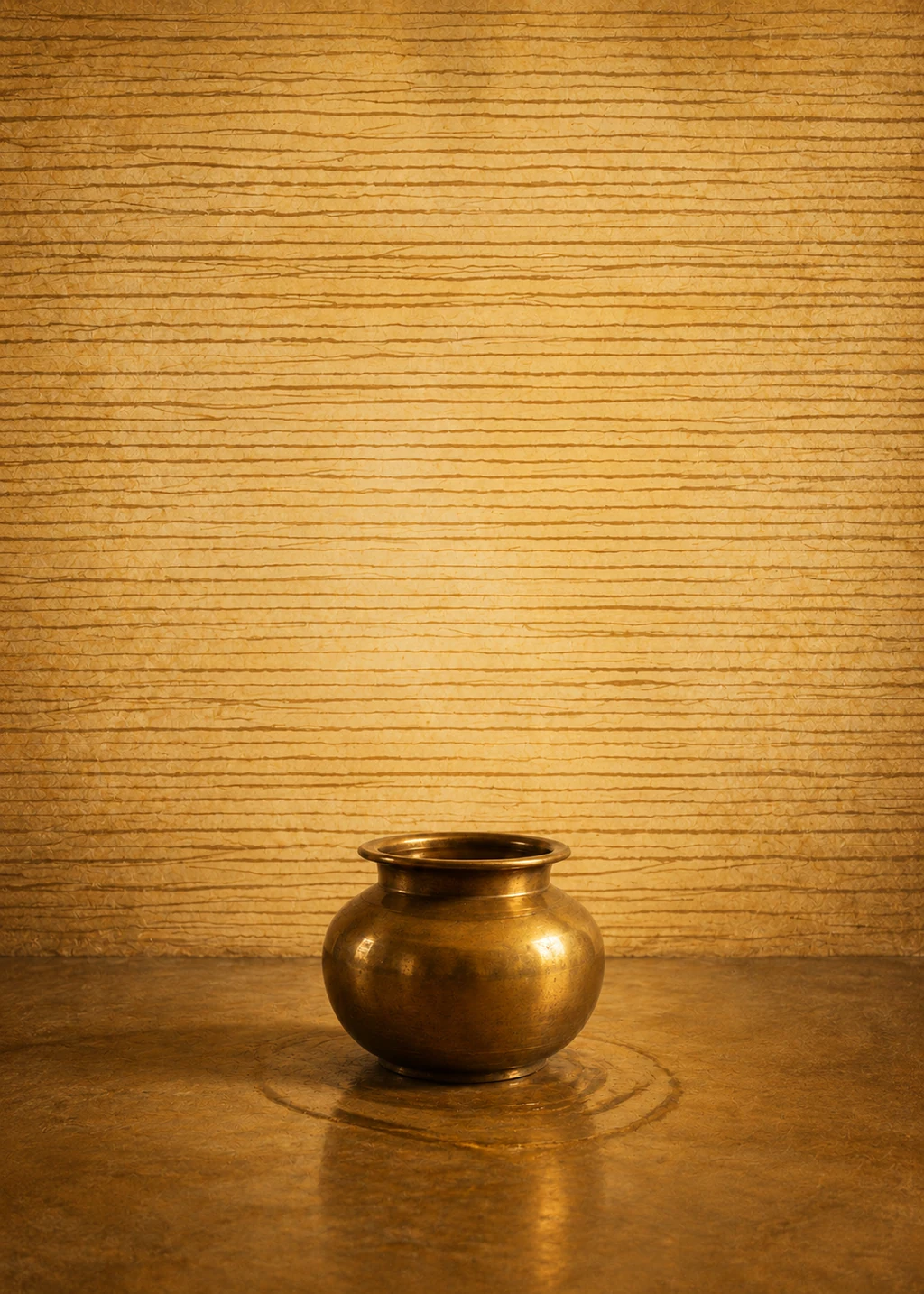
There was a brass vessel in our kitchen that nobody used.
It sat on the highest shelf in the kitchen, above the pressure cooker, above the steel dabbas, above everything practical and within reach. It had the colour that brass gets after years of being touched and then years of not being touched: halfway between gold and shadow, warm even in the kitchen’s afternoon dark.
I asked my grandmother about it once, when I was small.
She said it was for water.
We had a tap. The answer made no sense and I forgot the question almost immediately. That is the thing about answers that arrive before you are ready. They leave no mark.
The summer I turned seventeen, the water stopped.
It went slowly. The pressure dropped first. We noticed it in the shower, a thinning, a hesitation, and then at the kitchen sink where the stream became a thread. Then one morning my grandmother turned the tap and it ran for three seconds, coughed once, like a person clearing their throat before bad news, and went silent.
The kitchen felt different in that silence. Larger somehow.
My mother called the building secretary. My father called the municipal helpline and was put on hold, the tinny music filling the room. My brother went up to check the overhead tank, his footsteps loud on the terrace above us. There were doors opening and closing, voices overlapping, the organised panic of a household that has forgotten how to live without one thing.
My grandmother did none of these things.
She moved to the kitchen, opened the window, letting in dust and the smell of hot stone from the building across, and then climbed onto the small wooden step stool she kept near the shelf. It wobbled once. She steadied herself with one hand against the wall, as she always did, without looking down, without breaking her composure.
She reached up with both hands and brought down the brass vessel.
It came into the light of the kitchen.
I had seen it my entire life on that shelf and never truly seen it. Now it was in her hands at eye level and I understood it was old in a way that most things in our kitchen were not. Not antique. Not decorative. Used. Carried. Known.
She wiped it slowly with the end of her sari. The soft friction of cotton on old brass made a sound so quiet I felt it more than heard it. She looked inside it. Tilted it slightly. Then she set it on the counter and stood beside it.
She was waiting.
I watched her from the doorway.
“Baa, there is no water.”
“I know.”
“Then what are you doing?”
She looked at the vessel for a moment.
“Remembering,” she said.
Her village had a well with a name.
I did not know this until that afternoon.
I had known my grandmother my whole life: the warmth of sitting beside her, the smell of her that I cannot describe except to say it was the smell of someone who had been alive a long time and had made peace with it. I had known her prayers, her silences, her particular way of folding a sari into precise deliberate rectangles. I had not known that she came from a place where water had a name.
The well was called Hirni.
She said it as people say the name of someone they loved before I was born. Not with grief. With precision. The name still carried weight even though the one who bore it could no longer hear it.
As a girl she walked to Hirni every morning. The path was stone and then mud and then stone again. In summer the ground was cracked at the edges and the neem trees gave shade that smelled bitter and clean at once. She described lowering a brass vessel, one like this, on a rope into the dark water below.
“You could hear it,” she said. “First the rope going down. Then the vessel touching the surface. Then the sound changed, when it was full.”
She paused.
“You always knew. You didn’t have to see it. Your hands knew from the rope and your ears knew from the sound.”
I stood in our kitchen in the afternoon heat and tried to hear it. The darkness of a well. The rope burning slightly in the palms. The moment the vessel surrendered to the weight of the water filling it.
I could almost hear it.
Almost.
The flat had gone quiet around us.
My father was still downstairs. My mother was on the phone in the other room, her voice now patient and administrative. My brother had not come back from the terrace.
My grandmother and I were alone.
She told me Hirni had a caretaker. A man whose family had tended the well for four generations. He knew the water table as a doctor knows a long patient: its rhythms, its moods, its seasonal silences, when it needed rest, when it could give freely. He knew which months to draw less. He knew the sound of the well when it was under strain.
“What happened to him?” I asked.
“A pipe came,” she said. “From the city.”
She said it without bitterness. As simply as describing a change in weather. Which it was, in a way.
A pipe came from the city. Hirni was no longer necessary. The caretaker’s knowledge became knowledge with no use left: still true, still intact, belonging to a world that had moved on without looking back.
“And the well?”
She was quiet.
Outside, a crow landed on the window ledge and then left.
“Still there,” she said. “But nobody asks it anything anymore.”
The water came back that evening.
A pipe had been replaced somewhere below. The tap coughed, ran brown for a moment, smelling of iron, like old coins held in a warm fist, and then slowly, reluctantly, cleared.
My mother ran it for a while before filling anything. The sound of it filled the kitchen like a small celebration that nobody quite had the energy to attend.
My grandmother washed the brass vessel. Dried it. Climbed back onto the step stool. Positioned it on the shelf exactly where it had been, with the same small adjustment of her wrist at the end that I had never noticed before and now could not stop seeing.
She stepped down.
“Baa.”
She turned.
“Why do you keep it if you never use it?”
She looked at the vessel on the shelf. Then at me.
“So I don’t forget the weight,” she said. “When you carry water, your body knows exactly how much you are using. You feel every drop. You cannot waste what your arms have carried.”
She moved to the window and closed it against the evening dust.
“Now the pipe carries it for us,” she said. “So we have forgotten how heavy it is.”
That night I lay awake and listened.
The pump on the terrace cycling on. Water moving through the pipes in the walls, a sound I had heard every night of my life without once actually hearing it. My brother’s tap running while he brushed his teeth. Two minutes, maybe three. I had never counted before.
Water was moving through the walls of our building in the dark. I had never thought about where it came from. The river it had begun as. The rain that had filled that river. The ground that had held it in patience for longer than our building had existed. The treatment plant, the pumping station, the pipes under the road, the electricity that pushed it up to our tank, the hands, how many hands, that had built and maintained each step of its journey to reach us.
I had only ever thought about the tap.
And sometimes, on days like today, the helpline number.
The next morning I watched myself in the bathroom mirror.
Toothbrush in mouth. Tap running. Water streaming down the drain while I brushed. Two minutes of forgetting, gone into the pipe. I had done this every morning of my life without seeing it.
I counted. Two minutes. Maybe three.
I stood there with the toothbrush still in my mouth, water still running, and felt suddenly that I had been taking without ever noticing the taking.
Not from the municipality. Not from the building.
From Hirni. From the man who knew the water table. From my grandmother who had walked the stone path in summer heat to reach what I received without a thought.
I turned the tap off.
The silence in the bathroom was different now.
Three years later I moved to a new city for work.
A small flat on the fourth floor of a building where the lift worked on alternate days. The flat smelled, those first weeks, of paint that had almost but not completely dried, and beneath that, older, the breath of everyone who had lived there before me, already fading, making room.
I was twenty. I had a job, a mattress, and for the first time in my life, no one who could hear the tap running.
It is a kind of freedom you don’t know you have been waiting for until it arrives. Hot water at midnight. A shower so long the mirror fogged completely and the room became its own weather. I stood under it after hard days and let it take everything, the commute, the office, the careful performance of being new somewhere, and watched it all go down the drain with a satisfaction that felt, in those moments, completely clean.
The water bill arrived monthly. A number. I paid it as I paid all numbers, without looking long enough for it to mean anything.
There was a tap in the kitchen that dripped.
I told myself I would call someone. I did not call someone. I put a steel bowl beneath it that I emptied every few days, which felt like a solution without being one, and stopped noticing it within a week.
The bowl filled. I emptied it. The tap dripped.
I never thought about where it came from.
I never thought about where it went.
The year I turned twenty-six, I went to a hill station for a long weekend.
We stayed in an old house, a relative’s relative’s place opened for us as a favour, smelling of cedar and cold stone and the stillness of a room that is only occasionally inhabited. There was a garden with a plum tree that had dropped most of its fruit already. In the mornings the mist came in so low you could lose your hand in it at arm’s length.
The water came for two hours in the morning and two hours in the evening.
The caretaker, a quiet man with a system for everything, explained this on arrival, as you would explain a local custom to visitors. He said it without apology. This is how it is here. Plan accordingly.
We found it charming, as city people find inconveniences charming when they are temporary and surrounded by plum trees and mist.
The caretaker’s granddaughter was seven or eight. She appeared at the edges of things, the garden, the kitchen doorway, the path to the gate, without ever quite entering the spaces we occupied.
On the second morning I saw her at the courtyard tap.
She had a brass vessel, smaller than my grandmother’s, dented on one side, the dent worn smooth with use. She filled it with great seriousness, as if it mattered. It did. When it was full she lifted it with both hands, shifted it to her hip, adjusted her weight without looking down, and walked back toward the caretaker’s quarters.
Not a drop fell.
She was seven years old and her body knew something mine had never learned.
I stood watching her until she turned the corner.
The mist was still coming in across the plum tree. Somewhere above us a bird I could hear but not see was calling the same note over and over, as if reminding the valley of what it kept forgetting.
I thought of my grandmother’s hands on the brass vessel in our kitchen. The way she had wiped it with the end of her sari. The way she had waited beside it as if the waiting itself was a kind of prayer.
I thought of Hirni. A well nobody was asking anything anymore.
I went inside without saying anything to anyone.
At breakfast my friends talked about where to walk that day. I listened and answered and passed things across the table.
Some things you are not ready to say aloud until you understand them.
I went to see Hirni the following month.
My grandmother gave me directions as she gave everything, without fuss, without sentiment. Take the highway to the old bridge. Turn left where the banyan tree splits the road. Ask for the well with the name.
The village was smaller than I expected. Or perhaps I was larger than the space allowed.
An old man sat outside a tea stall. He had the look of a man who has watched decades dissolve into afternoons. I asked him about Hirni.
His eyes moved from my city shoes to my city posture to my city face. Then he pointed.
The well was still there. But still there was doing too much work.
The stone parapet was cracked. Weeds grew through gaps that hands had once kept clean. The rope marks on the stone, deep grooves worn by generations of pulling, were filled with dust. No one had smoothed them in years.
I lowered my phone’s flashlight into the darkness.
Water. But not the water my grandmother described. A thin reluctant layer at the bottom. Plastic bottles floated where brass vessels once drew. The smell was wrong: stagnant, forgotten.
The old man had followed me. He stood at a distance, watching.
“Your grandmother?” he asked.
I nodded.
“She used to come every summer. Even after the pipe came. She would sit by the well for an hour. Just sit.”
“What did she do?”
“Nothing. That was the point.”
He paused.
“She was the last one who asked Hirni anything.”
I stood there for a long time.
I still have the brass vessel.
My grandmother left it to me without explanation. No note. No instruction. Just the vessel, passed to me as certain things are passed, in the quiet trust that the receiver will one day be ready to understand.
It sat on my shelf for years the way it had always sat. High up. Untouched. A memory belonging to someone else.
Then one morning I took it down.
Not as memory. As tool.
I washed it. Dried it. Filled it at the tap.
It was heavier than I expected.
I stood at the counter with both hands around it, arms adjusting to the weight, and a feeling moved through me that I have no precise word for. It was older than guilt, and older than nostalgia. The body recognising a truth the mind had been told but never learned.
Water has weight.
That weight is the whole story: the river, the rain, the long patience of the earth, the morning walks, the rope, the sound of filling, the name of the well, the man who knew when to draw less, the little girl whose hip already knew how to carry. All of it is present in the simple heaviness of a brass vessel held in two hands on an ordinary morning.
When you carry water, you cannot pretend it comes from nowhere.
You cannot pretend it goes nowhere.
Your body will not allow either lie.
I began keeping it on the counter. The shower got a timer. I did it out of attention, the kind my grandmother gave to Hirni, not out of guilt. The water I waited for while the tap warmed, I caught in a bowl. What remained from washing vegetables went to the plants on the balcony.
My brother visited once and laughed. You’ve become the water police.
I didn’t defend myself. I handed him the filled vessel.
Here. Hold this.
He lifted it. Surprised by the weight. Held it for a moment. Set it down.
Something shifted in his face. Not conversion, not yet. The beginning of attention.
I have no idea if he changed anything. I only asked him to feel the weight.
I thought of Hirni often after that.
Still there. Nobody asking it anything anymore.
And I understood what my grandmother had really left me.
Not the vessel.
The attention.
The kind of attention that knows the name of things. That asks where they come from and where they go. That feels the weight of what it has been given and does not set it down carelessly.
Somewhere, someone still knows the name of the water that reaches you.