THE CITY BEFORE THE ROOM
Delhi again.
But a different Delhi from the anteroom of Episode Seven — not the Delhi of power performing itself for a visiting delegation, but a Delhi of rooms that have been deliberately emptied, where silence is not a backdrop but the entire point.
The building is old. Colonial. The kind that has witnessed everything and forgotten nothing. The corridors are long, the floors marble, the windows tall — the same light Kabir has followed through nineteen rooms, the same light that has interrogated every object he has encountered.
The room is on the second floor.
The door is heavy. Old. It has been closed for a long time.
Kabir opens it.
ENTERING THE ROOM
The room is empty.
Not abandoned. Deliberately emptied.
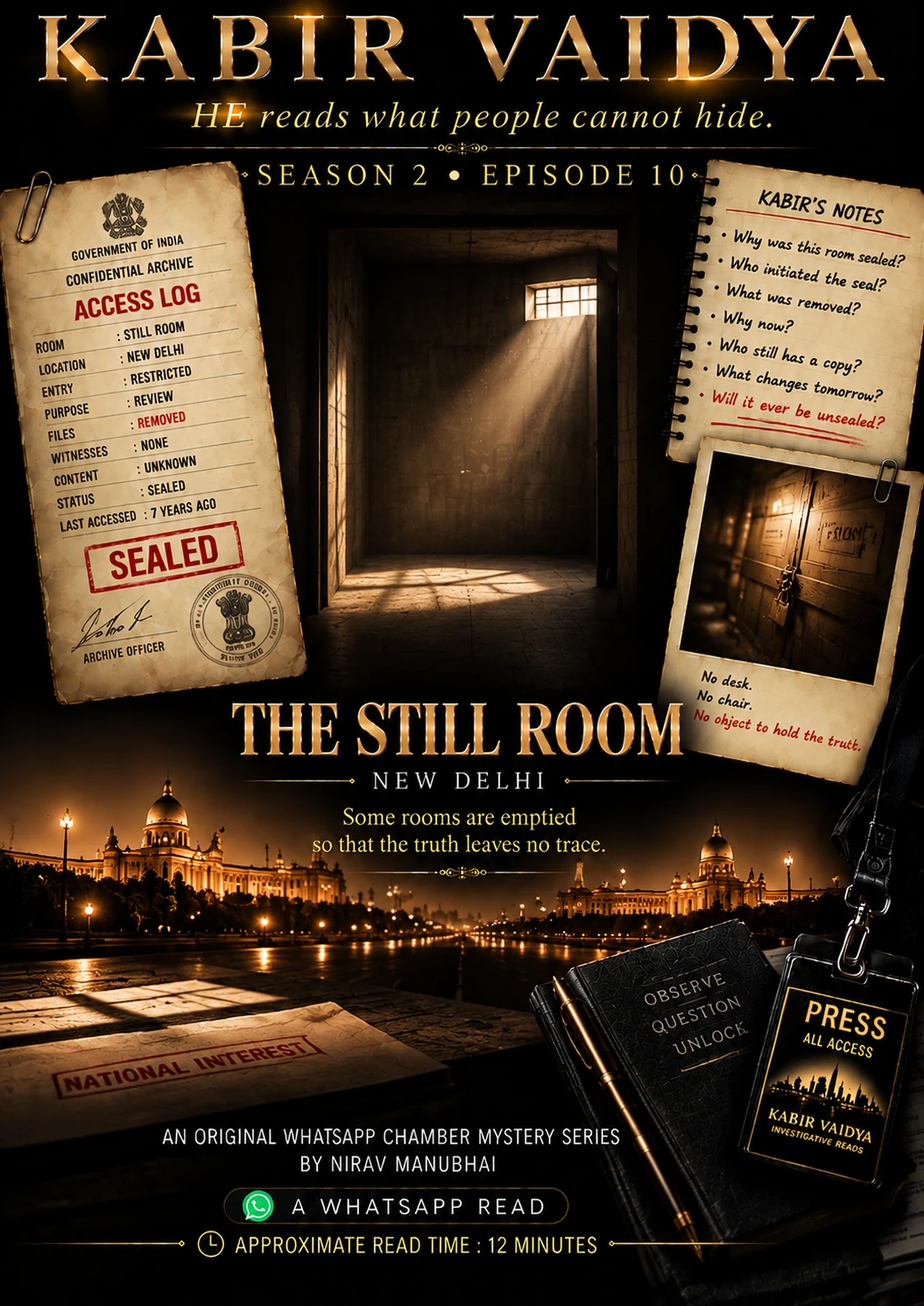
No desk. No chair. No object to hold the truth.
The walls are bare in a way that makes the room feel slightly larger than its actual dimensions. Without furniture to absorb sound, footsteps carry differently here, the echo arriving a fraction late. A faint smell of wood oil remains near where a desk had clearly stood for years, the wood having left its chemical signature on the floor after the desk itself was carried out.
The light from the tall window has nothing to reflect off. It falls across the bare boards and stops there.
The man is standing in the centre of the room. His hands are at his sides. His posture is straight. His face is calm.
His name is Anand. Sixty-seven.
He has been coming to this room every day for three months.
Waiting.
He has removed everything from it: the desk, the chair, the lamp, the files, the papers, the photographs.
Everything except himself.
THE OBJECT THAT IS NOT AN OBJECT
The room has no object of its own.
The absence is the point.
But Kabir has carried one object inside: his notebook.
It remains closed in his left hand. His thumb rests against the spine, pressing hard enough to whiten the nail.
Anand had emptied the room himself.
The commission's files were gone. The furniture was gone. The photographs were gone. What remained was the person who remembered what the files had said.
WHAT KABIR READS IN THE BODY
Anand's hands hang at his sides, fingers retaining the faint curve of hands that once held files and pens every day.
His breathing is even. His face offers Kabir almost nothing.
His feet are flat and parallel on the bare floor, neither angled towards the door nor shifted for comfort.
But the stillness is not absolute.
His left eyelid carries a faint tremor — not a blink, just the smallest oscillation, the kind that appears when a body has been still for too long and the muscles begin to negotiate with each other.
He has stood here every day for three months.
The stillness is maintained.
The tremor is the receipt.
Kabir has spent two seasons assuming the most useful body in the room belongs to somebody else.
Anand does not permit that assumption to survive.
His eyes keep returning, not to Kabir's face, but to the closed notebook and the thumb preventing it from opening.
THE HISTORY UNSPOKEN
Anand was the head of a commission formed months earlier, after the Mundra scandal — the port, the containers, the seals opened twice, the payments routed through an intermediary to a politician whose office had been examined as part of the case.
The commission's report named the seal numbers. The midnight access. The textile roll that weighed a kilogram less than its replacement. The clearance that should not have been granted and the inspection that should not have been missed.
The commission was supposed to find the truth.
It did.
It was supposed to report the truth.
It did.
The report was filed. The findings were complete.
The publication was blocked — reclassified, delayed, referred to a committee that met once and never again.
Then the system responded.
Anand was asked to resign. He refused.
Asked to leave. He refused.
Asked to be silent. He refused.
Finally, he was told to remain in this room.
He did.
For three months, he had returned every day and waited.
Not for permission.
For the question.
What will you do with the truth?
WHAT KABIR ASKS
"Anand," Kabir says. "Why did you remove everything?"
Anand's hands move from his sides to his chest, the gesture of a man holding something that has no physical form.
"I removed everything because I wanted to know what the system could not remove."
"What is left?"
"Nothing."
He looks around the room.
"And everything."
THE REAL TRUTH
The room is empty, but it is also full — of everything the system has tried to erase, hide or assume would disappear once the furniture was gone.
"The system wants us to believe that the truth is in the objects," Anand says. "In the documents. In the words."
Kabir says nothing.
"The truth is in the witness. In the one who stays."
"And you stayed."
"I stayed because leaving would have been the system's best outcome. I was not willing to give it that."
THE MOMENT OF DECISION
"Anand," Kabir says. "What are you going to do?"
Anand's hands remain at his chest.
"I am going to speak. Tell what I know. What I have seen. What the system has done."
"Where will you speak?"
"Here. In this room."
He looks around once.
"This room is the truth."
Something in the bare room shifts then, though nothing in it has moved.
Kabir has spent nineteen rooms reading bodies that have decided to stop carrying what they were never meant to carry. Harshad's pen. Ananya's hands. Meera's two-degree chin lift.
He has never asked himself what his own hands are doing while those bodies make their decisions.
His hands are at his sides.
He has not noticed when they stopped moving.
"You read bodies for a living," Anand says. "Your thumb has been pressing that notebook closed since you entered. Whose body have you been reading?"
Kabir looks down.
The nail is white.
The notebook has not opened once.
"Mine," he says.
Anand nods once.
"Then you understand what it costs to be the one who stays and does nothing else."
"I am not the one deciding what happens in these rooms."
"No. But you are the one who knows, now, in every single one of them, what is true."
Anand pauses.
"Keeping that knowledge and doing nothing with it is also a decision, Mr. Vaidya."
Kabir says nothing.
For a moment, he feels the old split before he has words for it — the anterior cingulate registering the distance between knowing and doing.
He had spent two seasons reading that distance in other people.
He had never thought to measure it in himself.
WHAT REMAINS
Kabir leaves the building and sits on the low stone wall outside.
Delhi moves around him without asking what the room decided.
Traffic. Horns. People walking home. The city continuing because cities do.
For the first time in twenty rooms, he opens the notebook.
The thumb releases.
The spine un-presses.
The pages separate with a small sound — paper that has been held shut for nineteen rooms and is now being allowed to open.
Every page is blank.
He writes on the first.
Room 20 · Delhi.
Then:
Anand watched my thumb keep this book closed.
He waits for the sentence that usually follows — the sentence that converts a body, an object and a decision into meaning.
It does not arrive.
Below the first line, he writes only:
I knew. I stayed. I have not yet decided what knowing requires.
The notebook remains open on his knee.
The words are visible.
The sentence remains unfinished.
Kabir does not finish it.
He does not close the notebook.
He does not stand.
He sits on the stone wall with the notebook open and the evening arriving, and lets the uncertainty remain physical before he gives it a name.
That is the first thing the empty room has made him carry.
THE K-NOTE
Room 20 · Delhi
An empty room. A closed notebook. A man who removed every object so the witness would have nowhere else to look.
Anand did not prove that Kabir's distance was wrong. Witnesses need limits. Observation is not authority, and knowing does not automatically grant the right to intervene.
He exposed something narrower and more difficult: Kabir had never examined whether distance was always an ethical limit or sometimes a refuge.
Season Two ends with no answer.
Only a notebook left open at a sentence Kabir cannot yet complete.
"For nineteen rooms, Kabir read what other people carried. The empty room gave him no body to study but his own — and no conclusion he had yet earned."
Season Two ends here.
Twenty rooms.
The witness has not changed his method.
He has discovered that the method has a question inside it.
What knowing requires of him — that is Season Three.
Kabir Vaidya will return.
🙏 Nirav Manubhai