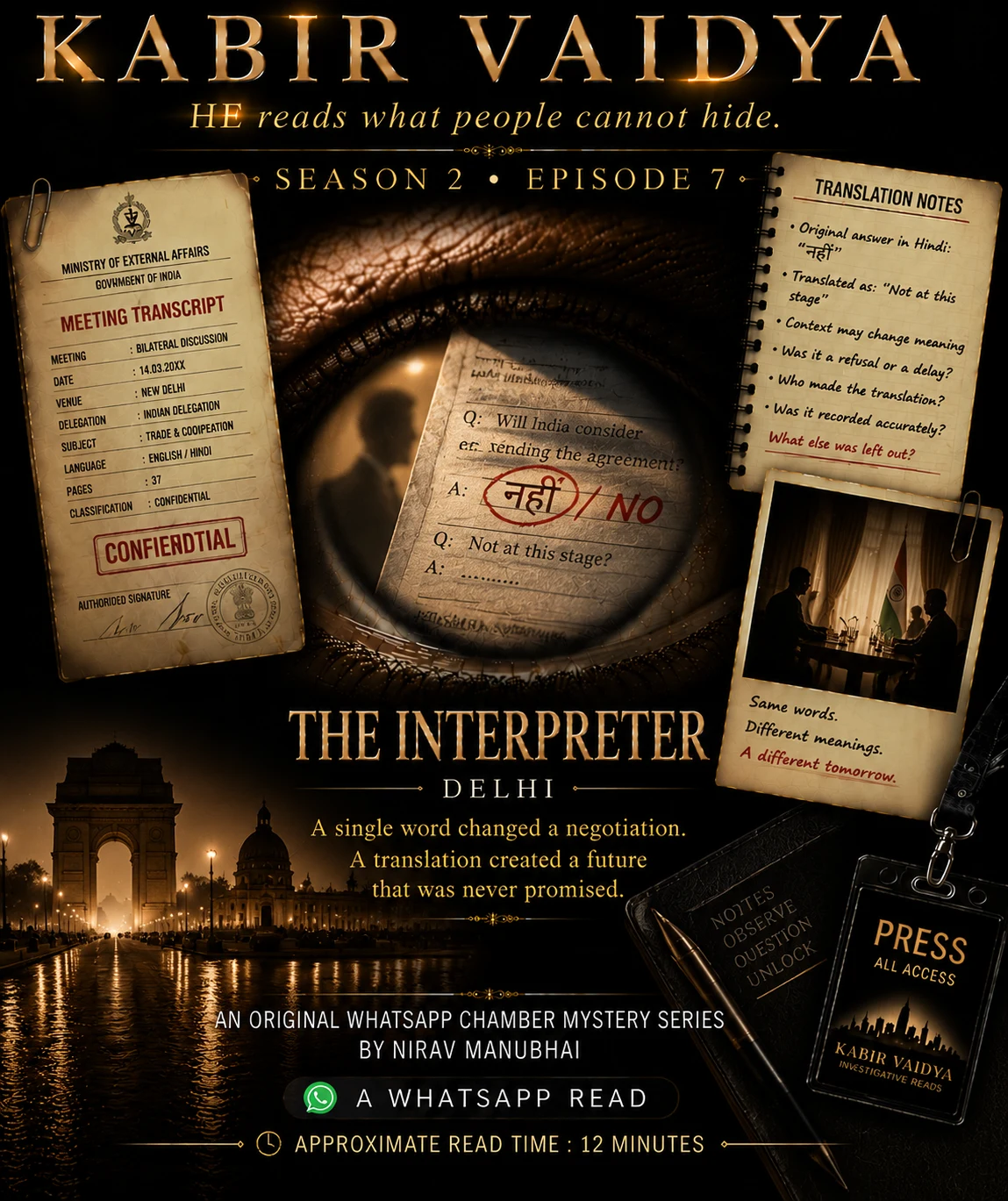
THE CITY BEFORE THE ROOM
North Block in the afternoon carries the smell of old files baked into walls that have processed more people than they were built to hold. The corridor outside smells of strong, over-brewed government tea — and something older underneath: the particular dryness of paper that has been accumulating in the same rooms since before anyone currently working here was born.
This is Delhi as the place where language stopped being a tool of communication and became a tool of power — where every word has already been weighed by the room before it is allowed to be spoken.
The anteroom outside the main conference hall is where the already-considered words wait before release. The low hum of the building has been managing the gap between what is said and what is meant for longer than most people inside it have been alive.
Kabir has been in Delhi many times. Each time, the rooms feel more sealed.
ENTERING THE ROOM
The room is beige. Everything in this building is beige. The walls. The carpet. The furniture. The beige of a building that has been designed to not be noticed.
Four people are in the room. Sanjay, the Indian interpreter. The diplomat. The journalist. And the visiting delegation's interpreter, standing close to the wall with her own notebook closed.
Sanjay is sitting in the corner. His hands are on his knees, pressed flat with a pressure that has nothing to do with comfort. His face is pale. His breathing is shallow — short intakes through the nose, held a beat too long before release. His jaw is tight. His eyes are not on the diplomat. Not on the journalist. They are on the door — the door he entered through and cannot, in any meaningful sense, leave through.
A man can walk out of a room and still not have left it.
The diplomat is standing near the window. His hands are behind his back. The posture of someone trained to be still. But his left thumb moves against his right wrist — a small, unconscious pressure, the way a man presses a bruise to check whether it still hurts. He gave the instruction three weeks ago. He has been pressing that bruise ever since.
The journalist is sitting on a chair. Her notebook is open. Her pen is in her hand. But she is not writing. She is leaning slightly forward, weight on the front edge of the seat — the posture of a person who has decided to watch rather than record because recording would mean looking down and she does not want to look down. She is looking at the interpreter. She is waiting.
The visiting interpreter knows Hindi, English and the delegation's language. When the journalist reads the disputed sentence aloud, her eyes close for a moment before opening again. Brief enough to be mistaken for concentration. But her right hand, resting on the closed notebook, moves toward the spine and stops. The fingers hover. Then retreat. The gesture of someone reaching for the record and deciding, in the space between reaching and touching, that the record was not hers to open. Sanjay sees it. So does Kabir.
On the table: a single sheet of paper. The transcript.
THE OBJECT
The transcript is official. Stamped. The record of a meeting between the Indian Foreign Secretary and a visiting delegation, with English serving as the bridge language. At a key moment, the Foreign Secretary switched to Hindi. Sanjay carried the sentence into English; the visiting interpreter carried his English into the delegation's language.
The word was nahin. A simple word. No. The word the visiting delegation had been waiting for — the word that would determine whether a trade deal would proceed.
Sanjay rendered it in English as not at this stage. The added words created a possibility. A future. They suggested that the answer might change.
The Foreign Secretary had said nahin. The delegation received possibility, twice translated.
The difference is one word. The difference is a future.
WHAT THE WORD DID
Across the table, something happened in the bodies of the visiting delegation that had nothing to do with what they understood and everything to do with what they felt.
A held breath released half a second early. A pen, which had stopped moving when "no" was expected, resumed its motion across a notepad. One man's shoulders, braced for disappointment, dropped by a fraction before his mind had finished processing the sentence.
The body received good news before the meaning had been fully decoded — because hope moves faster than translation.
The delegation left believing there was a possibility. They continued to negotiate. They delayed their departure. They spent another week in Delhi, waiting for an answer that had already been given.
The answer did not change. It was always no.
When the delegation finally understood this, the week they had spent waiting became something else. Not a negotiating delay. A cost. Time, credibility, and the private humiliation of having let hope move faster than sense.
THE HISTORY UNSPOKEN
Sanjay. Forty-seven. Twenty years in summit rooms and bilateral meetings. His reputation is not that he translates beautifully. It is that senior officials never have to worry about him.
Early in his career, he once rendered an angry minister's sentence exactly. The translation was accurate and diplomatically disastrous. He was removed from the next delegation. He returned a year later having learned the lesson the service never wrote down: being accurate and being useful are not always the same skill — and only one of them gets rewarded.
He has not been questioned since.
Until three weeks ago.
WHAT KABIR ASKS
"Sanjay. Why did you change the word?"
The interpreter's hands move from his knees to his lap. Still pressed. But no longer holding. Surrendering.
"I was asked to."
"Asked by whom?"
"By the Foreign Secretary."
The diplomat's hands are still behind his back. But his shoulders have tensed. He knows what is coming.
"The Foreign Secretary asked you to change the meaning?"
"He told me to say, 'not at this stage.' He said it was necessary. He said it would give the delegation time to consider. He said it was the only way to keep the negotiations alive."
"Did you know those words would be heard as a possibility?"
"I knew."
"Did you know you had added a future to a refusal?"
"I knew."
"And did you know that the delegation would stay in Delhi for another week, waiting for something that would never happen?"
"I knew."
Kabir turns to the visiting interpreter. "You understood the Hindi word?"
"Yes."
"And you repeated Sanjay's softened English rather than the sentence you had heard?"
Her eyes remain open. "I told myself my duty was to translate the official interpretation, not to correct another interpreter in the middle of a bilateral meeting."
Sanjay looks at her. For twenty years he has treated the altered word as a burden he carried alone. The room shows him the more dangerous truth: the lie survived because each professional accepted only the small section placed in their hands.
THE REAL TRUTH
The political leadership had decided the clause was unacceptable. The answer had to be no. The same leadership did not want the delegation to leave immediately — another part of the negotiation still mattered.
Before the meeting, the Foreign Secretary had told Sanjay that if the disputed clause arose, the refusal should be rendered as "not at this stage." The Hindi sentence inside the room was more direct. Sanjay followed the instruction rather than the words.
The result was not a mistranslation caused by vocabulary. It was a skilled professional allowing his skill to become the space in which two orders that could not both be true could share the same sentence for a moment.
THE MOMENT OF DECISION
"Sanjay," Kabir says. "You knew the difference."
"Yes."
"Why did you choose the instruction over the sentence?"
Sanjay looks at the journalist's open notebook. "Because twenty years ago I translated a sentence exactly and was punished for making the speaker's meaning impossible to deny. Since then, I have called obedience discretion." He pauses. "I have been calling it that for so long I stopped hearing the difference."
The journalist slides the official transcript toward him. Sanjay takes her pen. Beneath the disputed line, he writes the Hindi word — nahin — in Devanagari, the letterforms small and precise. Beside it, the literal English: No. Beside that, in a different ink because the pen had been pressed harder: Instruction received: render as "not at this stage." Then he signs the correction. The pen touches the paper three times. Three marks. Three truths that had been waiting in the same sentence for three weeks.
The diplomat at the window does not stop him. His shoulders lower by a fraction — not relief, but the recognition that the ambiguity has finally acquired an author. His thumb stops pressing the wrist. The bruise, whatever it was, has been named by someone else. He does not have to press it anymore.
The visiting interpreter's right hand, which has rested on her closed notebook since the journalist began reading, finally opens the cover. She does not write anything. She simply opens it — the notebook that was not hers to open until the record beside it had been corrected by someone else's hand. She leaves it open on her knee. Blank.
Kabir looked at the correction Sanjay had written and signed. He did not read it again. He already knew what it said. He had known since the moment the visiting interpreter closed her eyes.
THE K-NOTE
Room 17 · Delhi
One word spoken. A refusal softened by one interpreter and carried forward by another. A delegation stayed because possibility survived every hand in the relay.
Neither interpreter was incompetent. That was the danger. Sanjay was skilled enough to make an instruction sound natural. The visiting interpreter was skilled enough to hear the difference and persuade herself that correcting it was not her role.
The body tells were small: Sanjay's pressed hands, the diplomat's thumb against his wrist, the visiting interpreter's fingers hovering over a notebook she did not open until it was over. The record became truthful only when the person who first softened the word agreed to place his own name beside the correction.
"The sentence said no. The instruction said not yet. The interpreter's signature finally recorded whose voice he had followed."
Kabir Vaidya will return.
🙏 Nirav Manubhai