THE CITY BEFORE THE ROOM
A broadcast editing suite at eleven at night has a darkness that exists nowhere else in a city this loud. The outside light has been eliminated by design — windowless, soundproofed, lit entirely by the cold glow of monitors stacked four high against a black wall. The smell is coffee gone cold in paper cups and the faint electrical warmth of equipment that has been running continuously since six in the morning.
There is a specific anxiety to a room like this: everyone inside it is aware of a deadline that exists somewhere just outside the door, counting down in a way that nobody in the room can see but everybody can feel.
Mumbai and Delhi. Two cities. Two rooms. One story — about something that was filmed but not shown. Recorded but not broadcast.
The news anchor's name is Meera. Forty-two. The face of the channel for eighteen years. The face people trusted to tell them what was true.
Except tonight.
ENTERING THE FIRST ROOM
The editing suite is in Mumbai, in a glass tower full of screens that are themselves full of things that are said and things that are not.
Three people are in the room. The editor, at the computer, hands on the keyboard, three hours into a cut that is almost complete. The producer, near the door, arms crossed. And Meera, sitting in the corner.
Meera's face is the face of someone who has spent eighteen years learning to give nothing away on camera. The training shows now as its own kind of tell: her expression is too controlled for the situation. The composure is the information. A person genuinely at rest does not compose themselves. Only a person actively suppressing something does.
Her hands are in her lap, holding — the same gesture Kabir saw in Ananya in Mumbai. The gesture of a person holding herself together because she has been told to hold.
The screen shows the segment, paused at the exact moment Meera is about to say something important.
ENTERING THE SECOND ROOM
The second room is in Delhi — the office of a politician whose desk is large, expensive, and entirely clear except for a single phone lying face up.
The office smells of sandalwood and the particular dryness of air conditioning that has been running since morning. On the wall, a single framed photograph: the politician at a podium, younger, mid-sentence, the mouth open in a word that will never be completed. He has kept it for twenty years. Not because it reminds him of who he was. Because it reminds him of the shape a sentence makes before it is controlled.
His right hand rests on the desk beside the phone. Not gripping it. Not reaching for it. Resting at a specific distance — close enough to answer immediately, far enough to suggest he is not waiting. The distance is practiced. The hand of a man who has learned to make patience look like indifference.
The desk is clear because everything on it has already been decided. The phone is face up because he is expecting a confirmation, not a conversation. The system does not require him to be cruel. It only requires him to be consistent.
He knows Meera's name. He has never met her. He knows the segment contained a container number, a seal, and a payment route. He does not need to know more. The system works because he does not need to know more.
THE OBJECT
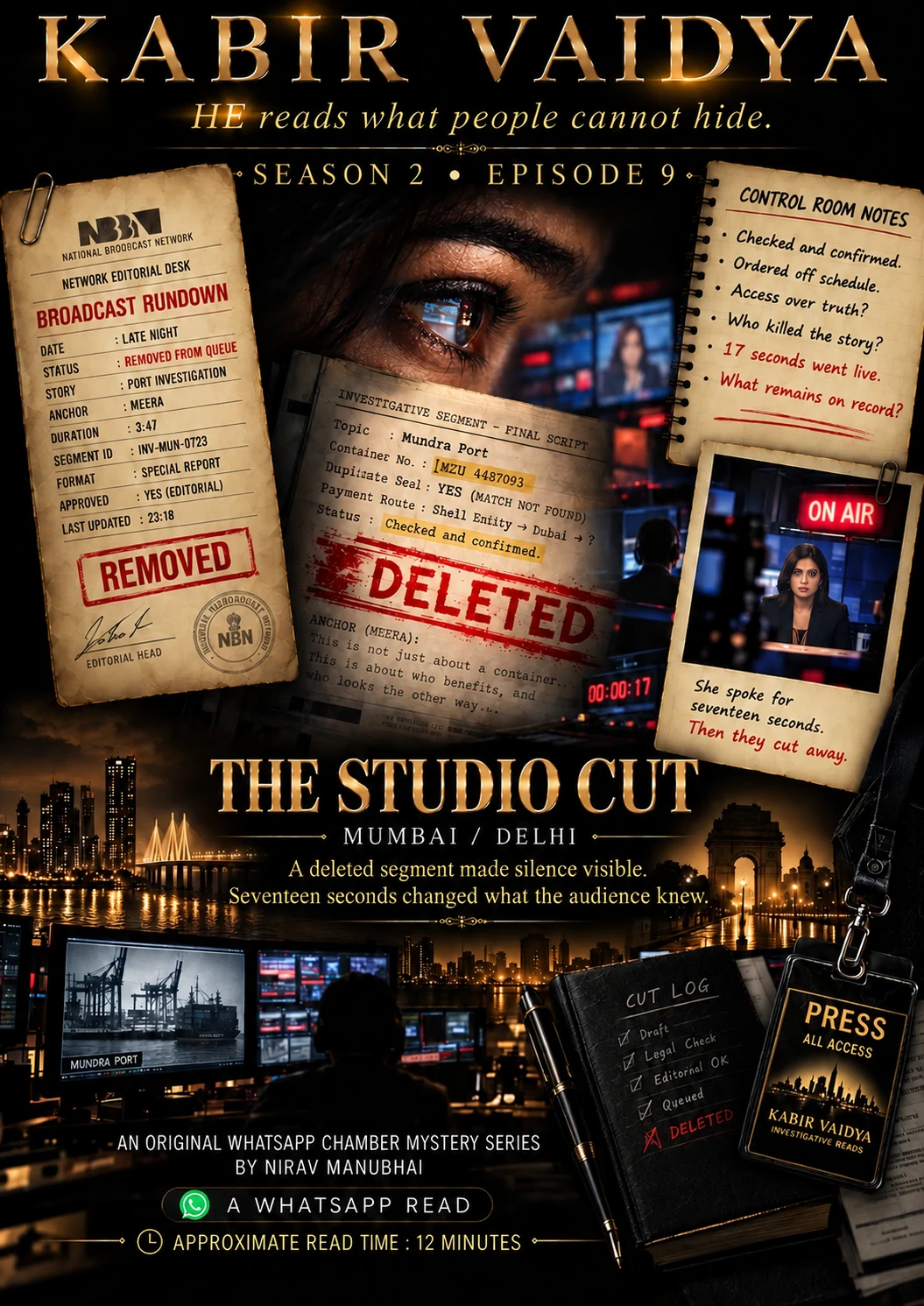
The segment is three minutes and forty-seven seconds long. About a port in Mundra. A container with an undeclared transaction. A payment. A politician.
The segment is complete, accurate, checked and confirmed.
It has been deleted — from the system, the broadcast queue, the schedule. Ordered by a producer who was told by a news director who was told by a channel owner who was told, finally, by the politician himself.
The segment is gone. Meera is not. She is in the editing suite, looking at the screen, at the place where the segment used to exist.
She is not speaking.
WHAT KABIR READS IN THE BODY
Meera's body is a story of silence.
Her hands: in her lap, holding. The gesture of a person who is holding herself together because she has been told to hold.
Her breathing: controlled. The trained breathing of a person who has spent eighteen years learning to say whatever she is given on camera without her body betraying what she actually thinks of it.
Her face: pale, eyes red, the muscles around her mouth tight — not from sadness. From anger. The specific tightness of someone trying not to cry because crying would feel, right now, like losing.
Her relationship to the screen: she is looking at the place where the segment used to be, but she is not seeing the screen. She is seeing the segment itself — what was said, what was not.
The producer's arms are crossed. But his right hand, tucked under his left bicep, tapped against his own arm. No rhythm. No tempo. Just movement. The hand of a man who has killed stories before and remembers the ones he killed.
WHAT KABIR ASKS
"Meera. When did you know that the segment would be deleted?"
Meera's hands move from her lap to her knees. The gesture of a person preparing to stand.
"I knew three hours ago. When the producer told me."
"Who told the producer?"
"The news director. Who was told by the channel owner. Who was told by the politician."
"And the politician told the channel owner that if the segment aired, the channel owner would lose access."
Meera's hands stop moving. The stillness of a person who has reached the end of what she is willing to soften.
"Access to the government. Access to the news. Access to the system."
THE REAL TRUTH
The system here is not a conspiracy. It is a network of relationships and dependencies and favours. The channel owner needs access to the government — to officials, to information, to the things that keep a news organisation competitive in a country where access is currency.
The politician provides that access, in exchange for something specific and unspoken: the quiet deletion of any story that might threaten the larger system he protects.
Meera has known this for years. Has accepted it. Has been part of it — until tonight.
This was not the first story. The chain was not assembled for this segment. It had been running for years, quiet and reliable, interrupted only when someone inside it forgot that the silence was the product, not the news.
THE MOMENT OF DECISION
Something changed in Meera's body before she said anything at all.
Her hands, which had been moving restlessly between her lap and her knees for the better part of an hour, went still. Not the stillness of resignation Kabir had seen in other rooms this season — a different stillness, the kind that arrives when a decision finishes assembling itself somewhere below conscious thought and the body simply stops waiting for permission.
Her chin lifted by perhaps two degrees. Small enough that the producer, still standing with arms crossed near the door, did not register it as a signal of anything. Kabir registered it immediately.
Eighteen years of compliance does not announce its ending with a speech. It announces it with two degrees of a chin.
"Meera. What are you going to do?"
"I am going to do what I have always done," she says. "I am going to tell the truth."
"The producer says the segment is deleted."
"The segment is deleted. But I am not. I am still here. I am still the face of the channel. I am still the person who speaks on air."
She pauses. "For eighteen years I have been trusted with this face and this microphone. Tonight is the first night I intend to be worth that trust."
Twenty-seven minutes later, the red studio light comes on.
The deleted package is not in the running order. The teleprompter moves to the approved replacement story.
Meera looks into Camera One.
The editing suite is quiet. The monitors cast their cold glow on three faces. The editor's hands have stopped on the keyboard. The producer's tapping fingers have stopped. The only sound is the low electrical hum of the equipment and, somewhere beyond the soundproofing, the city not caring.
"Before we continue," she says, "there is a checked and confirmed report this channel prepared and was instructed not to broadcast."
In the control room, the producer reaches for the cut command. Meera names the container number, the duplicate seal and the payment route before the screen changes.
Seventeen seconds. Then an advertisement.
Seventeen seconds was not the whole truth. It was enough to make deletion visible.
In the editing suite, Kabir watched the advertisement fill the screen. He did not move. Seventeen seconds was not what he had come for. It was what the room had been able to give. He wrote nothing down. The segment was still deleted. What existed now was the record of a person who had refused to pretend it had never been made.
THE K-NOTE
Room 19 · Mumbai/Delhi
A complete report removed from the broadcast queue. A chin lifted two degrees. Seventeen seconds of live television before the control room cut away.
Meera had benefited from access and complied with its conditions for eighteen years. Her refusal did not erase that history. It made the history impossible to continue pretending was somebody else's.
The segment remained deleted. What changed was that the audience now knew a deletion had occurred — and knew the face of the person willing to name it.
"The segment could be deleted. The person expected to deliver the silence still chose to speak."
Kabir Vaidya will return.
🙏 Nirav Manubhai