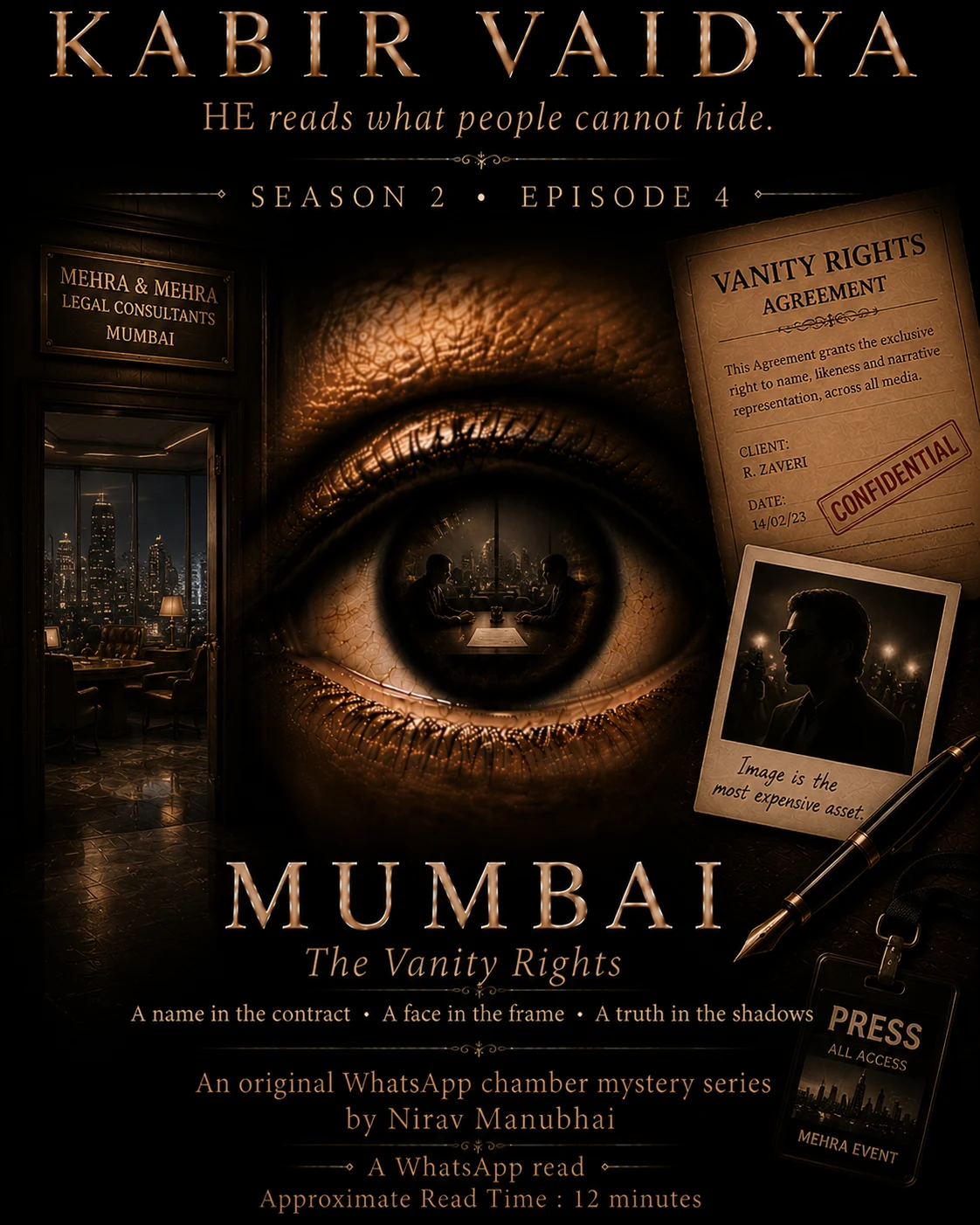
THE CITY BEFORE THE ROOM
Andheri West at eleven in the morning smells of three things at once: generator exhaust, dhaba cooking drifting from the workers' canteen, and the particular chemical sweetness of make-up and hair products leaking from a row of parked vanity vans.
The back lane behind the soundstage has its own economy and its own light. The light here has no relationship with the sun, because almost everything that happens in this lane happens under artificial light — strip lighting, ring lights, the harsh flat glow that makeup artists and cinematographers have agreed on as the lighting of truth, even though it is the most manufactured light in the city.
Kabir has been in Mumbai many times. He has never been in this Mumbai — the working Mumbai of glamour, not the glamour itself. The Mumbai that manufactures images of itself for an audience who will never see the generator, the dhaba, or the lane.
A small trailer is parked behind the soundstage. The kind that belongs to an actor who is not yet a star but is on the verge.
The van smells of perfume and anxiety and the particular smell of a space that has been lived in for too long.
ENTERING THE ROOM
The door of the van opens. The air inside is stale. Conditioned. The kind of conditioned air that has been recycled so many times it has lost all connection to the outside.
The woman inside is sitting in the chair. The actor's chair. The chair that faces the mirror.
But the mirror is covered.
Black fabric, the weight of it visible in the slight sag at the centre where gravity has pulled it from the corners. The tape at each edge has been applied with a specific care — not the rushed tape of panic but the deliberate tape of someone who measured the corners before pressing them down. A woman who has spent her career being looked at in mirrors, covering one not in anger but in the particular exhaustion of a person who has been looking at herself for too long and needs, for one hour, to stop.
Her name is Ananya. Thirty-two. The face of someone who has been told she is beautiful so many times that she no longer believes it. Her eyes are red. Her face is pale. Her hands are in her lap. Not positioned. Not resting. Holding. Holding something that is not there.
The producer is there. Dhruv Mehta. Forty-eight. His hands on his hips communicated control. The rest of him did not agree.
The editor is there. A young man named Karan. Twenty-six. His hands are on a laptop. The laptop is open. A video is playing. The video is paused.
The video is the reason for the covered mirror.
THE OBJECT
The video is short. Thirty-seven seconds. It shows Ananya in this van. The same chair. The same lighting. The same mirror. But the mirror is not covered. The mirror is clear. Ananya is looking at herself. She is speaking. The words are not clear. The audio is muffled. But the words, if they were clear, would be words that no one was supposed to hear.
The video is real. Recorded six months ago by a phone left in the van. The phone belongs to an assistant. The assistant has been fired.
The video was found three days ago, on a server belonging to the assistant. The assistant denies knowing how it got there.
The video is not the problem.
The problem is what has been added to it.
WHAT KABIR READS IN THE BODY
Ananya's body is a story of containment.
Her hands: the fingers curled inward at an angle that performers rarely show — palms slightly upturned, knuckles whitened not by gripping but by the strain of holding a position that has no object to hold. An actor's hands have been trained for twelve years to express everything on command. These hands had been asked, for the first time, to contain something instead, and the training had no gesture for it. The result was something between a fist and an open palm — neither, because neither was the truth.
Her breathing: slow. Controlled. A body that has been trained to do what it is told. A body that no longer knows how to do anything else.
Her relationship to the mirror: she cannot see herself. But she is looking at the covering. She is looking at the fabric as if it is a door. A door that she wants to open and cannot.
Her face: pale. The skin is tight. The muscles around her eyes are contracted. Not because she is sad. Because she is angry. The anger is old. It has been with her for years. It is the thing that keeps her going. And it is the thing that is breaking her.
THE HISTORY UNSPOKEN
Six months ago, Ananya was in this van. Rehearsing. A difficult scene.
The director had told her to find something real. Something raw. Something that would make the audience believe.
She found it. She found it by thinking about the thing she never speaks about. A director. A locked room. The sound of the lock turning — not loud, just final. The quality of the light in that room, yellow, institutional, the kind of light that makes everything look like a waiting area. The kind of thing that happens in this industry and is never the thing the industry admits happens in this industry. It happened when she was twenty-four. It made her want to be an actor. It made her want to be someone else.
She spoke the words to herself in the mirror. The words were not for anyone else. They were for her. They were the words that had been locked inside her for eight years.
The words were recorded. The video was found. The video was edited. The video was given to the producer. The producer was told that the video would be released if Ananya did not sign a new contract.
The proposed contract cuts her fee, expands image-use rights and gives the producer approval over future publicity. The paper itself is lawful. The method being used to obtain her signature is not. The threat makes the contract a cage long before any clause is enforced.
WHAT KABIR ASKS
"Dhruv Mehta. When did you see the video?"
The producer's hands have not moved from his hips. They are still there. But his face has changed. The confidence has drained.
"I was sent the video three days ago."
"Sent by whom?"
"By an anonymous email."
"An anonymous email that you did not report to the police."
"I... I did not think it was necessary."
"Dhruv Mehta. When did you create the edited version?"
A knock at the van door. Karan's assistant, leaning in: the production schedule needed Ananya on set in ten minutes, the second unit was waiting, could anyone confirm a delay. Dhruv seized the interruption with both hands — turned to it as if it were a rescue, began answering a question about call sheets with visible relief.
Kabir let him finish exactly one sentence.
Then: "The call sheet can wait. Dhruv Mehta. When did you create the edited version?"
The door closed. The relief left Dhruv's face as quickly as it had arrived.
THE MOMENT
The producer's hands fell. Slowly. The way hands fall when the performance they were maintaining is no longer worth the energy.
"I did not create the edited version."
"Then who did?"
"I cannot... I cannot say."
"You cannot say, or you will not say?"
The producer looks at Ananya. Her face is still pale. Her eyes are still red. But her hands have stopped holding. They are now open. Resting on her knees.
For a moment — brief, almost invisible — Dhruv's eyes moved to the covered mirror and stayed there a beat too long. The look was not calculation. It was the look of a man remembering Meera Joshi, who had played the lead in Raat Ke Baad before she signed the paper and vanished from every casting list in Mumbai. He had been in that room. He knew her name. And knowing had not made him stop. It had only made him quieter.
"The assistant created it," Ananya says. "The assistant was fired. But the assistant was not the one who wanted the video."
"Who wanted the video?"
"The director. The director wanted the video. He wanted the contract. He wanted to control my career. He wanted to own me."
"I spoke those words to myself because they were the only ones in that room that were mine."
THE REAL TRUTH
Kabir wrote the director's name in his notebook. The room may prefer a symbol. A complaint, a court and a career will require a name.
The assistant had been instructed to leave a phone recording while Ananya rehearsed. Karan later found two files: the original clip, with its metadata intact, and the edited version sent to the producer. Words had been rearranged and synthetic audio inserted to turn a private rehearsal into an apparent public statement.
The purpose was not release. The purpose was control. If Ananya signed, the file would remain hidden. If she refused, the edited clip would appear from an account nobody could trace back to the production.
There was one earlier actor. Meera Joshi. Karan found the old project folder. One earlier case was enough to establish the pattern.
Karan had found the folder four days ago. He had sat with it for three days before saying anything. He had told himself he was waiting until he was certain. He knew, if he was honest, that he was waiting to see whether the room would resolve itself without requiring him to be the person who made it resolve. It had not resolved itself. He was still sitting in it. His hands on the keyboard were the quietest thing in the van.
Ananya stands. For the first time since Kabir entered, her hands are not holding an invisible weight.
She looks at the black fabric covering the mirror. She does not pull it away.
"Karan," she says, still facing the covered glass, "export the original file, the edited file and the metadata. Send copies to my lawyer and to the cybercrime complaint address. Do it while we are all in the room."
Karan's hands moved to the keyboard without hesitation. He had been waiting, he understood now, not for certainty but for someone to make the request out loud. The request had arrived. He did not wait a fifth day.
Dhruv says her name as a warning.
She turns. "There will be no new contract."
She looks towards the van door. "Tell the second unit I will be on set in ten minutes."
The mirror remained covered. It no longer had to certify that she can work or return an image that belongs to anyone else.
Kabir wrote the director's name a second time. Once for the room. Once so he would not forget that the room had preferred a symbol and a career would require something more.
The mirror stayed covered. The files were exporting.
THE K-NOTE
Room 14 · Mumbai
A private recording. A fabricated version. A lawful contract offered through an unlawful threat.
Ananya had been harmed. She was also the clearest witness to how the harm was designed: record the vulnerable moment, manufacture a more useful one, then make silence the price of continued work.
She left the mirror covered and named the system instead. Fear had not left her. It had simply lost the right to negotiate on her behalf.
"The recording was real. The meaning was manufactured. The weapon was not the video. It was the promise that nobody would believe the difference."
Kabir Vaidya will return.
🙏 Nirav Manubhai