THE CITY BEFORE THE ROOM
The last time Surat called him, it was for a sorting office and a diamond certificate. This time it is a boardroom on the top floor of a building so new the lift still smells of packing foam. Glass and steel, and the smell of money that has been made and remade.
Kabir has been in Surat four times now. It is a city of deals. Every transaction here is a story, and every signature is a decision someone will have to live inside.
The whole city fills the windows — the city that reads light the way poets read silence.
The air conditioning is set to nineteen degrees Celsius. Precisely. The kind of cold chosen to keep people awake, and to stop the human body from settling.
ENTERING THE GLASS ROOM
The boardroom is all glass. Even the table: you can see the carpet through it, and the shoes of everyone sitting at it. The chairs are leather. The walls are white. The cold air meets Kabir's face like a dry slap.
The lawyer is already reading. The board representative is already checking his watch. And at the head of the table, the man the room exists for.
Vikram Desai. Fifty-two. A face shaped by decades of making decisions. His hands are on the table. Not resting. Not positioned. The distinction is important.
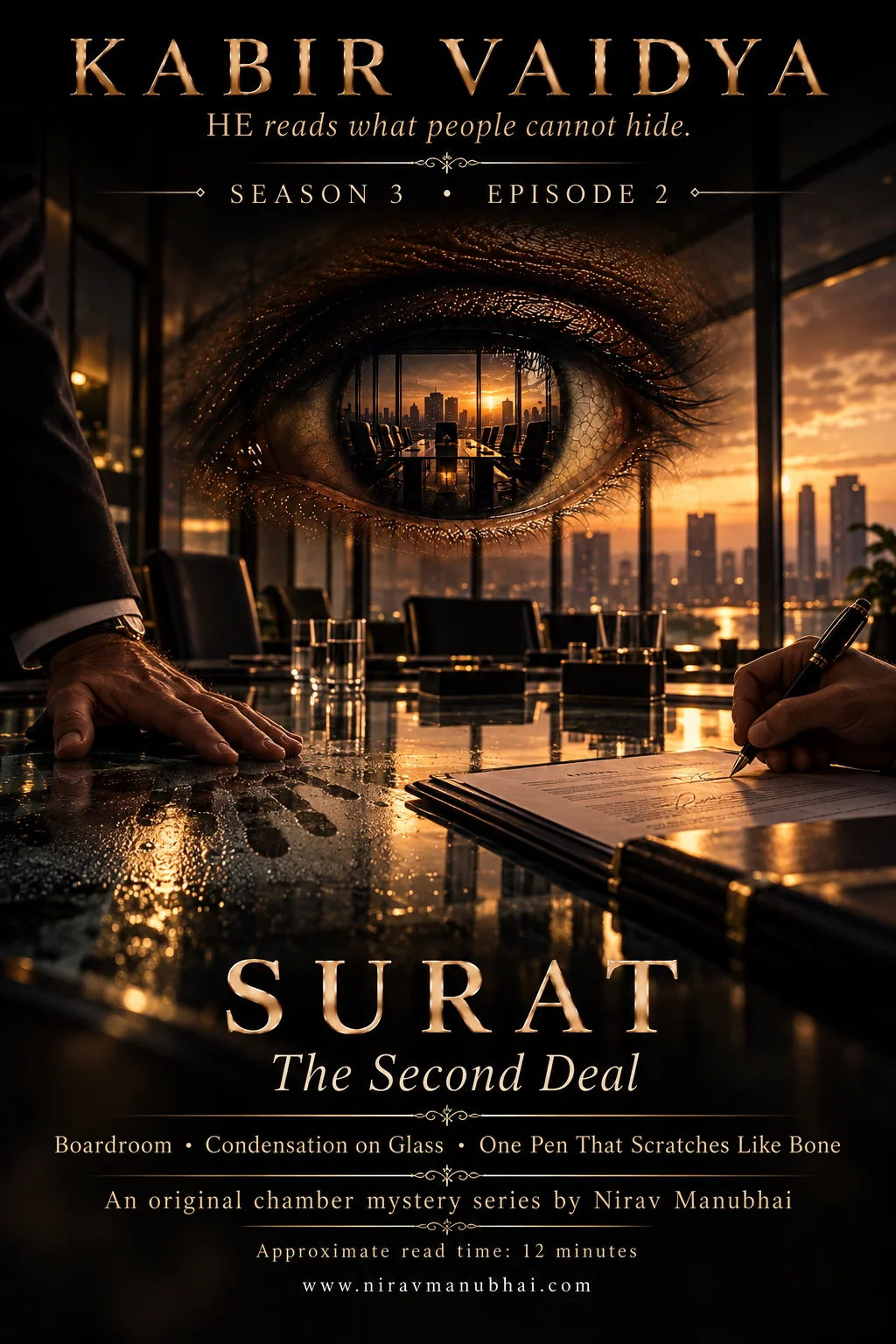
His left hand lies flat, palm down, on the glass. The cold surface is slowly gathering condensation from the heat of his palm — a cloudy outline forming under his fingers, a map of his hand on the transparent table.
His right hand holds a pen.
The deal is the acquisition of Mehta Surgical Instruments, a family company in its third generation that makes forceps and retractors for government hospitals. Vikram's company is the buyer. Efficient. Logical. Also the end of something.
The lawyer, on his right, presses her thumb along the edge of the agreement, testing the paper's weight the way a person touches a thing she has handled a hundred times and will handle a hundred more. She does not look up. Her body has been in this room before.
The board representative, on his left, keeps his hands crossed and his eyes moving — to his watch, away from it, back to it. The rhythm of a man who has decided the deal will close and is only waiting for the clock to agree.
Kabir is here to answer one question for the acquiring board: does Vikram Desai have doubts? Is his body saying what his words are not?
THE AGREEMENT ON THE GLASS
The agreement. The pages that will fold a third-generation company into a larger one, and end something while beginning something else.
The Mehta family's agreement had already been secured. What remained was Vikram's signature.
It lies on the glass between Vikram's hands. The pen in the right. The fogged outline under the left, growing clearer.
Kabir watches both hands.
TWO HANDS, ONE DECISION
The left hand does not move. The fog beneath it is the only proof it is alive — the warmth of the palm clouding the glass, then drying it, the outline fading even as it forms.
The right hand is busy. It turns the pen. Taps it once against the agreement. Under it, the glass stays clear. That hand is not resting on anything. It is working.
At every signing Kabir has watched, both hands took part in the decision. One steadies the paper. One writes. Here only the right hand has turned up. The left has gone somewhere else.
A body divided down the middle. One half doing the thing. One half declining to attend.
Kabir does not move. The fog under the left hand fades, returns, fades again. The afternoon puts a full degree of warmth into the glass before anyone speaks.
WHAT THE FOG REVEALS
"What would happen," Kabir asks, "if you did not sign?"
The air conditioning hums. The lawyer's thumb stops on the edge of the page. Under Vikram's left hand the fog is almost gone, and Kabir lets that fading take as long as it needs — the last grey ghost of a handprint dissolving back into clear glass, as if the room were giving the hand time to finish what it had to say.
Vikram looks at him. Steady eyes. Still hands.
"The board would replace me. The acquisition would happen anyway. Only someone else's name would be on the document."
"And your left hand would be satisfied."
Vikram's mouth opens. Closes. Opens again. The sentence does not arrive whole. "Yes. But —" He stops. Starts again. "The company I built was built to grow. To acquire. To become larger. The moment I stop doing what I built it to do, I become someone who built a thing and then could not commit to what the thing was."
For a man who has given a thousand speeches, it comes out badly. That is the tell. The speech stumbles exactly where the hand stumbles.
"So you commit to something your left hand cannot bear."
"Yes."
Now Kabir understands. Vikram is not torn between doubt and certainty. He is torn between what he built and who he is — and he is choosing to be the man who built the thing, even if it costs him the other hand.
Vikram signs. The right hand does it alone. The left stays flat on the glass.
WHAT KABIR SIGNS
Then Kabir does something he has never done.
He reaches into his jacket for his own pen and signs a secondary line on the agreement: Witnessed by K. Vaidya. And the date.
He is a reader. An observer. He writes down what he sees and leaves the room as he found it. He does not put his name on other people's decisions.
His hand hesitates above the page. A micro-resistance. Then the nib goes down into the thick, textured bond paper with a dry, distinct scratch. Sharp. Final. A small bone breaking in a quiet room.
The board representative looks up from his watch and does not look back down.
Vikram reads the line. His left hand is still flat on the glass. His right still holds his pen.
"What does that mean?"
"It means someone saw you choose," Kabir says. "Not the board. Not the company. You chose. That is different from having no choice."
Vikram's left hand moves. Not much. A twitch of the fingers on the glass. The hand of doubt, acknowledging that it has been seen.
That evening Kabir tells Maya. Maya has listened to every room without entering one; she knows the sound of his voice when a room has cost him something. She is quiet for a moment. Then she says the only thing she will ever say about it: "A witness line in an acquisition document does not expire, Kabir. You have just given your name a shelf life longer than yours."
THE K-NOTE
Surat
Left hand still. Right hand signing. Fog on glass, fading slowly enough for the room to watch it go. A pen that scratches like bone.
He was never undecided about signing. He was undecided about who he would be once he had.
I carry the left hand home with me now. Not a regret. A mark — the place where his body said I did not want this, and I was in the room to see that it counted.
"Staying is not absolution. It is witness, and witness marks what was chosen."
Kabir Vaidya will return.
🙏 Nirav Manubhai