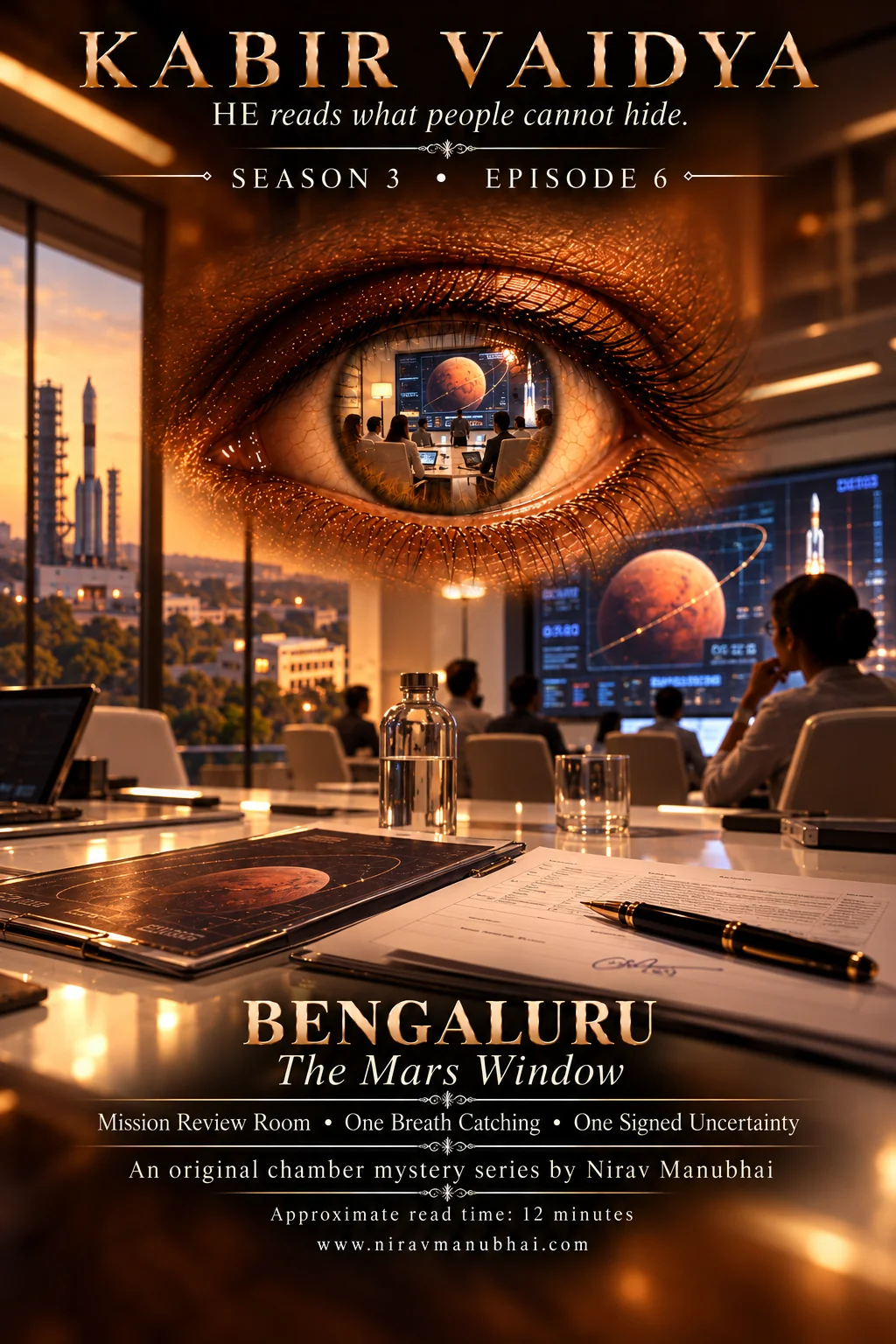
THE CITY BEFORE THE ROOM
Last season, Bengaluru meant Whitefield: glass towers, food-court ventilation, and a model that knew too much. This is the other Bengaluru. Older and quieter — the defence-and-space campuses that were here long before the IT boom gave the city its louder voice.
The gardens are neater here, less performed. The buildings were put up by people who never expected to be photographed for an investor deck. And the people walking between them move differently from the tech-corridor crowd: slower, more deliberate, with the particular gravity of those whose work, if it goes wrong, leaves the atmosphere and does not come back.
The mission review room is in Bengaluru. The rocket is in Sriharikota. Screens and data and the nervous systems of the people in both places tie the two together.
The Mars probe launches in eleven days. The launch window is twenty-three days long. After that, it shuts for twenty-six months.
One question is left: is the thermal sensor suite ready?
ENTERING THE ROOM
The room is white. The walls, the long table, the chairs, the screens. White chosen for focus.
It is the kind of white that tires the eyes. The light was calibrated to reduce fatigue; the white undoes the work. No colour anywhere, and no comfort.
Under the floor, the hum of a cleanroom server bay. Low and constant. Systems, running.
Three people are at the table besides Kabir: the mission director, a senior scientist, and the thermal sensor lead.
Dr. Meera Pillai, the thermal sensor lead. Forty-nine. She has spent six years building these sensors. Six years of her life, her career, her body. In March she missed her niece's wedding; she watched it on a phone propped against a thermal vacuum chamber, one eye on the bride, one eye on the temperature gauge. She told herself she was multitasking. If she was honest, she was hiding inside the work, because the work was the only thing in her life that answered when she touched it.
Every time someone says thermal sensor, her breath catches.
Kabir hears it the second time. It is not just a pause. It is a small, dry click in her throat — the sound of someone about to state an equation she cannot guarantee, and stopping.
A bottle of distilled water stands open on the table in front of her. It tastes of nothing. It does not help.
THE OBJECT
The thermal sensor suite. Six years of building, testing, simulating. On paper it is ready. Peer review says ready. The models say ready. The simulations say ready.
Dr. Pillai cannot say yes.
She cannot say no either.
She is asking for a permission she does not know how to ask for.
WHAT KABIR READS IN THE BODY
Her breath: catch, pause, release. The breath of someone trying to answer a question with no answer. The click is audible now — a mechanism trying to turn over and failing.
Her hands: on the table, fingers slightly curled. Not gripping. Guarding.
Her eyes: on the countdown screen. Days. The window. The twenty-six months that follow a no.
Her jaw: set. The tightness of a person holding herself together because she is not sure what happens if she stops.
WHAT STAYING REVEALS
The algorithm for a 2018-scale dust storm is ready. But it has never met a real storm of that size, because the next one has not happened yet.
She has peer review. She has models. She has simulations. She does not have the event.
So the real question underneath the review is this: can I send something to Mars without knowing everything?
Kabir stays with the click. He does not hurry it.
WHAT KABIR ASKS
"If you had seen the storm, and the algorithm held — would you be ready?"
"Yes."
"The storm hasn't happened. The algorithm is sound. So what is left?"
The breath catches. The click. The white room hums.
"Permission," she says. "To be the scientist who sends something to Mars without every answer."
Kabir sits with that for a moment. He knows what he says next will not be one of his usual observations. He is not about to name a tell. He is about to hand someone a permission no institution was ever built to give.
"One page," he says. "What has been tested. What cannot be tested until Mars tests it. What you will watch for in the first forty hours of data. Then sign it. A signed uncertainty is not a weakness in a review file. It is the only completely honest document the file will contain."
Dr. Pillai looks at him for a long moment. Then she reaches across for the pad in front of the mission director.
When the page is finished, it holds the completed tests, the untestable remainder, and three no-go conditions, in her own hand. The mission director signs beneath her recommendation. The authority is the director's. The uncertainty is hers. Neither pretends to be the other.
The mission director reads the page twice before he signs beneath it. When he hands it back, he does something Dr. Pillai has not seen him do in six years of reviews: he folds it himself and walks it to the records officer in person, rather than passing it down the table the way every other document today has travelled.
Dr. Pillai watches him go. Then she picks up the bottle of distilled water in front of her, and for the first time, drinks from it.
The next time she speaks, the click is gone. Not because the doubt has gone. Because it finally has somewhere to live that is not her breath.
THE K-NOTE
Bengaluru/Sriharikota
A catch in the breath. A dry click in the throat. Six years. A wedding watched on a phone propped against a vacuum chamber. White walls, a constant hum, water that tastes of nothing.
She was never unsure of the science. She was unsure she was allowed to go ahead without certainty.
I am starting to think readiness is not the absence of doubt. It is doubt given a shape the institution can hold, so the body no longer has to hold it alone.
"The moment someone stays long enough to see your uncertainty and does not leave, you have permission."
Kabir Vaidya will return.
🙏 Nirav Manubhai