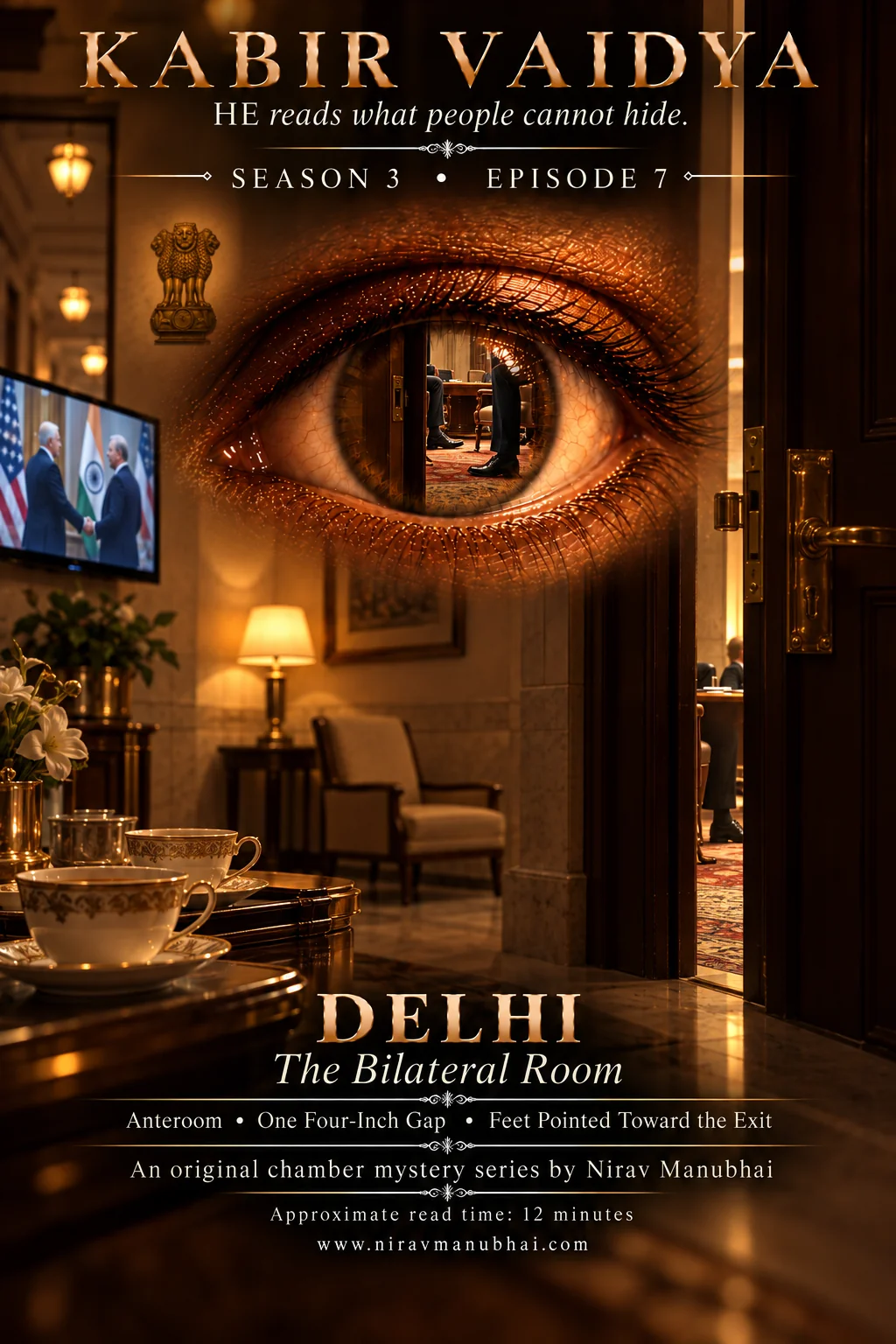
THE CITY BEFORE THE ROOM
This is the Delhi of the formal visit — a city built to announce the permanence of decisions that are never, in fact, permanent. This morning the approach to the government building smells of fresh flowers and floor polish, and of the cold, formal air of a corridor that has been brought to an exact temperature for a guest who has not yet arrived. Marigold garlands have been strung along the gate for the occasion. They will come down again by evening. Even the city seems to know the ceremony is theatre — necessary theatre, sovereignty performed — and that the real business of the visit will happen in the minutes nobody photographs.
The building was designed to say one word: permanence. Thick walls. Long corridors. Heavy doors.
Kabir is placed in the anteroom outside the meeting. Placed, not seated. The PMO contact chose the chair himself, and the chair's sightline, with the care of a man who could never ask a visiting delegation what it was feeling and so had hired someone who would not need to ask. His hands were steady as he set the chair down. Too steady. The steadiness of a man who has done this before — placed a witness, chosen a line of sight, and walked away without looking back.
Through a gap in the door, Kabir can see exactly one thing: feet.
ENTERING THE ANTEROOM
The anteroom is small and beige. The whole building is beige — the colour of a place designed not to be remembered.
On a side table, cardamom tea has been cooling for a long time in fine bone china. The cups are full. No one has touched them.
A television on the wall plays with the sound off: world leaders shaking hands. Silent smiles. Silent agreements.
Kabir is alone. He is not meant to see the meeting. He is meant to wait. But the door has not quite closed.
The gap is about four inches wide. Enough for ankles, the lower legs of two chairs, a strip of patterned carpet, and one corner of the long table, where someone has put down a folder whose edge never moves. Kabir watches the meeting the only way it will let itself be watched: in slices. A hand comes down into the gap, adjusts a glass of water, withdraws. A foot taps twice and stops. The light shifts as someone on the far side leans into a lamp and out of it again.
The President's feet are pointed at the door. Not the door to the anteroom. The other one. The exit. The way home.
They were not always. At minute twenty-two, the feet turned. Since then they have pointed at the exit, and they have not moved.
The angle is not subtle. The feet are not hesitating. They are carrying out an escape before anyone has mentioned a signature.
THE STATEMENT NOT YET WRITTEN
The object is not in the room yet. It is the joint statement that will be issued afterwards — measured, noncommittal. The feet have already answered it.
WHAT THE FEET SAY
The feet: pointed at the exit. Not by accident. A body carrying out a decision.
The weight: Kabir cannot see the President's shoulders. He can see the heels — lifting now and then off the carpet, the weight forward on the balls of the feet. The posture of someone about to stand.
The time: minute twenty-two. Something was said at minute twenty-two that made this body decide to leave. Not now. But it has decided.
So the agreement will not hold. The statement will be careful. The feet have already given the real answer.
On the side table, the tea goes on cooling. On the wall, the leaders go on shaking hands without a sound.
WHAT STAYING REVEALS
Kabir does not go to the PMO contact. He goes out of the gate to a tea stall and orders chai — not the cardamom tea cooling in fine china inside, but the ordinary roadside kind, served too hot in a small glass, sweet enough to sting the back of the throat. He drinks it standing, the November morning sharp on his face, the heat working into his fingers.
A head of state's body has just told him something the government does not yet know. The knowledge sits in his chest differently from anything he has carried out of a room before.
For the first time, he understands that witnessing power is not the same as witnessing people. The obligation is different.
With ordinary people, the work is to help them see what their own body already knows. With the powerful, the work is to know what the body knows — and to choose not to turn it into a weapon.
WHAT KABIR KEEPS
He finishes his chai. He walks back into the building. He does not mention the feet.
The PMO contact is waiting for him in the corridor, by the chair he placed so carefully that morning. He does not ask Kabir to sit this time.
"Well?" he says. Just that. The practised steadiness from the morning is gone from his hands; they are in his pockets now, and his pockets are doing the job his face is not.
Kabir could tell him. The feet. The exit. Minute twenty-two. It would make this man's afternoon simpler, and possibly his year.
"I watched a meeting," Kabir says. "That's what I was placed here to do."
"That's not an answer."
"It's the only one I have for you."
The PMO contact holds his eyes a second longer than courtesy requires. Then he nods once — the nod of a man filing something away that he will not ask about again, not because he believed the non-answer, but because he has correctly worked out that asking twice would cost him more than the silence does.
The joint statement comes out that afternoon. Measured. Noncommittal. It includes the sentence "both sides acknowledged the importance of continued dialogue" — a sentence that could mean anything and commits to nothing, and that a pair of feet had contradicted at minute twenty-two.
The feet were right. Kabir keeps what he knows. He has now been asked for it directly, by a man with the power to make not-answering expensive, and he has paid the small, specific price of that man's trust to keep it.
THE K-NOTE
Delhi
Feet toward the exit at minute twenty-two. Beige walls. Cardamom tea going cold. A silent television. A four-inch gap that showed me everything that mattered and almost nothing that was said aloud.
I did not report it. I drank chai at a stall outside the gate, ordinary and too sweet, and I stayed with the knowledge there, not in the beige room where it arrived.
It will stay with me. It will not be used. It will not be shared. I will carry it the way the architect in Jaipur carries the measurements of a door that is gone — quietly, exactly, and without turning it into leverage.
"With power, you stay to make sure the witness remains a witness and does not become a tool."
Kabir Vaidya will return.
🙏 Nirav Manubhai