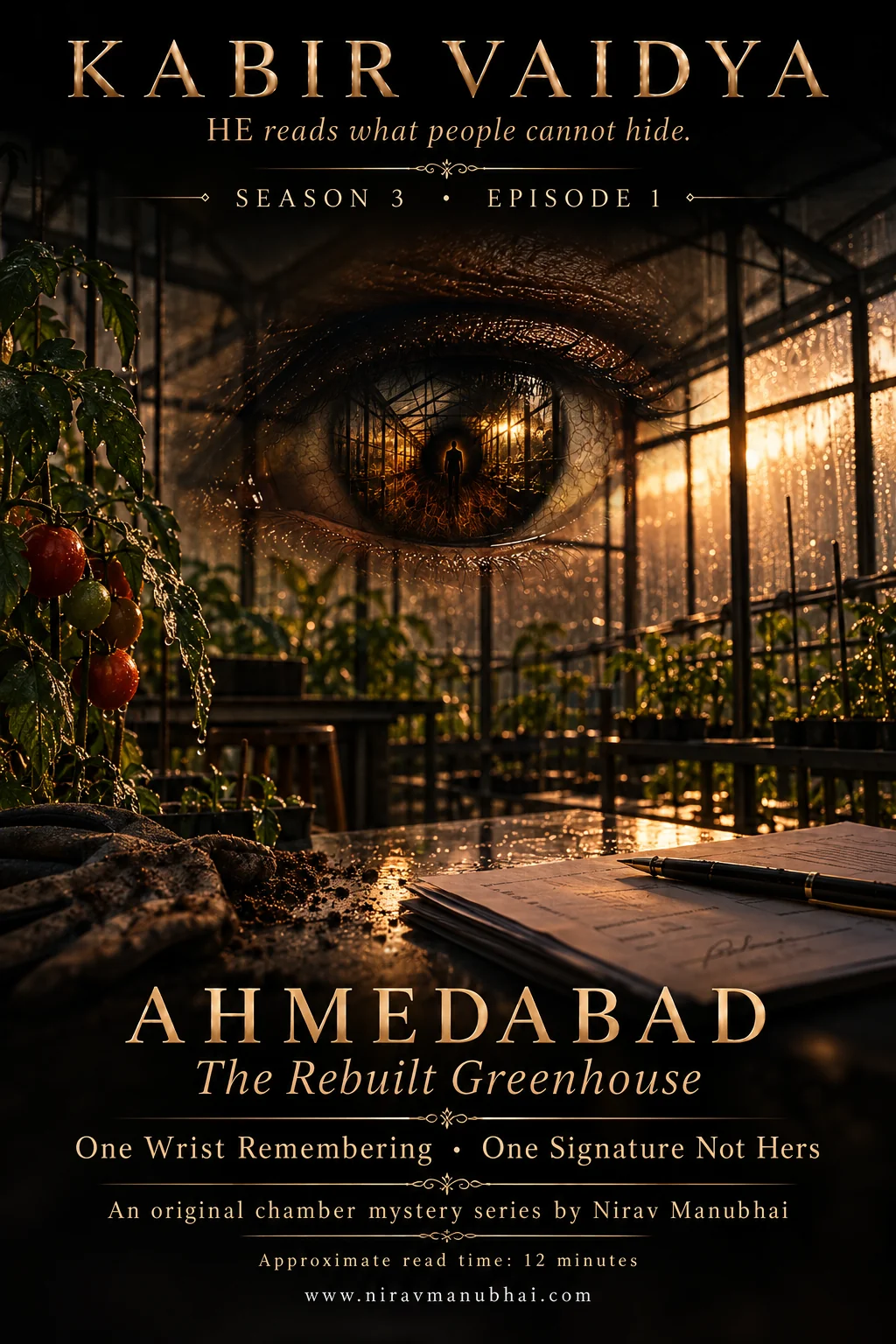
THE CITY BEFORE THE ROOM
Ahmedabad arrives as dust and memory.
The same dust that settled on the first greenhouse four years ago. The same city that watched a man burn what he had built rather than let it fail slowly. The same light that Kabir had walked through then, when he believed that reading a body meant understanding a life.
Kabir has been in Ahmedabad many times now. The city no longer surprises him. But it still remembers.
The greenhouse is on the outskirts. A different plot. A different structure. But the same shape. The same intention. The same determination to grow something that the city's heat wants to kill.
Kabir's footsteps on the gravel are the only sound. The gate is open. The path is clear. Someone has been expecting him.
ENTERING THE ROOM
The greenhouse is not a room in the traditional sense. It is a room made of glass and intention.
The moment Kabir steps inside, the heat hits him. Not the dry heat of the city. A thick, heavy, moist heat. The kind that wraps around your skin like a warm, damp blanket. It smells of wet potting soil, crushed tomato leaves, and the sharp chemical tang of liquid fertiliser.
A row of tomato plants climbs thin wire supports along the eastern pane, the first fruit already reddening, the leaves broad and slightly furred, each one carrying a small bead of condensation that catches the afternoon light. Beside them, a tray of basil has been pruned recently — the cut stems still pale, still weeping faintly. The greenhouse is alive in the specific, indifferent way of living things that do not know they are being witnessed.
Water drips somewhere. A slow, mechanical plop… plop… plop… from an irrigation line. The sound paces the silence like a metronome.
The afternoon light pours through the panes, hitting the leaves, the soil, the water droplets that cling to the stems. Everything is growing.
And everything is waiting.
THE PERSON WAITING
The woman standing in the centre of the greenhouse is twenty-three. Her name is Isha. She is the daughter of the man who burned the first greenhouse four years ago. She was nineteen when she watched her father set fire to what he had built.
She has rebuilt it. Every pane of glass. Every irrigation line. Every seedling. Better than it was before.
But her hand keeps returning to her left wrist.
Not touching it. Returning to the space where something used to be.
Kabir notices this before she speaks. The hand rises. Hovers. Returns to her side. Rises again. Hovers. Returns. The motion is unconscious. The body repeating a gesture that no longer has an object.
Isha's posture: straight. Too straight. The spine of someone who has been holding themselves upright for a long time. Her shoulders are locked, bracing for impact.
Her breathing: shallow. The breathing of someone afraid that a full breath will release something they are trying to keep inside.
Her jaw tightens when she looks toward the far end of the greenhouse — the end where a small office desk holds a stack of documents and a pen. The jaw of someone holding back words.
THE OBJECT THAT IS NOT THERE
The object is not in the room. The object is in the space where Isha's wrist keeps going.
Kabir can see the evidence: a faint, pale indentation on the skin. A slight groove where something heavy used to sit. A strip of lighter skin surrounded by the tanned surface of her arm. The wrist has not forgotten what it carried.
When her thumb strokes that empty groove without her noticing, Kabir feels the phantom weight himself.
Plop.
The irrigation drip continues, even, unhurried, indifferent to the conversation it is shaping.
Kabir watches the hand rise and fall. Rise and fall. A metronome of absence.
THE HISTORY UNSPOKEN
"Someone is trying to take the greenhouse," Isha says. Her voice is flat. Controlled. The voice of someone who has learned to make herself smaller. "A developer. A real estate company. They sent a purchase order. Signed. They say it is valid."
"Signed by whom?"
"I don't know. The signature is not mine. But the greenhouse is mine. I built it. I own it. The signature is not mine."
She walks to the desk, takes the top document from the stack and hands it to Kabir. Her fingers are cold. The paper is warm from the greenhouse heat.
Kabir reads the document. The signature is clear. Not Isha's.
He does not know the hand. Isha says she does not either. Her jaw tightens as she says it.
He does not press. He stays with the document. He stays with Isha's hand that keeps returning to her wrist. He stays with the greenhouse rebuilt around what was lost. He stays with the irrigation drip pacing the silence.
WHAT KABIR READS IN THE BODY
Isha's hand: still rising. Still hovering. Still returning. The gesture of someone who has removed a weight but cannot remove the memory of the weight. The body does not forget what it carried. It only forgets that it is no longer carrying it.
Her breathing: still shallow, but with a catch now. A pause before the exhale. The pause of someone about to say something she has not said before.
Her jaw tightens again when Kabir's eyes move toward the document. The jaw is protecting the signer. The body knows who signed before the mouth will say it.
Kabir waits. He does not fill the silence. He lets it sit between them. The drip lands on wet soil now, the sound fuller and softer than it was when he came in. Something here has changed.
"Isha," Kabir says. The words are quiet. Careful. "What did you wear on that wrist?"
"A bracelet. My father gave it to me the night of the fire. I wore it for four years."
"And why did you take it off?"
A long pause. The drip continues. The hand rises. Hovers. Returns.
"My mother asked me to."
THE REAL TRUTH
Isha tells him the rest in pieces, between the drips.
The signature on the purchase order is her mother's. Not because the mother is trying to steal the greenhouse. Because the mother is dying.
She signed the purchase order because she wants Isha to sell the greenhouse. To take the money. To leave the city. She does not want her daughter to spend her life rebuilding what her father burned.
The mother has cancer. Six months. Maybe less. She has been dying for two years, watching her daughter rebuild the greenhouse, watching her daughter carry the weight of her father's fire, watching her daughter's wrist remember the bracelet.
She asked Isha to remove the bracelet because she wanted her daughter to stop carrying the weight. To let go. To be free.
But Isha's wrist could not let go of the weight. The indentation is still there. The groove where the bracelet used to sit. The wrist has not filled in the space.
WHAT KABIR DOES
He does not leave after reading the document. He does not leave after understanding the signature, or the mother. He stays.
He sits down on the edge of a planting bench, and after a moment Isha sits beside him. The afternoon light moves across the floor. The tomato plants continue to climb their wires. The basil continues to weep from its cut stems. The drip continues to pace the silence.
He asks her a question. Not a counsellor's question. A witness's question. Rooted in what he has seen.
"Your wrist keeps going to the space where the bracelet was. But your hands have been building for three years. Every pane. Every line. Every seedling." He looks at her hands. "Which one are you building for?"
The greenhouse is silent except for the drip. Isha does not answer him. But her hand goes to her wrist. And for the first time, she touches the space where the bracelet was without her body trying to remember it.
She does not stroke the indentation. She does not try to fill the groove. She simply places her palm over the pale skin and holds it there.
Her hand stays on her wrist. Her breathing changes. Deeper. Slower.
Kabir does not interpret the breath. He does not name what has shifted. He lets the hand stay where it is. The drip continues. The plants climb. The light moves.
THE K-NOTE
Room 21 · Ahmedabad
A wrist that remembered a bracelet. A mother dying. A daughter rebuilding. An irrigation drip pacing the silence. The pale indentation on the skin.
Isha did not need Kabir to solve the developer problem. She needed someone to stay while she decided whether the weight her wrist remembered was hers to carry, her father's to carry, or something both of them had been carrying together and could now set down.
Staying means not solving. It means being present while the person decides what they actually want to carry.
The mother did not sign the purchase order to steal the greenhouse. She signed it to give her daughter permission to let go.
The pale line on Isha's skin will fade. But it will never completely disappear. It will become a map of where the weight used to be.
"The body does not rebuild itself. It rebuilds around what was lost. Stay long enough, and a person learns to carry it in a hand that knows the shape."
Kabir Vaidya will return.
🙏 Nirav Manubhai