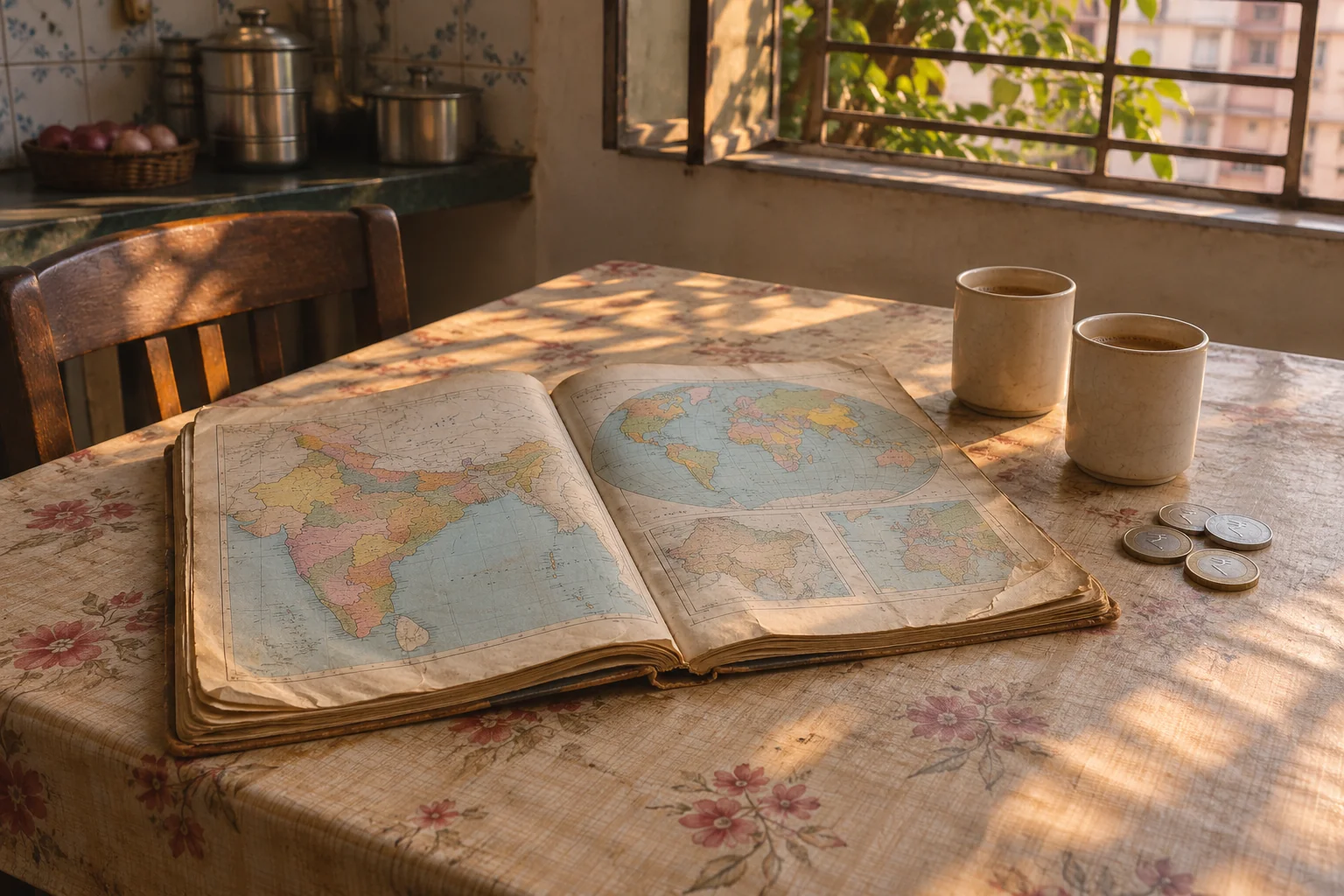
At eleven in the morning, the bookseller phoned to ask Kajal if she still wanted the secondhand atlas. A boy was in the shop with the money.
“Give me till four,” she said.
“You said that yesterday.”
“Yesterday you said you’d give me till today.”
He thought about it. Kajal could hear him turning pages while he thought. She knew exactly how that atlas opened. Someone had used a bus ticket to mark the Indian Ocean and the book fell open there every time.
“Four,” he said.
She put down the phone and went into the kitchen, where her grandmother was using a blunt knife to cut through the string on a parcel of tea.
“How much for the old sewing machine?” Kajal asked.
“How much did he say for the atlas?”
“Two hundred. I have ninety.”
“And the other book?”
Kajal had forgotten she’d told her about the geometry guide. The school copy had to go back on Monday. Each time she borrowed it somebody had added a new pencil diagram in the margin, usually wrong.
“Sixty,” she said.
Bhanu split the string. Fresh tea spilled across the newspaper, dark and sharp smelling. She swept it into the tin with the flat of the knife.
“I said you could sell the things in the sack,” she said. “The machine is staying.”
Kajal looked down at the sack. There were stove parts, a bent milk can and a pile of heavy curtain rings that had come from a house her grandmother hadn’t lived in for forty years. She’d packed everything herself. She’d even washed out the can. If the machine went in, she could buy both books and bring change home.
“You can’t use it anymore,” she said.
“I used it yesterday.”
“What for?”
“Your skirt.”
Kajal touched her waistband. There was a stiff little ridge inside it where the elastic had been turned and stitched back on itself. She’d assumed her mother had done that.
Bhanu held the sack open while Kajal put in the last of the curtain rings. When Kajal hoisted it, the old woman took the rope from her, folded a scrap of cotton over it, and handed it back.
“Hold it there.”
Kajal took the long way to the scrap yard because she could rest the sack on the wall outside the milk shop. The shopkeeper lifted the lid off a tray of hot gathiya as she passed. At the corner the smell was still on her, and she could taste the fennel from the last time she’d bought a paper cone on her way home. She still had all ninety rupees when she put the sack down inside Kishan’s chalk line.
“Let’s see what she’s sent,” he said.
“I brought it.”
“Yes,” he said. “I can see that.”
He tipped out the contents and sorted the metals. Kajal watched him do the arithmetic. Twice he went back to check the milk can, which made her think it might be worth more than he’d first reckoned.
“Hundred and forty,” he said.
She had enough for the atlas. If she bought the guide as well, she’d be thirty short.
Kishan opened the shallow drawer under the ledger. From where she stood, she could see a brass weight, two pencils and a comb with a tooth missing. He took out three ten-rupee notes and laid them beside her money.
“What are those for?” she asked.
“Your Baa used to get a little extra.”
Kajal looked at the notes. She could be at the bookshop in ten minutes. She could put both books down on the counter without asking the man to do her any favours. She reached for the money, then stopped.
“Does she still get it?”
“She hasn’t brought anything for months.”
“I mean, did she know?”
Kishan moved the three notes away from the rest so she could pick up either pile. “My uncle used to put that brass under the pan. He thought she didn’t see.”
Kajal bent a little. From where she was standing, she could see the ledge, but only if she knew where to look.
“Does the bookshop still have that stool outside?” she asked.
“The one with the broken leg?”
“He has two.”
“What are you buying?”
“An ocean,” she said.
Kishan looked up.
“And a geometry guide.”
She picked up the money for the scrap. At the gate she unwrapped the scrap of cotton from the rope and put it in her pocket.
Kajal got to the bookshop at twenty to four. The atlas was on the counter. So was the boy who wanted it, with two notes laid end to end in front of him. The bookseller had made him wait.
She bought the atlas. The boy took back his notes one at a time, so she waited until he’d gone to ask if she could copy the geometry exercises she needed before closing. He pulled a stool out from under a stack of cartons and told her it was the only one with four good legs. Five minutes later he asked her to move because he needed the stool to reach the top shelf. She finished the last diagram standing up.
By the time Kajal got home, Bhanu had made tea. Kajal told her about the atlas, the exercises and the three notes. When she got to the brass, her grandmother reached for the sugar tin and put one spoonful in each cup.
“I saw it the first week,” she said.
“Kishan said Somnath thought you hadn’t.”
“He looked down at the scale. I used to look at the window behind him.”
Kajal waited.
“The glass was black with dirt,” Bhanu said. “You could see his hand in it as clear as anything.”
“Why didn’t you tell him?”
Bhanu tasted her tea. She put half a spoon more in her own cup.
“That first Tuesday I needed it,” she said. “The next Tuesday too.”
Kajal opened the atlas. The bus ticket was still there. Her grandmother slid the tea out of the way and leaned over the blue page.
“Show me where we are.”
Kajal found the west coast and moved her finger inland. Bhanu bent closer. One corner of the atlas kept rising off the table. She took the change Kajal had brought home, laid it flat on the corner, and set her warm cup down on it.