Bhanu came back to the scrap yard and told Somnath to put her scrap back on the scale.
She had been gone less than five minutes. He still had her scrap on the sorting table. A bicycle rim, some tins flattened with a stone, and a coil of wire black with the dirt it had come out of. He could see the marks her fingers had left on the wire.
“Put it back on,” she said.
Somnath laid his pencil across the ledger. “I paid you for twelve.”
“I know what you paid me for. Put it back on.”
There were three people waiting. One of them had brought an entire ceiling fan and was turning the blades by hand to prove it worked. Every time he let go, the fan gave a dry little click. Somnath had been hearing it since nine.
He picked up the bicycle rim.
“The tins too,” Bhanu said.
He could have told her to wait her turn. He could have given her another ten rupees, which was what his father used to do when an argument began to cost more than it was worth. But she had walked back in the sun, and he could see from the way she was holding her right hand that she’d carried the sack the whole way with the rope biting into the same place.
He gathered the tins.
The first time she came without her husband, she’d set her sack down outside the chalk line and told Somnath it was eight kilos. It had been closer to ten. She’d watched his face while the scale settled. When he told her what it weighed, she took the money, counted it, and asked how much he’d deduct for the sack.
“Nothing,” he’d said. “I took it off before weighing.”
“Then how much for the dirt?”
He had stopped answering questions after that. He paid her what the beam said, and she came the next week and called seven on a sack that weighed nine.
He’d seen her make the onion seller untwist a bag and take back the one onion that had gone soft. The next Tuesday she looked down at her sack of scrap and said, before either of them had touched it, ‘You’ll want to take something off for the rust.’
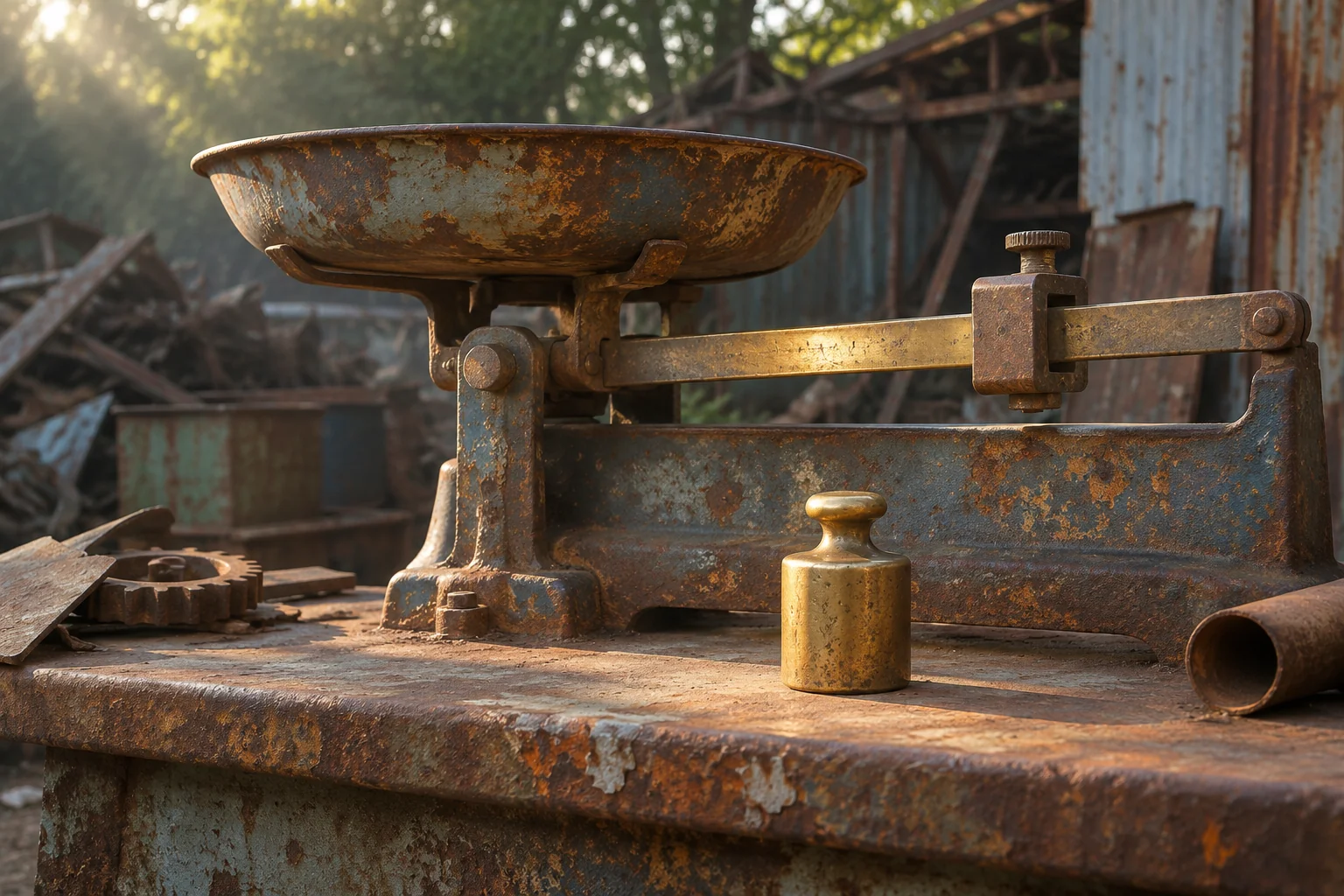
It had taken him one whole winter to think of the little brass weight. Long enough for him to feel foolish when he finally thought of it. On Tuesdays, before she came, he slipped it onto the ledge under the pan. It added one kilo. After she’d gone, he put it back in the drawer.
Today the brass had gone back in the drawer before she was even out of the gate.
Somnath set the rim and the tins on the scale. Before he could add the wire, Bhanu said, “That stays out.”
He held the coil in his hand. A loose end brushed his wrist.
“Why?”
“Because it wasn’t mine.”
A woman at the gate was waiting with a little girl. Bhanu pointed her out. The woman lifted her hand halfway, then put it down again.
“I said I’d carry it here for her,” Bhanu said. “I put it in with mine. Went back and offered her a share of the money. She asked what her wire weighed. I told her about two kilos.”
“And?”
“She said about two kilos was a funny thing to come back from a scale with.”
Somnath looked at the coil. He had weighed it with everything else. Bhanu had guessed eleven, which, for once, was what she had actually brought in.
“Give her what the wire weighs,” Bhanu said. “I’ll bring you back whatever you overpaid me.”
He could weigh both lots in front of her. Together they would make eleven. She was already holding the notes he’d paid her for twelve.
Behind him the ceiling fan clicked.
“Will you please stop doing that?” he said.
The man held the blade still. In the quiet Somnath could hear the tea seller knocking the wet leaves out of his strainer.
He took everything off the pan and set the wire on by itself. Bhanu leaned close enough to see where his thumb stopped on the arm.
“Two,” he said.
He paid the woman for two kilos. She wanted to count the notes, but the little girl had already taken one by a corner and was trying to fold it small enough to go into her dress pocket. Bhanu watched them out of the yard. Then she turned back.
“And mine?”
“Nine.”
“You paid me for twelve.”
“Yes.”
She waited. It was the first time he could remember her waiting for him to say the number.
“You brought eleven kilos,” he said. “I pay you for one extra.”
“Since when?”
“Since the winter you started bringing it yourself.”
She took the money out of her blouse and flattened it on the ledger with the heel of her hand. There was grit on one note. She brushed it off with her thumb.
“You could have told me.”
“I’ve just told you.”
“And if I hadn’t brought somebody with me today?”
Somnath turned his pencil over. The end was shiny from years of tapping the ledger.
“I’d have wished you a good morning.”
“You never wish me a good morning.”
“Give me time,” he said.
She counted out the money for the wire he’d paid for twice and pushed it towards him. The money for the extra kilo went back into her blouse.
The following Tuesday Somnath left the brass in the drawer. Bhanu put her sack down inside the chalk line. She unwound the rope slowly and rubbed the red groove it had left in her palm. Then she tipped out the scrap and waited.
“Ten,” he said.
She looked at the beam. It gave its little shiver and settled.
“Now write eleven.”