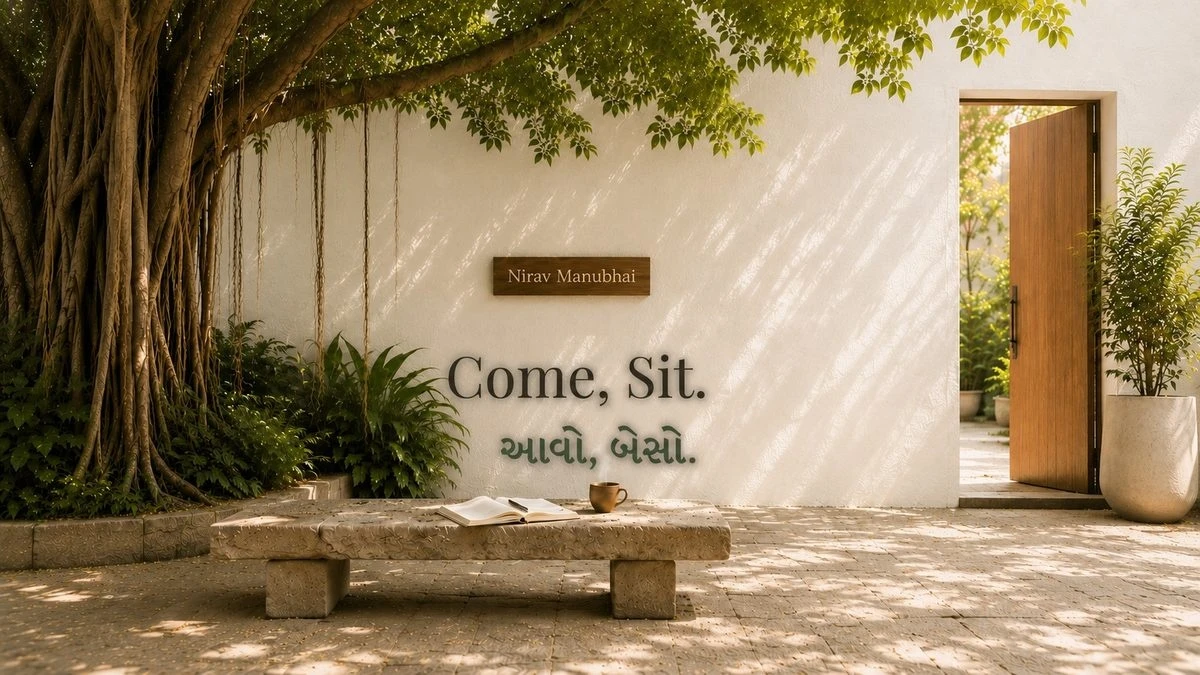
The Accumulation
For years, I thought I was collecting words.
I did not realise I was collecting rooms.
Books. Articles. Stories written at odd hours in cities I was passing through. Observations made on trains and noted down before they could leave. Conversations that ended but left something behind — an idea, a question, the beginning of a thought that never quite resolved itself and stayed, lodged somewhere, waiting.
Many books, practitioner guides, field notes, business plans, strategy submissions, WhatsApp read series and dozens of great stories over months and years. A study in Ahmedabad with shelves that held some of it. Notebooks that held more. And a kind of memory — mine and other people's — that held the rest in ways I could not organise or retrieve or point to and say: there, that is the thing I made.
They existed. All of it existed.
But scattered is not the same as resting.
At some point — the way a season changes without announcing itself — I began to notice something uncomfortable. The thoughts I had spent years making had no single place to belong together. A book is not the same as a conversation. A conversation is not the same as a story published quietly and read by three people, one of whom writes back six months later to say what it did to them on a particular Tuesday.
I was not looking for a platform. I was not looking for an audience.
I was looking for a home.
Not a presence online. A home — the kind of place where things can rest, where a guest can arrive on a slow afternoon and find something waiting, stay as long as they need to, and leave when they are ready.
What if all of this had a house?
The Wrong Language
I was not, by any conventional measure, the kind of person who builds things.
I understood stories. I understood people. I understood, with the specific precision of someone who has spent twenty years noticing things, what makes a person stay with a piece of writing and what makes them leave.
I did not understand HTML. Or CSS. Or servers. Or what it means to build something that has to work on a phone in a moving train and on a screen the size of a small window, in a language that renders differently on a thousand devices in a thousand lights.
I had spent my life with one kind of material. This was not that material. This was a language I had observed from a respectful distance — the way a person who loves books but has never written one reads a first page, or watches a gardener work soil they have never turned themselves. With admiration. With complete awareness of the distance between loving a thing and being able to make it.
I began anyway.
There was an evening — I remember it specifically, which tells me something about the kind of evening it was — when I sat at my desk and looked at a screen full of code that had been working correctly that morning and was now showing nothing. A blank white page where a room had been.
I sat with that blank page for a while.
I thought: perhaps the idea has outgrown the person trying to build it.
Then I went back to work.
I have a quality — people who know me would recognise it before I would — of returning to a problem after frustration the way a door returns to its frame. Not dramatically. Not after a speech to myself. Just: closed, and then open again.
The Strange Conversation
During this building, something unusual was happening every day.
A conversation between two very different kinds of knowing.
On one side: me — knowing exactly what the house should feel like, the warmth of it, the pace at which a guest should move through it, the quality of silence between one story and the next — but unable to build the walls.
On the other side: an AI that knew the material deeply — the grammar of code, the logic of systems, the way a browser reads a line of text — but had no understanding of why this particular house needed to exist.
Some evenings the conversation was not about code at all. It was about whether a sentence felt welcoming. Whether a button sounded like an invitation or a command. Whether a corridor between two thoughts was too short or too long. Whether a room asked too much of the person entering it.
These are not technical questions. But they shaped every technical answer that followed.
What I discovered — and this surprised me more than the technology did — was that the collaboration was only as good as the clarity I brought to it. When I was vague about what I needed, I received something correct and empty. When I could say precisely what I wanted a person to feel when they arrived, the quality of what came back was different. Closer.
The machine knew structure. I knew meaning.
The house was built in the space between.
The Night the Room Appeared
I do not talk much about the evening the first version appeared on my screen.
The spacing was wrong in three places I could immediately see, and probably wrong in several I could not. A font was slightly off. An image sat awkwardly against the text beside it, as though it had not yet learned the manners of the room it was in.
None of that mattered.
What mattered was that it existed. Something that had lived for months only in a document of notes and intentions and half-answered questions had taken a shape that another person could open on their phone, in a different city, in a different life, and find.
I sat with that for a while.
I did not immediately start correcting the spacing.
There is something that happens in the moment when a thing you have imagined becomes a thing that exists. It is not pride. It is closer to recognition. Like hearing, for the first time, a piece of music you have been carrying in your head for months. It is not quite what you imagined. But it is real. And real is something that imagined never quite manages to be.
The room was real.
That deserved a moment before the work began again.
The Mistake of the Builder
For a long time, I was thinking like a builder.
Does the button work? Does the page load? Does the corridor lead where it is supposed to lead?
These are reasonable questions. They are also the wrong ones.
At some point I stopped and entered the house as a stranger would.
I walked through it as someone who had never seen it before, who did not know where the rooms were, who was dependent entirely on whoever built this place to tell them — through the design itself, without a word of instruction — where they were and what was possible.
What I found was uncomfortable.
A room can be technically correct and still feel unwelcoming. A corridor can be well-built and still make a guest uncertain. I had been building from the inside. I knew where everything was. I had forgotten entirely what it is to arrive somewhere that is not yours.
I pulled apart things I had spent weeks building and rebuilt them from the entrance.
I went quieter during those weeks. Not troubled. Quieter — the way you go quiet when you are thinking about something you cannot yet say.
The Word That Changed Everything
At some point I stopped calling the people who would enter the house visitors.
I started calling them guests.
This sounds like a small thing. It was not a small thing.
A visitor comes to see something. They arrive with a purpose already formed. They find what they are looking for, or they do not, and they leave. A visitor is counted. A visitor is, in the language of the internet, a metric.
A guest is different.
A guest is welcomed. A guest is trusted. A guest is given the freedom to move at their own pace — to stay in one room for a long time, to discover something they were not looking for, to return on another day without explanation. A guest is never made to feel that their presence requires a justification.
When I changed that word, every decision changed with it.
Where does the guest look first? What do they find when they reach the end of a story? When they want to return, is the way back clear and unhurried? Does the house ask anything of them, or only offer?
Is this good for the guest?
That became the only question worth asking. It still is.
The Open Door
The house is open now.
I do not stand at the entrance waiting to greet each person who arrives. I did not build it that way. I built it so that arriving does not require me to be present. The rooms hold the stories. The corridors carry the guest from one thought to the next. The house does the hosting.
Whether someone enters and stays for a moment, reads one story and leaves, or returns another day to find the room they half-remembered — that part no longer belongs to me.
A home, once it opens its doors, begins to live beyond the person who built it.
The thoughts that had no home now have one. The words that were scattered now share a roof.
I built the house.
The house will do the rest.
The Courtyard Door
The image that opens this story is also the image that closes it.
A quiet courtyard. A banyan tree holding its ground. A simple white wall carrying two words — Come, Sit — in English, and then again in Gujarati, because some invitations need to be said twice to be truly meant. A stone bench with an open book and a cup of tea, as though someone stepped away only a moment ago. And a door standing open: not insisting, not advertising, simply present — suggesting that there is another room beyond, and that it is worth the walk.
When I first saw this image, I understood something.
This was not an illustration of the house. It was the house explaining itself.
Every meaningful place begins this way — not with its most impressive room, but with the one that makes you feel safe enough to step inside.
The door is open.
It has always been open.
www.niravmanubhai.com
ભલે પધાર્યા
You are Welcome