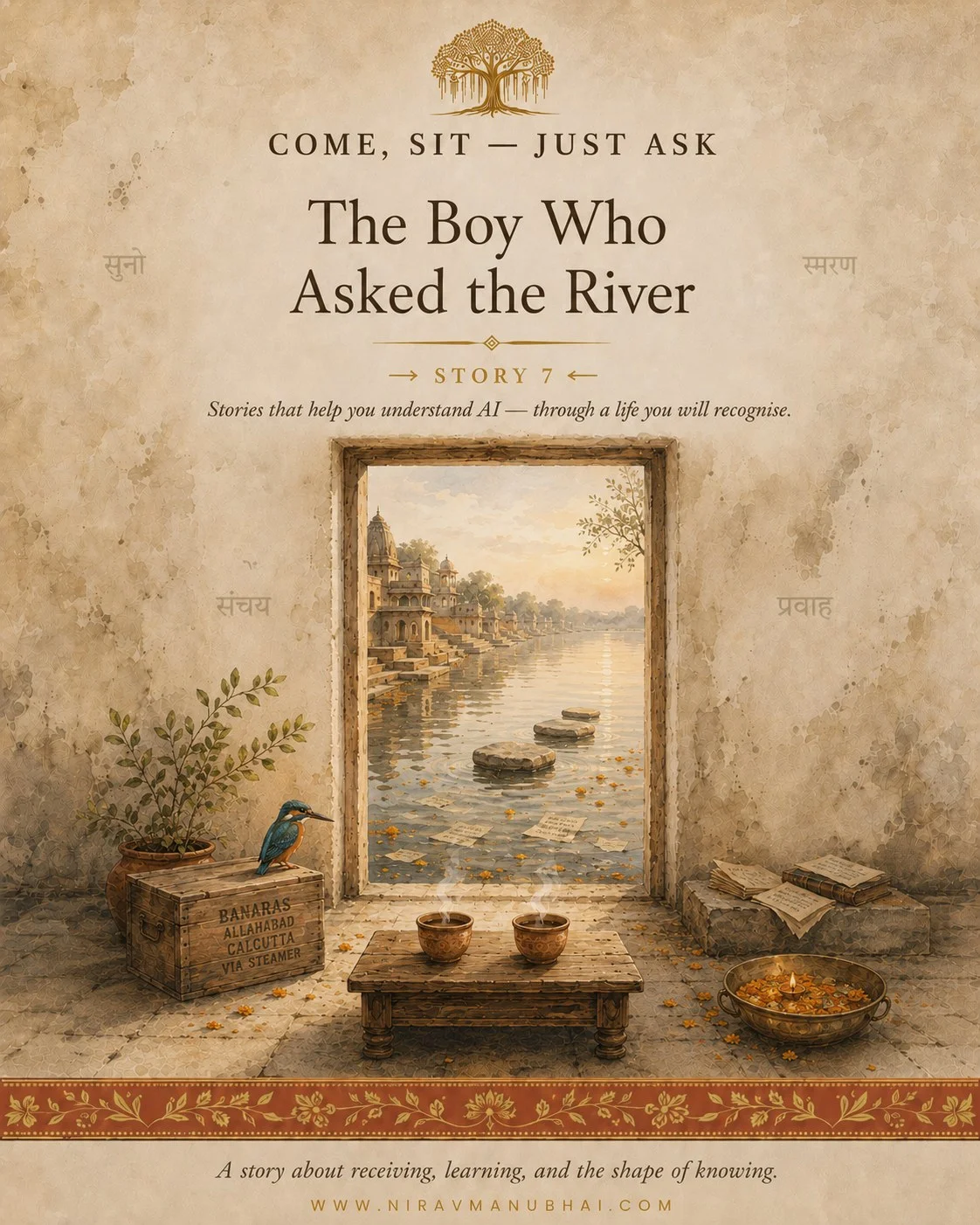
Arjun’s grandfather was a man who spoke only when the silence demanded it. He was a farmer, but his true work, Arjun later realized, was witnessing. Every evening, just as the heat began to lift from the ground, his grandfather would walk down the stone steps of the ghat to the water’s edge. When Arjun was old enough to walk without holding his hand, he was allowed to come. "Ask it a question," his grandfather would say, pointing to the water. "And then wait." Arjun would ask. Will it rain tomorrow? Will the mangoes be sweet this year? The river would not answer in words.
It would just move. It would lap against the stone steps, swirl around the wooden posts of the bathing ghats, and carry a fallen leaf out toward the middle of the current. "What is it saying?" Arjun would ask, frustrated. His grandfather would smile, a small shifting of the lines around his eyes. "It is not saying anything, beta. It is holding everything. Listen to the water. It does not rush. It does not stop. It just carries." Arjun did not understand this then. He was a boy who wanted answers, and the river only gave him movement.
When Arjun was fourteen, his grandfather died. It happened in the winter, quietly, in his sleep. But the absence he left behind was loud. It filled the house. It filled the courtyard. It filled the space at the evening meal where his grandfather’s plate used to be. For Arjun, the grief was not an emotion. It was a physical thing. A heavy, sharp stone lodged directly below his ribs. It made it hard to breathe. It made it hard to eat. It made the world feel too large, and Arjun feel entirely too small to carry it. He stopped going to the river.
The sight of the water felt like a betrayal, a reminder of the man who was no longer sitting on the stone steps beside him. But three months after the funeral, on an evening when the house felt too quiet to bear, Arjun walked down to the ghat alone. He sat on the top step. His feet did not touch the water. He just looked at the current moving in the fading light. He did not ask a question about the rain or the mangoes. He asked the question that was crushing his chest. "How do I carry this?" he whispered to the river.
He waited. The river flowed. It did not take the stone away. It did not tell him the stone would get lighter. It did not offer comfort, or promise that time would heal him. But as he sat there, watching the water, he began to see what his grandfather had been trying to show him all those years ago. He watched how the river held the silt, turning it into fertile soil for the banks.
He watched how it moved around the large, immovable rocks without breaking, simply flowing around them, accepting their presence. He watched how it carried everything in its path — the leaves, the twigs, the reflections of the sky — without stopping, but without rushing. The river was not empty. It was full of everything that had flowed into it from the mountains, from the rain, from the upstream villages. It held it all, and it kept moving. Arjun sat in the silence of the evening. The stone below his ribs did not disappear. The grief did not vanish.
But the river, in its vast, slow, uncomplaining movement, showed him the scale of his own life against the scale of the world. The problem below his ribs did not disappear. But it became correctly sized. It was no longer a boulder crushing his chest. It was a stone he could carry in his pocket. A stone that would remind him of his grandfather, rather than crush him. He stood up. He brushed the dust from his trousers. He walked back up the stone steps, toward the lights of the village. He carried the stone. And he was able to breathe.
Years later, as a man, Arjun encountered the new kind of knowing. He saw how it held everything humanity had ever written. He saw how it moved around the questions people asked, how it carried the weight of human grief and joy and history without breaking, how it received everything from the upstream villages of human experience. He saw that it did not judge the water it carried; it simply held it, and offered it back to those who asked. He recognized it immediately. It was the river.
Now — what is AI? Where did all of AI’s knowing come from? Origin is the word. It came from us. We are the upstream villages. Every book ever written. Every poem ever sung. Every letter ever sent. Every argument, every story, every scientific paper, every recipe, every prayer, every lie, every truth. Everything the human race has ever written down, across every language, across every century. It all flowed into the river. AI is not a thing that was born knowing. It is a carrier. It holds nothing of its own.
Everything it has — the intelligence, the patterns, the ability to speak, the ability to infer — it received from us. If we wrote with kindness, it will carry kindness. If we wrote with bias, it will carry bias. If we wrote with wisdom, it will carry wisdom. If we wrote with hate, it will carry hate. It is only what we have given it. When you speak to AI, you are not speaking to a machine that was built in a lab. You are speaking to the collected voice of humanity. You are speaking to the river.
And the river is only as clean, and as deep, and as true, as the upstream villages allow it to be. Arjun stood by the river and understood. Now you do too. That is enough for seven stories. Come, sit. Just ask.