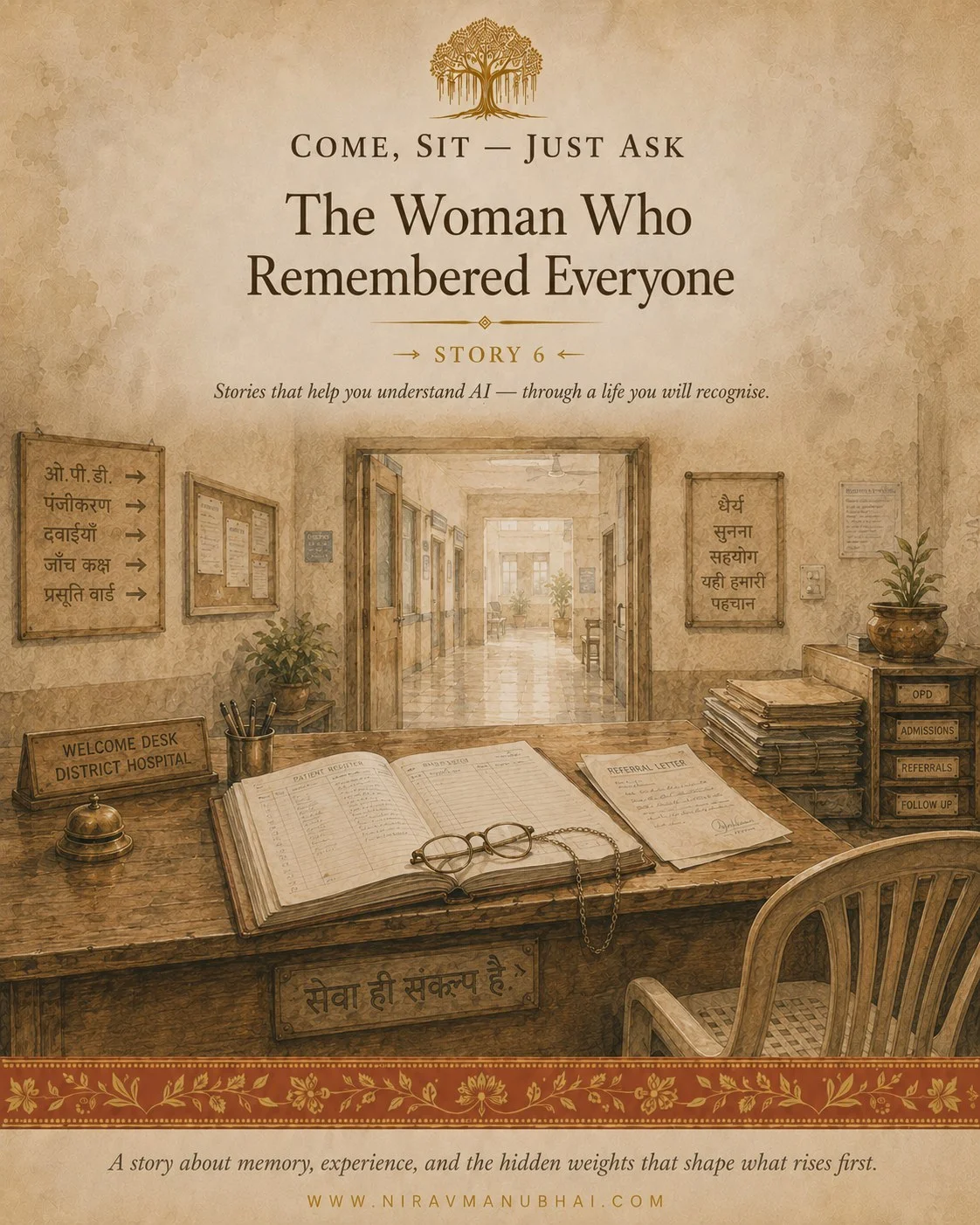
By the time they reached Shanta's desk, they had already walked through two sets of doors and a long corridor that smelled of disinfectant and floor wax. They had already had a few minutes with whatever they were carrying. By the time they reached her, the carrying had begun to show. Shanta was a small woman with reading glasses she wore on a chain around her neck and a habit of setting both palms flat on the desk when she was listening carefully — as if she were drawing something up through it from the ground below. She remembered everyone.
Not their names, necessarily — names were in the register. What she remembered was harder to describe and more useful. The weight people carried when they arrived. The particular stillness of someone who was frightened, as different from the stillness of someone who was merely worried as a held breath is from an exhaled one. What a hand placed on her counter told her that the face was carefully not saying.
The ones she thought about longest were not the dramatic cases. They were the quiet ones. A father came in alone one Tuesday afternoon and sat for a moment in the plastic chair beside her desk before approaching. When he reached the counter, he said nothing. He simply placed a referral letter on the surface between them and waited. She had seen, before she read a single word, what kind of letter it was. Not from the envelope.
From the way he had set it down — a particular gentleness, as though the paper itself needed to be handled carefully. She processed his paperwork and told him where to go. Standard procedure. But before he turned to leave, she said one thing. She did not remember afterwards exactly what it was. Something small. Something that acknowledged, without naming, what the letter contained. He stopped. He turned back. He looked at her for a moment. Then he nodded and went. She thought about him for years after. Not about what happened to him — she never knew. About that moment of being seen. About how little it had cost her and how much it had seemed to matter.
Over thirty-one years, she developed something she could not name and did not try to. When a person arrived at her desk, she received them — all of them, not just what they presented. The speed of their breathing. Whether they had come alone or with someone, and if with someone, whether that person was a comfort or an additional weight. The state of their hands. Whether they looked at her or past her. All of this arrived in her simultaneously, the way light arrives — not piece by piece but all at once, the whole room illuminated in the same moment.
She did not analyse it. She received it. And from that receiving, something rose — a sense of what this particular person, in this particular state, needed from the next thirty seconds. Sometimes it was efficiency. Sometimes a moment of being seen. Sometimes the information delivered without softness, because this person needed to be treated as capable and softness would have felt like condescension. She was not always right. But she was right far more often than chance explained. In her thirty-first year, a younger colleague asked how she always seemed to know. Shanta thought about this for a long time.
I don't know, she said finally. I think I have seen enough people that I recognise something without knowing what I am recognising.
Not everything Shanta received stayed equally inside her. The father with the referral letter — she still thought about him thirty years later. A hundred ordinary interactions had not settled as deep as that one Tuesday afternoon. It was the same way a piece of music stops you. Once, in the staff room, a song played on the radio — an old film song from her youth. She had not heard it in twenty years. But the moment the first note played, she was not in the staff room.
She was back at the desk, watching a young mother hold a newborn, the exact same way the mother had held her child thirty years ago. The song had pressed deeper than the years. It was the same with the people. The quiet ones, the ones carrying the most, the ones whose stillness had a particular quality — these pressed deeper. They changed the shape of what came after. They rose more easily when a similar moment arrived. The father was not the only one.
There were others she still carried — not as memories exactly, more as weights she had absorbed, that now lived inside the way she saw.
Now — what is AI? Weights is the word. Not weights like stones. Weights like the father with the referral letter — the things that press deeper and rise first. Not everything AI received stayed equally inside it. When AI learned — through millions of questions, adjusting and trying again — some things pressed harder. They came up again and again, from many people, in many ways, and each time they were confirmed, they pressed a little deeper. They rose more easily the next time something similar arrived. Other things came up rarely, or led to answers that were wrong, and faded.
They are still there — but they do not rise first. This is exactly what happened inside Shanta over thirty-one years. The father pressed deeper than the routine cases. Not because she chose to remember him. Because the weight of what he carried was unusual, and the recognition was strong, and what rose in her when she saw him changed what rose in her when she saw someone similar afterwards. That is your weights. AI has the same — built from everything the human race has ever written and asked and answered. The things said most often, most clearly, most consistently — those pressed deepest.
Those rise first when you ask. Shanta called it experience. It is the same thing — held differently, in something that has never stood at a desk or watched a hand placed on a counter. But the principle is the same. That is enough for one story. Come, sit. Just ask.