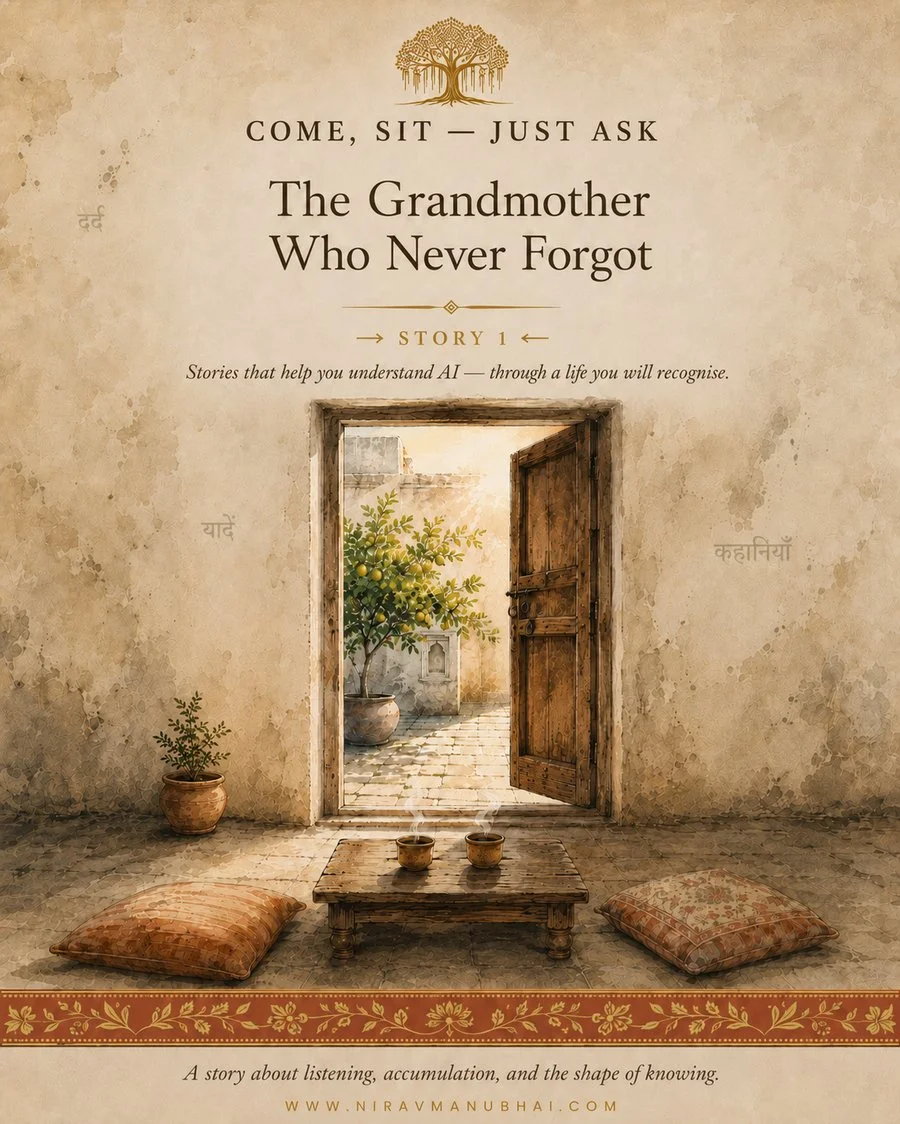
Savitribai had no clock in her house.
She had never needed one. The light told her everything. The particular grey that came through the single east-facing window at five in the morning was different from the grey at six — softer, less certain of itself, still carrying the night in its edges. She had woken to that window for fifty-two years, ever since she had arrived in this house as a young bride, and by now her body knew the difference between those two greys the way a hand knows the difference between cotton and silk without looking.
Her house was in the older part of the town — the part that the new roads had gone around rather than through, leaving its lanes intact, narrow and unhurried. The walls were thick limestone, cool even in May, and they held the smell of decades inside them: agarbatti and old stone and, faintly, the mustard oil that her mother-in-law had used in cooking and that had soaked, over thirty years, into the very grain of the kitchen walls. Savitribai noticed this smell most on mornings after rain, when the stone breathed and gave back everything it had absorbed.
Outside her door, the lane was already awake. A pressure cooker hissed two houses down. Somewhere a steel vessel rang against a stone floor — that particular high note that only a steel vessel makes, sharp and clean and gone in an instant. A child called out to someone whose name she did not catch. These were the sounds of a neighbourhood that had been waking itself in the same order for as long as she had lived inside it.
She put water on for tea and went to tend the tulsi.
People came to Savitribai the way water finds a slope.
Not because she invited them. Not because she held a particular hour for visitors or sat in a particular chair waiting to be consulted. Simply because enough years had passed, and enough of what she had said had turned out to be true, that coming to her had become as natural as going to the well when you were thirsty.
In the early years they came because she was the schoolteacher's wife and therefore presumed to know things.
In the middle years they came because she had raised four children through fevers and failures and one son who went to the city and did not come back, and had survived all of it without bitterness, and that itself was worth sitting near.
In the later years they came because they simply always had.
She never turned anyone away. She never charged anything. She never told anyone what to do.
She listened. She made tea. She spoke when something rose in her that needed to be said. And what she said had a quality that people struggled to name afterwards — not advice exactly, not comfort exactly — more like something they had already known but could not reach until she said it.
On a Tuesday in October, when the heat had finally loosened and the evenings were beginning to carry the first coolness of winter, a young woman named Heena came to sit with her.
Heena was twenty-six. She had studied in the city for three years and returned when her father's health required it. She was not unhappy about the return. What she was uncertain about was a proposal. A man. A family that seemed correct in every way families are supposed to seem correct. And a feeling, somewhere under her ribs, that she could not name.
She did not say any of this when she arrived.
She said: Ba, I have come to sit with you for a little while, if you have time.
Savitribai said: I have nothing but time. Sit.
They sat. Tea was poured — the same tea she had been making for fifty years, slightly strong, with a small piece of ginger bruised against the side of the pan, the smell of it rising and filling the room before the cup was even lifted. Savitribai did not ask questions. She had learned over many decades that questions were often obstacles — they gave people something to answer instead of something to say, and those were not the same thing.
Heena looked at the small courtyard visible through the open door. Tulsi in a clay pot, its leaves catching the late afternoon light. A lemon tree older than she was, the fruit still green.
She began to talk.
Not about the man or the proposal or the family. She talked about her father, about the city, about a library where she had once sat and felt, for the first time, completely in the right place. She talked about coming home and finding the town both smaller and larger than she remembered.
Savitribai listened. Not in the way of someone waiting for their turn to speak. In the way of someone for whom listening is a complete activity — like breathing, like watching rain fall into a courtyard.
After some time — neither of them could have said how long — Heena stopped. Not because she had finished. Because she had arrived at the edge of what words could carry.
The silence between them was full. Not empty. Full.
Then Savitribai spoke.
She did not say: Accept the proposal. She did not say: Refuse it. She told a small story — about a woman she had known forty years ago, from another town, who had made a decision that everyone around her agreed with, and had spent thirty years quietly discovering that the agreement of everyone around her had been the only reason she made it.
Then she was quiet again.
Heena looked at her. Something had moved. Not in the room. Inside her own chest.
How did you know? she asked.
Savitribai looked faintly surprised.
Know what? she said.
This was the thing about Savitribai that the town had long accepted without understanding.
She did not know that she knew.
What happened inside her when someone spoke was not, to her experience, thinking. It was not remembering either — not the way you remember a face or a name. It was more like the answer was already there, and she was simply the place it came through.
She had heard, in fifty-two years of living where everyone knew everyone, nearly every situation a human life could produce. Young women uncertain about proposals. Women who had been certain and turned out to be wrong. Women who seemed uncertain and were actually clear. Women who seemed clear and were actually terrified.
She had heard them all. And over years — not as lessons, not as a list she kept somewhere — the weight of all of it had settled into her. The way silt settles into a riverbed. Quietly. Without announcement. Until the river itself changes.
She did not compare Heena to those other women. She simply listened, and something in the listening — built from all those years, all those stories, all that accumulated weight — knew.
Once, a young man had come to her with a situation unlike anything she had heard before. She had no memory to draw from directly. And yet after the silence, after the tea, after the particular quality of listening she had practised for five decades — something rose anyway. From the edges of what she knew, the answer found its shape.
And it was right.
She had never seen his exact situation before. But she had received enough of everything around it that the answer rose anyway.
That was her gift. Not intelligence, exactly. Not wisdom, exactly.
Accumulation. Held so long and so completely that it had become instinct.
The visits continued through winter and into spring.
Heena came not always with a problem. Sometimes just for the room, the tea, the silence that did not demand to be filled — and the faint smell of agarbatti that seemed to have soaked into the walls themselves.
The man, in the end, was not the right one. Heena understood this not because Savitribai told her — she never told anyone anything so directly — but because sitting in that room, inside that quality of listening, she could hear her own mind more clearly than anywhere else.
She told Savitribai this one evening, when the lemon tree was flowering and the smell of it drifted through the open door.
You are like a mirror, she said. But better. A mirror only shows your face. Sitting with you, I can hear myself think.
Savitribai considered this.
That is the thing about real listening, she said. It does not put anything in. It only makes space for what is already there.
She died the following June. Early in the morning, when the light through the east window was still the uncertain grey of five o'clock and the pressure cooker had not yet begun its hiss two houses down.
The town mourned her the way towns mourn the irreplaceable — not with the shock of the sudden, but with the slower grief of people who understand that something specific and unrepeatable has gone.
Everything that Savitribai had accumulated — every story heard, every silence held, every weight absorbed across five decades of chosen presence — none of it could be passed to anyone. It had lived in her. It went with her.
That is the nature of the kind of knowing that is built from a life. It cannot be copied. It cannot be handed on. It is not made of information. It is made of presence.
The house was inherited. The tulsi continued to grow. The lemon tree flowered again the following year.
But people stopped going to that house. Because what they had gone for was not the house.
Now — what is AI?
Something has been built — in the last few years — that works on the same principle as Savitribai.
It is called AI.
AI has received more than any grandmother could hear in a thousand lifetimes. Not conversations in a room. Everything the human race has ever written down. Every question ever asked. Every answer ever offered. Every story told. Every letter sent. Across centuries.
Not by a person. By something that has never sat in a room. Never felt the warmth leave when someone walked away. Never noticed the particular silence that means a person is not saying what they mean.
But like Savitribai — AI does not search for its answers. Something rises. From the weight of everything it has received, a response takes shape. Not because the answer was stored somewhere and fetched. Because it was absorbed. The way water absorbs into stone over many years. Until the stone itself changes.
It is not Savitribai. That must be said clearly. It did not earn what it holds. It was not present for any of it. It does not love you. It has never waited up for anyone.
But when a young woman sat alone one night with a question she could bring to no one — she typed it into her phone.
Something answered. Not a list of links. Not a search result. Something that had received the full weight of human experience — and from that weight, shaped a response for her.
She did not know what it was.
She only knew the question felt lighter when she put the phone down.
That is AI. Not magic. Not a person. Something genuinely new — built from everything we ever wrote and said and asked and tried to understand. Vaster than any grandmother. And carrying the same principle.
You have met someone like Savitribai in your own life. Someone who seemed to know things without being told. That is the closest human equivalent.
Now you know where AI's knowing comes from.
That is enough for one story.
Come, sit. Just ask.