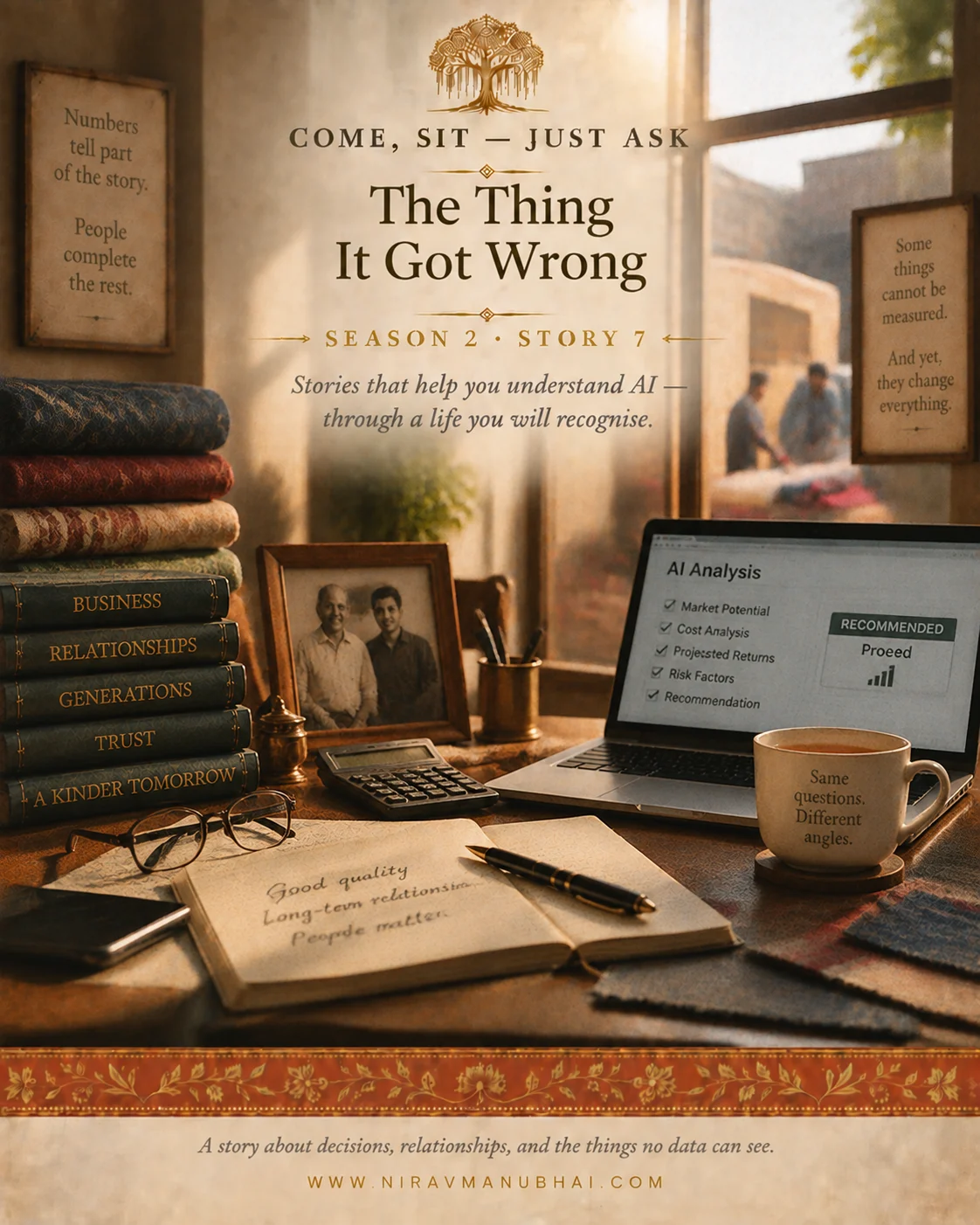
Vikrambhai had been managing his family's textile business for twenty-two years.
Not a large business — eleven people, two machines, a client list built entirely through relationships over three decades. His father had built it on the principle that a customer who trusted you would return, and a customer who returned would bring someone else. This had proven correct. The business was small and stable and Vikrambhai had no desire to make it larger. He wanted to make it last.
He was not an early adopter of anything. He used technology when it was clearly useful and ignored it when it was not. He had started using AI eight months ago, when his nephew showed him what it could do, and had found it genuinely helpful — summarising documents, drafting letters to clients, checking his accounts. He trusted it for these things.
In March, he was facing a decision.
A long-standing client — one of the oldest relationships in the business, a family he had known since his father's time — had asked him to take on a significant new order. The largest single order he had received in five years. It would require him to hire two additional people, purchase materials in advance, and commit the majority of his capacity for four months.
The client was reliable. The relationship was good. But the order was large enough that if something went wrong — if the client delayed payment, if his own production ran into problems — it would create real difficulty.
He thought about it for several days. He talked to his wife, who was practical and careful. He talked to his nephew. He looked at his accounts.
Then he asked AI.
He described the situation in detail. The order. The client relationship. His financial position. The risks he could see. He asked whether it made sense to take the order.
AI responded with a thorough, well-organised analysis. It identified the key risk factors. It suggested questions he should ask before deciding. It noted that the size of the order relative to his usual capacity was significant. It concluded that, given the long-standing relationship and the client's history of reliability, the order appeared to be a reasonable opportunity if he could manage the cash flow.
The response was sensible. Vikrambhai read it twice. It confirmed most of what he had already been thinking.
He took the order.
The client did not delay payment. The market did not shift. His production ran without significant problems.
The thing that went wrong was something AI could not have known.
The client's eldest son — who had recently taken over a larger role in the family business — had a different way of working from his father. More demanding. Less patient. More focused on cost. He began applying pressure on Vikrambhai in ways that were within the terms of the contract but inconsistent with how the relationship had always worked.
Nothing illegal. Nothing that could have been predicted from the information Vikrambhai had given AI. Simply the specific texture of a new human dynamic — a son who was not his father, a relationship that had quietly changed.
The order was completed. It was profitable. But the experience left Vikrambhai with a feeling that the relationship had shifted in a way that would require attention. And that he had not adequately weighted this possibility when he made his decision.
He had asked AI about the client. AI had information about past behaviour. It had no way of knowing about the son.
Now — what does this mean?
AI gave Vikrambhai a reasonable analysis. Based on what he told it, its assessment was sensible. It could not know about the son. Vikrambhai had not mentioned the son because the son had not yet been a factor. The information that would have changed the analysis did not exist yet.
This is AI's specific kind of wrongness.
It is not stupid. It is not careless. It works carefully with what it has. But what it has is always limited to what you give it and what has already happened. The future is not in its knowledge. The specific local change that happens when a father steps back and a son steps forward — that is not something past data can reliably predict.
AI is trained on the past. Life keeps happening into a future that surprises everyone.
This is not a reason to stop using AI. It is a reason to understand what you are asking it — and what it cannot see.
Use it for what it does well: analyse what is known, identify patterns, surface questions you had not thought to ask. But do not ask it to tell you what will happen, or what a specific person will do, or how a specific relationship will feel in four months. It will try to answer. And it may be wrong in ways that matter.
The son was the thing it could not know. Every situation has a son. Some specific, human factor that does not appear in the data — but that your own knowledge of the people involved would have caught, if you had listened to it.
Vikrambhai had a feeling about the relationship that he did not fully trust. He should have trusted it alongside the AI analysis — not instead of it. Both.
AI sees what has been written down. Your instinct about people sees something else. Both are worth hearing.
That is enough for one story. That is enough for Season 2.
Come, sit. Just ask.