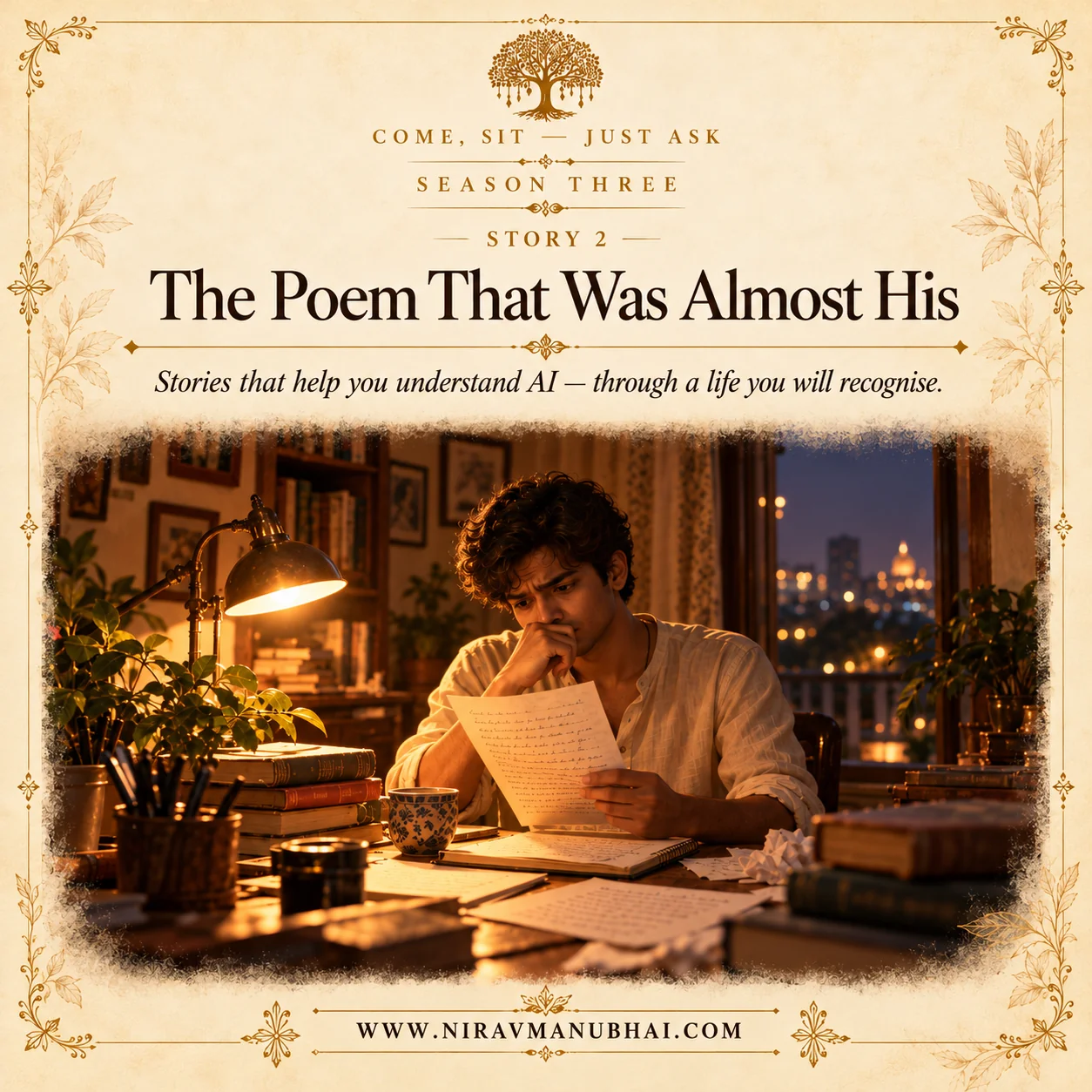
Devang was twenty-three and had been writing poetry since he was fourteen.
Not well, at first. Not well for a long time. The early poems were heavy with feeling and light with craft — too many adjectives, too much longing, not enough precision. He had filled three notebooks with them before he was nineteen. He had shown them to no one. They were not for showing. They were for the act of making — the slow, frustrating, occasionally electric process of finding the exact word for a feeling that had no exact word.
He had studied literature in college. He had read widely. He had learned, slowly, to cut. To trust the image over the explanation. To let a line end where it ended and not reach for one more adjective to make it safer. His poems at twenty-three were not the poems of a master. But they were his. He knew them the way you know your own handwriting — not because they are beautiful but because they came from your hand.
He lived in a small flat near the university where he was finishing his master's degree. His window looked onto a lane where a chai-wallah set up at six in the morning and a woman walked her dog at seven in the evening. He wrote in the early morning, before the lane filled with sound. Two hours. A notebook. A pen. The specific silence of a mind trying to catch something that moved.
He had begun using it in his second year of master's. For research, at first. For finding a reference. For understanding a critical essay that was written in language so dense it seemed designed to exclude.
This was useful. He did not question it.
Then a friend showed him something. You could bring it a half-formed line and it would offer you ten directions. You could give it an image and it would give you back five ways of holding it. You could say: I want to write about my grandfather's hands but I cannot find the angle — and it would find the angle. Or three angles. Or seven.
Devang tried it. The suggestions were good. Sometimes better than good. Sometimes they were exactly what he needed — the door he had been walking past without seeing.
He used it carefully. As a spark. A beginning. A way into a poem he already half-knew.
Then, slowly, the using grew. Not dramatically. Not all at once. A line here. A stanza there. An image he liked but couldn't make work — he would describe it and receive it back, shaped, ready, almost his.
The poems improved. His professor noticed. His friends noticed. He was invited to read at a small gathering. The poems were good. They were, by any measure, better than what he had been writing alone.
He told himself this was collaboration. That all writers used tools. That the pen was a tool, the typewriter was a tool, and this was a tool.
He believed this. Mostly.
The evening that concerns this story was a Thursday in February.
He had written a poem. Or made a poem. Or assembled a poem. He was not sure which verb was correct and the uncertainty sat in his chest like a stone he could not swallow.
The poem was about his grandmother's kitchen. The smell of mustard seeds in hot oil. The specific sound of her voice calling him from the other room — not his name exactly, but a shortened version that only she used. The quality of afternoon light through a window that had not been cleaned in years and had developed its own softness.
It was a good poem. He knew it was good. Three of the images were his — the mustard seeds, the shortened name, the light through the unclean window. Two of the transitions had come from the suggestions. The final line — the one that made the poem land, the one that turned it from description into something felt — had arrived in a conversation at two in the morning, when he had typed: I need an ending that holds all of this without explaining it. And the answer had come. And he had read it and thought: yes. That. Exactly that.
He had changed one word. One. The rest was as it had arrived.
He sat with the poem that evening. He read it aloud. It was beautiful. He felt the beauty of it. And underneath the beauty, something else. A small, persistent question he could not put down.
Which part was his?
Not the images — those were his. Not the feeling — that was his. But the architecture. The movement. The final line that made everything land. Was that his? He had chosen it. He had recognised it. But he had not found it. He had not sat with the blank page for three hours pulling it out of himself the way he had pulled every line of every poem in those three early notebooks.
He could not tell where he ended and the help began. That uncertainty stayed with him long after the reading. The poem was good. The poem was almost his. And the almost was a room he did not know how to live in.
He did not write anything the next morning. Or the morning after.
On the third morning, he opened the notebook. He uncapped the pen. He wrote four lines. They were not good. They were clumsy and uncertain and reached for too much. But they were his. The page still held all the crossings-out and the hesitations. He could see where he had begun again, and where he had decided to leave a line alone. He knew they were his the way you know your own face in a mirror — not because it is beautiful but because it is the one that came from you.
Now — what does this mean?
Devang had made a good poem. He had done nothing he needed to hide. The poem was good. The feeling was real. The grandmother's kitchen existed and the mustard seeds were true and the shortened name was true.
But that evening he sat with the poem and could not tell which lines had cost him something and which had arrived without cost. The uncertainty stayed.
Devang wanted to know what part of the making he could still recognise as his own. Which lines were his. Which hours were his. Which failures were his. He had learned to love even the failures — three hours of nothing before a single line finally came. Those hours belonged to his life as a writer.
He did not know yet what he would do. Whether he would bring the four clumsy lines to the familiar place, or sit with them alone until they grew. Both roads were open.
But the next morning he woke early, and he did not reach for the phone. He made chai. He sat with the notebook. And the four lines were still his. Clumsy. Uncertain. His.
Think of something you have made recently. A letter. A meal. A decision. A sentence. Do you know which part is yours? Does it matter to you?
The answer is yours. No one else can give it to you.
That is enough for one story.
Come, sit. Just ask.