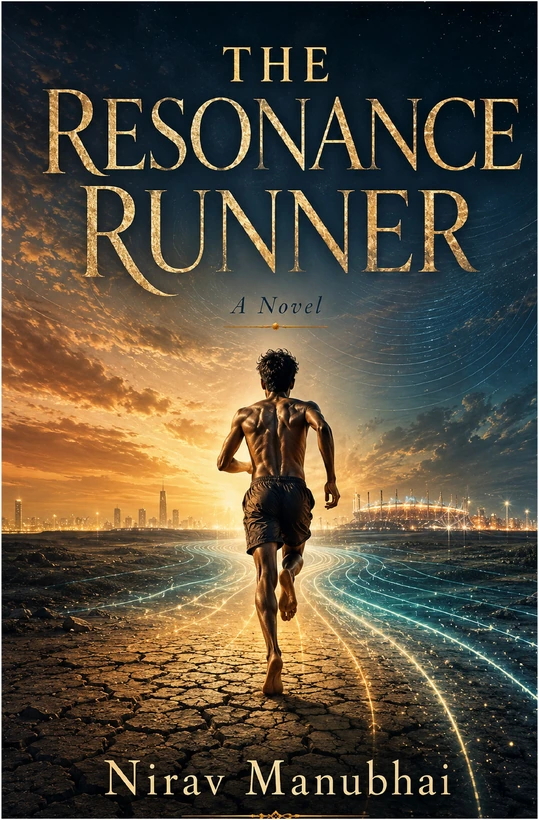
His name was Dhanush, and he ran because the earth asked it of him. He ran on a riverbed that hadn't seen true water in three monsoons — a wide, cracked expanse of pale, fractured clay, etched with the memory of a river's flow. He ran barefoot, the soles of his feet leathery and wise, reading the text of the land: the smooth patches, the sharp stones, the treacherous, crumbly edges. He didn't measure distance in meters or miles, but in stories. From the ancient neem tree where the village elders gathered to gossip, to the rusted skeleton of the old John Deere tractor, was the length of one full folk song, the kind his mother hummed while rolling chapatis. From the tractor to the shrine of the local goddess was a haunting ballad of love and loss.
Above him, on the raised embankment road that cut through the hills like a careless scar, a white SUV was parked, gathering a fine layer of red dust. Inside sat Arif Khan, a man whose body was a museum of past glories and current aches. His right knee was a ruin, a complicated map of pain from a parachute landing gone wrong twenty years ago. His shoulders, once broad and powerful enough to pull him through championship swimming lanes, now only remembered the ghost of that motion. Retirement was a quiet, persistent boredom.
Out of sheer, mind-numbing habit, Arif picked up the handheld speed gun on the passenger seat. He pointed it idly at a lumbering truck groaning up the hill. 42 kilometres per hour. He grunted. Then, his gaze drifted downward, to the human speck moving with impossible fluidity across the lunar landscape of the riverbed.
He pointed. Clicked.
The digital display blinked, then settled on a number that made Arif's breath catch in his throat.
32.7 kilometres per hour.
Over broken ground. Barefoot.
"Impossible," he whispered to the empty car. A calibration error. A trick of the dust-hazed light. He fumbled for the door handle, his bad knee protesting with a sharp stab as he climbed out. He half-slid, half-stumbled down the steep, rocky embankment, each jarring step a fresh insult to his joints.
Dhanush saw the stranger descending like a clumsy avalanche and slowed to a stop, his chest rising and falling in smooth, powerful bellows. He was lean, all long limbs and taut sinew, his skin the color of roasted almonds. He watched Arif with the wary curiosity of a wild creature.
"Why are you here?" Dhanush asked, his voice younger than his body suggested. "This is not a road."
Arif didn't answer. He just stared, his coach's eye — an eye that had seen a thousand boys try to become men on tracks and in pools — taking inventory. The phenomenal drive from the hips. The relaxed, efficient swing of the arms. The foot strike that was less a strike and more a kiss, a quick, precise contact before the earth was left behind. It was a dialect of speed he had never seen written in any training manual. It was primal, born of necessity and open space, not of synthetic tracks and starting blocks.
"Run again," Arif commanded, and the old parade-ground authority flooded back into his voice, momentarily drowning the pain.
Dhanush frowned. "Why?"
"Because," Arif said, his voice trembling with a sudden, fierce emotion he couldn't name, "I have to be sure I'm not dreaming. That I haven't finally gone mad from this damn quiet."
A slow, bright smile broke across Dhanush's face. It transformed him from a serious, focused runner into a boy. Without another word, he turned. And then he exploded.
It wasn't the start Arif was used to — the coiled tension, the explosive push from blocks. It was a seamless transition from stillness to fluid, devastating speed, as if he had simply decided to stop being here and start being there, faster than the eye could properly track. He became a blur of motion, a brown streak against the pale clay, devouring the distance to the neem tree.
Arif didn't need the gun now. His heart hammered against his ribs. He had spent a lifetime looking at potential, recognizing the raw material of greatness. What he was seeing was not potential. It was the thing itself, waiting only to be shaped, to be directed. And Arif felt it — not in the data, but in the ruined map of his own knee. A faint, forgotten tremor, like an echo of a pulse he once knew.
When Dhanush loped back, barely winded, Arif wordlessly pulled out his cheap, government-issue smartphone. He pressed it into the boy's dusty hand.
"My number is saved. Call me tonight. At seven. Not a minute later."
Dhanush looked at the device as if it were a strange, smooth stone. "My father — he says I have to study. That running is for goats and fools."
Arif placed a heavy hand on the boy's bony shoulder. He looked him directly in the eyes. "Your father is a wise man who wants the best for you. But listen to me now. You are done studying to be a small man in a small room. Your classroom is here." He gestured to the vast, empty sky, the endless riverbed, the towering hills. "You are now a student of the sky. And I will be your teacher, if you'll have me."
He turned and began the agonizing climb back to the road, leaving Dhanush standing alone in the riverbed, holding a phone that felt less like a tool and more like a key to a door he never knew existed.
After Arif's jeep disappeared in a curtain of red dust, Dhanush stood on the embankment road a long time. The phone in his hand felt fraudulent. He was sixteen years old and had never owned a phone. He had never been given anything by a stranger.
He walked back to the village slowly, turning the device over and over in his fingers.
His cousin Rajesh was sitting on the charpai outside their shared compound wall, eating a mango with the focused pleasure of a man who owned the world. Rajesh was eighteen. He worked at the flour mill in the next town and came home every Sunday with money and opinions. He had a phone. A real one, not government-issue, with a cracked screen he'd paid to have fixed twice.
"What is that?" Rajesh said, eyeing the handset.
"A man gave it to me."
"What man?"
"He saw me run."
Rajesh laughed — not unkindly, but with the full, practised condescension of the older cousin. "Running. People run everywhere. You know what they don't do? Give you phones for it." He bit off a slab of mango. "Did he ask for anything?"
"No."
"Then be careful. Men don't give things for nothing, Dhanush. Not even madmen."
Dhanush said nothing. He put the phone in his pocket.
That evening, his father came home from the fields with the particular stoop of a man carrying invisible weight. He washed his hands at the tap, dried them on his dhoti, and sat down without looking at anyone. His mother placed rotis before him. The silence at the table had its own grammar, built over years — it said: we are tired; we are here; that is enough.
Dhanush watched his father eat. The rough hands, the sun-darkened neck, the way he chewed slowly, as if even that required conservation of energy. His father had wanted him to study. Not out of ambition — he had no language for ambition — but out of fear. Fear that without education, Dhanush would inherit this exact table, this exact silence, this exact stoop.
Dhanush thought: I don't want to inherit it either. But I also don't want to leave it behind. I want to take it with me somehow. I want to run so fast that I arrive at a place where the stoop is not necessary. And then come back and show him.
He almost said this aloud. Instead, he asked his mother for more dal and kept the phone hidden.
Later, alone on the roof under the vast indifferent sky, he pressed call. Not because the stranger deserved his trust. Because something in the man's broken, hopeful face had recognized something in his own chest. A frequency. A vibration like a string pulled tight.
He would not examine it too closely. He would simply answer and see.
The line connected on the first ring.