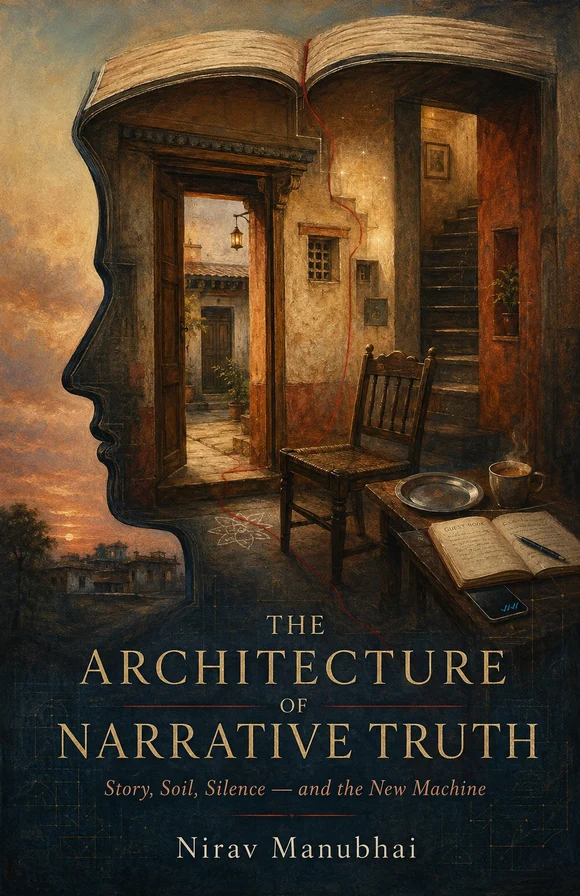
For a long time, I had no reason to call myself a writer. I had work. Work has its own vocabulary. Targets. People. Problems. Decisions. Seasons. Money. Meetings. Deadlines. Responsibility. You can spend decades inside work without ever thinking of it as narrative. And perhaps that is healthy. Nobody needs a storyteller standing in the corner of every meeting thinking about symbolism. Most days need to be lived before they are interpreted.
But looking back, I can see that something was happening long before I wrote stories. I was watching. I was watching people. Not consciously. Not as a technique. I was interested in the distance between what something claimed to be and what it became when actual human beings entered it. A process looked perfect on paper. Then a person had to carry it. A policy appeared reasonable. Then it reached the floor.
A strategy made complete sense in the room where it had been designed. Then it met weather, fatigue, ego, fear, pride, habit, memory and the small private calculations human beings make before agreeing to anything. That distance interested me. It still does. Perhaps that is one reason soil has remained important in my life. Soil has very little interest in presentation. You can call a field fertile. The crop will give its own opinion.
You can prepare a beautiful plan. The roots will still encounter what is actually there. Compaction. Moisture. Salt. Life. Absence. Things above the surface may look similar while completely different conditions are operating underneath. There is something about that which has always felt familiar to me. Organisations are like that too. Families are like that. People are like that. The visible thing is rarely the whole thing. I do not want to force the metaphor too far.
Soil is soil. A boardroom is a boardroom. One of the easiest ways to damage a metaphor is to become too pleased with it. But they did teach me the same discipline. Do not assume the surface has told you enough.
Look again.
That was probably the beginning. Not writing. Looking again. There were people I met whose behaviour remained with me long after I had forgotten the agenda of the meeting. A person who spoke very little but whose silence changed the room. Someone who carried a responsibility nobody else seemed to notice. Somebody who repaired what was broken and then quietly moved on to the next thing. A family member whose gesture at a table said more than the conversation.
A sentence delivered casually that revealed an entire relationship. A person reaching for a glass. A pause before an answer. A door held open. A name avoided. A bill paid. A plate placed. A chair left empty. At the time these were not “material.” I am grateful for that. The moment we begin treating life primarily as material, I think we lose something important. People become useful to the writer.
That is a dangerous arrangement. I prefer to think that life happens first. Sometimes, much later, something survives. That survival interests me. Why this gesture and not another? Why do I remember the plate but not what we ate? Why a sentence but not the conversation around it? Why the red line? Why the door? Why the question in the guest book? Memory is selective in ways I do not fully understand.
It is also unreliable. We will come to that later. But as a finder of stories, memory does something interesting. It keeps certain objects on the table. Years pass. The object remains. Perhaps a story has been waiting beside it. I did not know that then. I only knew that some things stayed. Writing came later. And when it came, I did not begin by announcing a literary project.
I wrote. Then I wrote again. Some pieces were observations. Some became fables. Some needed mystery. Some needed almost nothing. As the work accumulated, I began to notice another problem. The stories did not all want to live in the same form. This may seem obvious now. It was not obvious to me then. A three-hundred-word observation could not be treated like a three-thousand-word commissioned story. A chamber mystery written for WhatsApp could not breathe like a printed novel.
A note about attention and technology did not want the machinery of fiction. A difficult idea about artificial intelligence did not want technical explanation. And occasionally a story arrived simply because a particular day deserved one. I could either force all of them into one publishing stream or listen to what each form was asking for. The second choice eventually created rooms. STILLS became one room. Axiom another.
Kabir Vaidya another. Come, Sit — Just Ask. The Quiet Signal. House Specials. At first, these names described categories of work. Over time they became disciplines. Each developed rules. Not rules imposed from theory. Rules discovered through failure. That distinction matters to me. A rule discovered because a story broke in your hands feels very different from a rule copied from a textbook. STILLS learned that the moment we explained the observation, the observation lost power.
So the form became stricter. Find the Tell. Let it be physical. Let it be something a camera could have captured. Do not tell us what the gesture means. Then hold up the Mirror and step away.
The discipline became:
Observe. Reveal. Step back.
Axiom learned something else. Companies are surrounded by language about themselves. Values. Mission. Vision. Quality. Innovation. Excellence. The words may be sincere. The problem is that they are conclusions. Stories do not like beginning with conclusions. So Axiom began asking a different set of questions. What invisible burden do the best people here carry? What decision does nobody see? What standard is protected before anyone notices? What lonely moment defines the profession?
What does an insider understand that the outside world does not? The story begins there. Not with the value. With the human cost of protecting it.
The evolved Codex eventually reduced the movement to four stages:
Invisible experience.
Story.
Recognition.
Residue.
I like that because it keeps the company out of the way long enough for the human being to arrive. The employee should recognise themselves before they recognise the organisation. That is a subtle difference. It is also the difference between propaganda and dignity. Kabir Vaidya came with another lesson. I had thought the interesting part would be reading bodies. The hand. The breath. The eyes. The shoulder.
The tiny physical betrayal arriving before language has organised its defence. That remained interesting. But the series changed. A method that only succeeds becomes a trick. A witness who only observes eventually becomes morally comfortable. So the rooms began turning. The person became the system. The system became the choice. The choice became distance. Kabir began to discover that seeing clearly does not tell you what to do.
There are rooms in which non-judgement is wisdom. There are rooms in which it is an alibi. There are moments when staying still is the discipline. There are other moments when staying still becomes the most consequential decision in the room. The series had begun by asking whether the body betrays the person. It grew into a question about what witnessing costs. I did not plan that at the beginning.
I am glad. If the writer already knows everything the character will teach them, the character may not be alive enough. Come, Sit — Just Ask made me confront another habit. We equate understanding with vocabulary. Especially around technology. We believe that if we introduce the correct terms in the correct order, understanding will follow. Sometimes it does. Often it produces a person who can repeat the vocabulary without possessing the idea.
So that room made a severe rule. No technology words inside the story. No algorithm. No model. No token. No parameter. No neural network. No brand. No company. Find the human equivalent. A grandmother. A cook. A postmaster. A well. A grain store. A map. A pattern. A remembered route. If I cannot explain the idea without hiding behind the technical word, perhaps I do not yet understand it well enough myself.
That is not only an AI lesson. It is a writing lesson. Technical vocabulary can hide weak understanding. So can literary vocabulary. So can business vocabulary. A complicated phrase may sometimes be necessary. It may also be furniture placed in front of a door we are afraid to open. The Quiet Signal taught me yet another distinction. Information and judgement are not the same resource. Information has become abundant.
Attention remains finite. AI can increasingly help us find, summarise, generate, compare and retrieve. That does not automatically tell us what deserves our attention. The Field Notes therefore begin with ordinary observation. Not the big idea. Observation first. Reflection second. Writing third. AI is not the protagonist of that room. It is the weather. The question is what becomes more important about human judgement when intelligent machines are present everywhere around it.
And House Specials taught me something I should perhaps have understood much earlier. A story can be hospitality. It does not always have to arrive because the publisher's calendar says Tuesday. It can be waiting because the host noticed the day. The story can begin before the text begins. A twenty-second voice. One image. Then the words. Not announcement. Welcome. Not audience. Guest. The difference sounds cosmetic until you build around it.
Then it changes everything. By the time these rooms existed, the House itself had become part of the thinking. A website can be treated as a container. Pages. Menus. Links. Traffic. Or it can be treated as architecture. A courtyard. Thresholds. Reading Rooms. Stories. A bookshelf. A study. Places one enters deliberately. The original assessment of my work noticed this before I had fully named it myself: the House was not merely visual design. The spatial structure was changing the reading behaviour.
That mattered. Because much of the modern web teaches us to move quickly. Scroll. Swipe. Refresh. Next. The House increasingly asked for the opposite. Enter. Sit. Read. Return. I do not romanticise slowness. Sometimes fast is exactly right. A STILL must move. A Kabir episode must defeat the thumb. An Axiom story has to respect the fact that somebody is reading on a phone between two parts of a working day.
But respecting speed is not the same as worshipping it.
Compression is not hurry.
A short sentence may have taken an hour. A three-minute story may contain thirty years. That is another reason I wanted to write this book. The forms I was working in had begun teaching me things I wanted to understand more deeply. And once I started looking, other people arrived. Hemingway. Carver. Chekhov. McKee. Campbell. Vonnegut. Lencioni. Duarte. Coelho. Gladwell. The Moth. Pixar. Indian storytellers. Gujarati writers whose names readers began sending me.
Practitioners. Editors. Advertisers. Teachers. Some immediately felt useful. Some irritated me. Some seemed brilliant until I tried to apply the framework. Some became more valuable precisely because I disagreed. This was perhaps the moment the original textbook began. I wanted a map. If I am doing this work seriously, where does it sit? What have people already discovered? What structures repeat? What mistakes repeat? What can a business fable learn from literary fiction?
What can microfiction learn from cinema? What can a WhatsApp story learn from newspaper serialisation? What can a Gujarati household teach a storytelling framework designed in California? What can Chekhov teach a boardroom? What can a grandmother teach an AI explainer? What can AI teach a writer? What should the writer refuse to learn from it? The first document tried to answer these questions systematically. That was useful.
But something had changed by the time I returned to it. I no longer wanted only the map. I wanted to walk through it. That is the book you are now reading. It will still contain frameworks. I like frameworks more than my literary instincts sometimes admit. A good framework gives language to something the hands already know. It lets you diagnose. It helps when a story is failing and you cannot immediately see why.
But frameworks have a weakness. They enjoy being right. Stories are less obedient. A character refuses the role. A quiet scene carries more weight than the climax. The hero is not one person. The ending should remain unresolved. The audience does not want to be transformed. The supposed villain has the better argument. The object you thought was symbolic is simply a cup. Life enters. Architecture has to adjust.
That tension interests me. Structure without imprisonment. Craft without performance. Simplicity without shallowness. Emotion without manipulation. Meaning without sermon. Technology without surrender. Locality without provincialism. AI without worship. AI without panic. Perhaps that is what I have really been trying to understand. Not how stories work. How to make them work without damaging the truth that made us want to tell them in the first place. That is a much harder question.
It is why I am suspicious of storytelling when it becomes only a tool. We hear that leaders should tell stories. Brands should tell stories. Teachers should tell stories. Founders should tell stories. Data should tell stories. Everyone, apparently, should tell stories. Fine. But story is not automatically virtuous. A lie can have excellent structure. Propaganda understands narrative extremely well. Manipulation loves emotion. A false memory can be beautifully told.
A company can wrap an uncomfortable fact inside an inspiring story and call the result culture. A writer can take another person's pain, improve the ending and receive applause. Craft does not absolve responsibility. If anything, the better the craft, the greater the responsibility. We will spend time on that too. And then there is the machine. It has entered at a strange moment. Just as I was learning more deeply how difficult a sentence can be, we created machines capable of producing thousands of sentences before lunch.
Just as I was learning to value the precise image, images became generatable in seconds. Research accelerated. Translation accelerated. Drafting accelerated. Variation became nearly free. The blank page became less blank. This is extraordinary. I mean that sincerely. I have no interest in pretending otherwise. But abundance changes the location of scarcity. If sentences become abundant, perhaps judgement becomes more valuable. If competent images become abundant, perhaps taste matters more.
If information becomes abundant, perhaps attention matters more. If imitation becomes abundant, perhaps lived experience becomes harder currency. If a machine can sound warm, perhaps actual care requires clearer evidence. If a machine can sound like me, perhaps I need a better definition of what me means. These are not future questions. They are sitting beside the manuscript as I write it. And therefore AI will not be a fashionable final chapter added to make an old storytelling book seem current.
It belongs inside the architecture. It changes research. Drafting. Editing. Images. Translation. Audience. Authorship. Education. Children's storytelling. Serial forms. Trust. The economics of creative work. The speed at which mediocrity can be produced. The speed at which an idea can become visible. The temptation to stop thinking too early. I use it. I learn from it. I argue with it. I reject it. Sometimes it shows me something I missed.
Sometimes it confidently makes the room worse. Sometimes it gives me ten options and helps me understand that the first sentence I wrote before asking was the right one. Sometimes it tells me that something is profound when what I really need is somebody to say: No. This paragraph is doing nothing. We will talk about that problem. Perhaps at length. Because the flattering machine may be more dangerous to a writer than the critical one.
But we are not there yet. Before the machine, before the masters, before the frameworks, before the House, there was something simpler. There was a person looking. That is where I want to return before Part One begins. I sometimes imagine all the stories I must have missed. Thousands, surely. A person passes through decades of life. How many rooms? How many tables? How many railway platforms? How many fields?
How many meetings? How many arguments? How many silences? How many sentences we understood only years later? Most disappear. Perhaps they should. A life in which everything becomes story would be unbearable. But occasionally something remains. No announcement. No music. No writer present yet. Just a small thing refusing to leave. I think that is the room before the words. And if this book has a beginning before its first chapter, it is there.
Not at a desk. Not in a theory. Not in the sentence. In the moment when something ordinary happens— and, for reasons you cannot yet explain, you look again.