The Rooms
Before anything else — before the gift system, before the philosophy, before the story of how it was built — there is the House itself.
Not a website. A house. The distinction matters more than it sounds.
A website is a storefront. You visit it, you find what you came for, you leave. The transaction is the point. The experience of being there is incidental.
A house is different. A house is inhabited. It has rooms with different qualities of light. It has corners where certain kinds of thinking happen and other corners where different kinds happen. It has a feeling — specific, earned, not designed by committee — that tells you something about the person who lives there before they have said a word.
Nirav Manubhai built a house on the web. It has rooms.
Kabir Vaidya — a chamber mystery series. Kabir does not chase criminals. He watches rooms until they confess. The object nobody moves. The silence that lasts a second too long. The body that answers before the mouth is ready. Two complete seasons. Twenty Indian cities. Each episode a world complete in itself.
Come, Sit — Just Ask — a series about artificial intelligence told through ordinary Indian lives. Not through the technology. Through the lives. A grandmother who remembered everyone in her village and never wrote a name down. A cook who read thirty-eight diaries alone in a kitchen with no windows. A letter sorter in Baroda whose hands learned to read the weight of what people carry. A teacher who realised that what she brings to the classroom is not knowledge — it is the irreducible fact of a person who was once confused and found her way. Two seasons. Fourteen stories. Not one technical term.
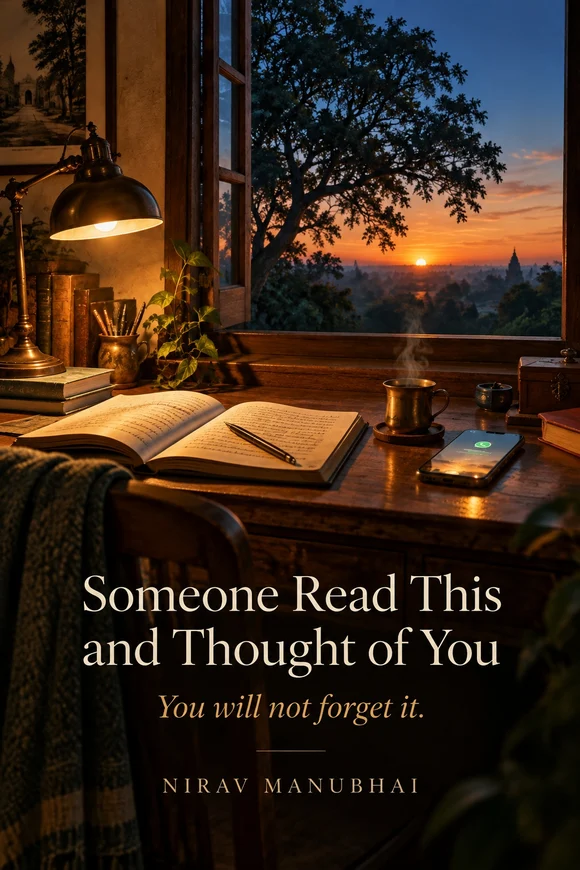
STILLS — which looks at objects and finds the human life inside them. A tea tray. A co-signed flat. A study window at dusk. The premise: a story is not always about what moves. Sometimes it is about what stays perfectly still — and what that stillness holds.
The Quiet Signal — field notes from the edge of attention. Short, unhurried observations about what gets missed when the world moves too fast. Not a newsletter. A signal — sent when there is something worth saying.
House Specials — stories that belong to no room and every room. The Witness Genre at its most personal and most free.
And many books — genre-defining work across many shelves. Sport. Soil and trees. Fiction. And the Witness Genre, which Nirav originated: the art of attending to a life or a moment with such sustained patience that what was always there but invisible becomes, finally, visible.
The rooms are different from each other. They have different qualities of light, different tempos, different things they ask of the reader who enters. But they share something — the same host, the same sensibility, the same quiet insistence that ordinary moments are worth looking at carefully.
That insistence is the House.
The Gift That Travels
On every story page in the House, below the last line and above the silence that follows it, there is a button.
It says: Gift this story.
Click it and WhatsApp opens. A message is already written — warm, specific, ready. The message contains a link. That link is unique. It belongs to this gift, from you, to the person whose name you will type. No account required on either end. No registration. No payment gateway. No delivery window. No unboxing. No receipt.
Just the message. Just the link. Just: I read this and I thought of you.
That sentence is one of the oldest sentences in human culture. Before printing, people told stories to each other by firelight. Before the postal system, they sent handwritten letters across weeks of travel. Before WhatsApp, they left books on doorsteps with notes tucked inside the cover.
The impulse is ancient. The button does not create it. The button catches it.
And when the receiver opens the link — when their phone shows them the page with the story waiting — a counter moves somewhere that they cannot see. Last sent from Bengaluru. Last read in Pune. The story was here, then it was there, then it was somewhere else entirely. The cities appear on the page like small confirmations of something most people already know: that a story, once loose in the world, goes where it needs to go.
Stories are meant to travel. The House just built the roads.
The counter below the gift button is not vanity. It is testimony. It tells the next reader: this story has already moved through the world. Other people found someone worth sending it to. You are part of something that is travelling.
The Bouquet
A single story is a gift. But what about an occasion?
A birthday that deserves more than one story. A mentor who has shaped you across many years. Someone going through a quiet time who might need three rooms to wander through, not one.
The Story Bouquet is three stories curated around a single feeling. Three rooms from different corners of the House, chosen to belong together the way flowers from different stems belong together in the right arrangement.
The Bouquet of Observation — for the person who notices what others miss. The Bouquet of Curiosity — for the restless mind. The Bouquet of Connection — for someone far away.
The sender chooses the occasion. The stories are already chosen — by Nirav, not by an algorithm. The gift travels on WhatsApp. The receiver lands on a page with three stories waiting and a greeting:
Greetings. Someone who thinks of you has sent you three stories — chosen with care, wrapped for this moment. Enjoy your read.
No gift button on that page. No selling. No promotion. Just three stories and a path back to the bouquet between each one.
The bouquets are three today. They will grow. There will be a bouquet for someone who just became a parent. For someone who just retired. For someone who is grieving and does not need advice, only company — the specific company of three stories that understand something they are going through.
That act of curation is itself a gift.
Standing Beside a Story
Below the gift button on every story page in the House is something else. Not another button. A question.
Stand by this story. Add your name. Tell us what stayed with you.
People do this. They write three sentences. A first name. A city. Something specific about what the story left behind. Nirav. Ahmedabad. Priya. Bengaluru. Someone whose full name Nirav will never know, who read a story at eleven on a Tuesday night and felt something shift, and chose to say so.
These names appear on the story page itself — quietly, below the last paragraph, before the silence. They appear on the Patrons page, which is a roll of witness: who was present when a story passed through them, and chose not to be anonymous about it.
This is not crowdfunding. There is no money. No transaction. No subscription.
It is the oldest form of support a reader can give a writer: I was here. I read this. I am counted.
The Witness Genre is not only what Nirav writes. It turns out to be what his readers practice.