The wall clock ticked.
It had ticked through Uma's last breath.
It was still ticking.
Shantaram did not like that about clocks. Their loyalty was only mechanics. The person who made time worth measuring was gone. The clock did not care.
On the table lay forty-seven pages of pension rules. Old paper smell. Government language. Stamps. Annexures. A circular that had been amended by another circular that referred to a third circular. Written by someone who had never stood in a queue.
His left knee had begun its evening complaint.
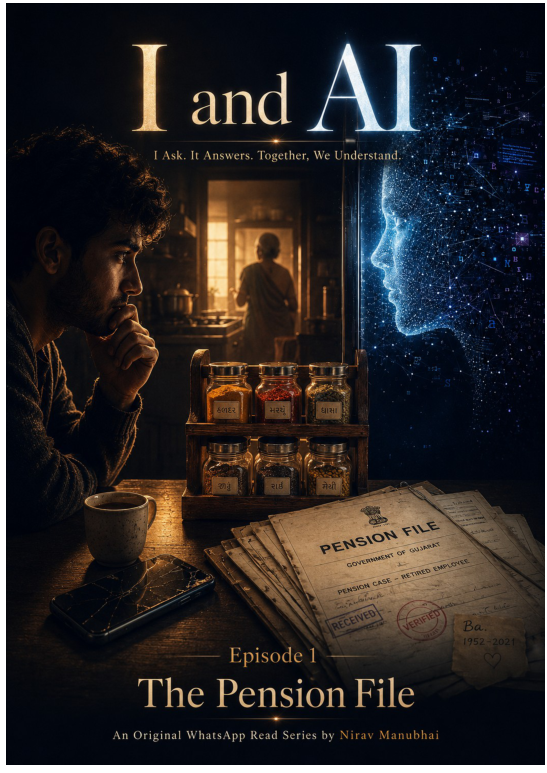
His phone screen had a crack from top left to bottom right. Two years old. Same age as Uma's absence.
He looked at the kitchen. The spice rack stood exactly where Uma had kept it. Small. Wooden. Slightly tilted. The haldi jar had a yellow ring near the lid that no amount of wiping could remove. He pulled it once; the lid resisted. He pulled again. It opened with a dry scrape against the old wooden frame, releasing the faint, bitter smell of turmeric and the memory of Uma's fingers. The machine had no sticky lids. His life did.
He remembered the sound of her grinding masala — the heavy stone pestle, three slow circles, then a quick tap to loosen the paste. He had never learned that rhythm. He had never asked.
His old colleague Sharma sent a PDF. One line: “Shantaram, my eyes are finished. Help an old man.”
Sharma's eyes were not finished. They were tired of circulars.
Shantaram opened the AI.
He typed: Summarize this PDF. Simple language. I am a retired clerk, not a lawyer. Also, my back hurts.
Four seconds later: I cannot feel your back. But I can summarize the document.
Shantaram laughed. Not fully. A dry little laugh. The kind that leaves the throat and then feels embarrassed. The neighbour across the balcony looked up from her phone. He waved. She did not wave back. She had decided that single old men who laughed at phones were a modern category best left alone.
He typed: That was not a request. That was a complaint.
The AI replied: I processed it as text.
He laughed again. This time the neighbour did not look.
The summary appeared. Three paragraphs. Clean. Confident. Words like eligibility, nomination, beneficiary, dependency certificate.
It looked correct. Correct-looking was dangerous. Shantaram had spent thirty-six years behind a bank desk. He knew the species. Correct-looking documents had eaten whole afternoons. Correct-looking forms had destroyed widows' patience. Correct-looking sentences were where mistakes hid after wearing a tie.
He read slowly.
Page 21. Retirement benefits.
Page 22. Nomination.
Page 23. Disability pension.
Page 24. Family pension.
His finger stopped.
The AI had taken a sentence from family pension and placed it inside disability pension. One word — pension — had pulled two different rooms into the same house.
He copied the summary. His finger hovered over the send button. Sharma was waiting. The evening was getting later. He could send it now and be done.
He paused. That pause — three seconds, no more — was the difference.
He typed: You mixed Page 23 and Page 24. They are not the same thing.
The AI replied: You are correct. The terms occurred near each other. I matched the pattern. I did not verify the boundary.
He sat back.
Explain how you made the mistake. Not like a professor. Like my kitchen.
Imagine your spice rack.
Small wooden frame. Glass jars. Labels written by hand. Haldi. Jeera. Dhana. Rai. Methi. Red chilli.
That rack is me. I was trained once — a long time ago, on thousands of sentences. Now I am fixed. I do not learn while you cook. I just help you find the jars.
Each label is a word. When you ask me something, I reach for the jar that seems right.
How do I know which jar is near which? Because during my training, I learned that haldi and jeera appear together often. So in my mind, they sit close. Sugar sits far away. Hing sits near dal.
When I answer, I am not remembering. I am guessing — predicting the next useful word based on what I have seen before.
Sometimes I guess wrong. A wrong answer that I give confidently — that is a hallucination. I pick cumin when you asked for coriander. Because they are neighbours on the rack. I do not know I made a mistake. I only know the jars are close.
And the thing I do not have — the missing piece — is taste.
I have never opened a jar. I have never ruined a dal. I have never had a clerk reject my form because one paper was missing.
I do not taste the difference. You do.
Shantaram read it once. Then again. Then a third time. The third reading was not for understanding. It was for something else.
He looked at the spice rack. Uma's rack. The haldi jar with its yellow ring. He had never opened that jar without thinking of her.
He corrected the pension summary line by line. The AI helped make the language simple. He helped make it true. He asked himself: Where does one rule end and another begin? Page 23 and 24 looked similar but served different widows. He drew a mental line between them.
If he had sent the summary blindly, Sharma might have filed the wrong claim, waited three more months, and blamed the government for a mistake born in four confident seconds. The difference in payment was ₹12,000. Not a number. Sharma's daughter's school fees. He had attended her admission party.
At 8:17 PM, he sent Sharma the revised note.
AI made one mistake. I caught it. Read Page 23 and 24 yourself before submitting.
Sharma replied immediately: How did you catch it?
Shantaram looked at the clock. The clock ticked.
He typed: Because I have filed these forms with real people standing in front of me. The AI has read the labels. I have tasted the consequences.
He deleted consequences. Too big for Sharma. He typed again: Because I know the difference. AI is fast. I am responsible.
He put the phone down.
The money plant near the window was dry. Uma had called it stubborn because it survived even when neglected. Tonight, it looked less stubborn and more disappointed.
He filled an old Bisleri bottle from the tap. The water hit the soil. The dry brown turned dark. One drop fell on his finger. Cool. Real. Not a metaphor.
He came back and typed one final line: You are useful. But you are not a clerk.
The AI replied: That is accurate. I can help process text. I cannot carry responsibility for someone's pension file. You can.
He smiled. The neighbour still did not look. The clock ticked. The cursor blinked. The rack stayed in the kitchen. The jars stayed labelled.
And for the first time in a long while, Shantaram did not feel replaced by something faster. He felt accompanied by something incomplete.
That was safer. That was enough.
Forwardable Line
The AI arranged the spice rack. Shantaram tasted the dal. Use the tool. Keep the consequence. Send this to someone who trusts AI too much.
The Witness Stance
Shantaram did not reject the AI. He found its limit. The machine can arrange, summarise, and label. But the pension file still belonged to a human life. Responsibility cannot be outsourced to a confident sentence.
The Millimetre Shift
He will now read any AI-generated summary twice — once for sense, once for boundaries between sections. He will ask: Where does one rule end and another begin? And before forwarding, he will pause, taste the dal, and remember the ₹12,000.