Chapter 1
The Story of Creation
"સૂરજ ઊગે ત્યારે અંધારું ક્યાં જાય?"
"When the sun rises, where does darkness go?" — Narsinh Mehta
Before We Begin: The Simplest Possible Version
Before any Sanskrit. Before any diagram. Before any story from the Bhagavatam.
Let us start with something you already know.
You Are Not Your Thoughts
Right now, as you read this sentence, something in you is aware that you are reading. That awareness is not the same as the reading itself. The reading can stop. The awareness remains.
Try it. Put the book down for ten seconds. Think about something — anything. Your morning tea, tomorrow's plan, a worry.
Now notice: something in you was aware of those thoughts. You were watching them.
That watcher — that awareness that stands behind every thought, every feeling, every sensation — is what Sankhya calls Purusha.
And everything that was watched — the thoughts, the feelings, the sensations, the body doing the reading — that is what Sankhya calls Prakriti.
That is the entire philosophy. Purusha and Prakriti. The Watcher and the Watched.
Everything else in this book is just unpacking those two words.
Three Moments You Have Already Lived
Here are three experiences you have certainly had. They are not philosophical. They are ordinary. But each one points directly at what Sankhya is describing.
The First Moment: The Name You Almost Forgot
Someone asks you: what is the name of that actor — the one in that old Amitabh Bachchan film — the one who played the villain? You know you know it. It is there, somewhere. But it will not come. You say: 'It is on the tip of my tongue.'
Now stop and look at that phrase. Tip of my tongue. You are saying: I know that I know something that I cannot currently access. Who is the one who knows that they know? That meta-awareness — the awareness of your own awareness — is Purusha. The name, the memory, the frustration, the search — all Prakriti. You, watching the search happen: Purusha.
The Second Moment: The Argument That Kept Replaying
Something happened. An argument, a misunderstanding, a moment that did not go the way you wanted. That evening, or the next morning, you found your mind replaying it. The same words, the same gestures, the same sequence — again and again. Like a film stuck on a loop.
But notice: there was something in you that knew the replay was a replay. Something that could say, even while it was happening: 'There I go again, replaying that scene.' That knowing — that observer of the loop — was not inside the loop. It was watching. That observer is Purusha. The loop — the replaying mind, the frustration, the words running again — that is Manas, which is part of Prakriti.
The Third Moment: Waking from a Dream
You were dreaming. In the dream, something frightening or worrying was happening. Then you woke. In that moment of waking — that precise fraction of a second — you knew two things simultaneously: the dream felt real, and it was not real.
Who knew both things at once? Not the dreaming mind — that was fully inside the dream. Not the waking mind — that had not yet fully arrived. Something in between. That in-between awareness, that instant of pure knowing, is the closest most people come to experiencing Purusha directly. Sankhya calls it a glimpse. Your entire practice is the art of extending that glimpse into waking life.
A Fourth Moment - Sabarmati Riverfront at 6 AM
You are walking on the riverfront promenade before the city has fully woken. The stone is cool under your bare feet. The water moves slowly. A heron stands still. Your mind is still half in sleep, half in the day ahead.
Now stop. Feel the stone - that is Prithvi. The air moving across your skin - Vayu. The warmth of the rising sun on your face - Agni. The faint smell of the river - Gandha Tanmatra. The sounds - a distant bell, a bird - Shabda Tanmatra.
And behind all of it, something knows you are here. Not the mind planning the day. Not the body feeling the stone. Something quieter.
That something is Purusha. It was at the riverfront before you arrived. It will be there after you leave. You just stopped long enough to feel it.
This is not a special spiritual experience. This is a Tuesday morning in Ahmedabad. Sankhya just gave you the vocabulary for what you already lived.
| THE 2026 MIRROR · The Bhakti Bridge: What Your Mother Already Knows Your mother does not use the word Purusha. She may not know the Sankhya Karika. But she knows something you are still working to understand. When she sits in the puja room and surrenders the outcome of a prayer — when she says, in effect, 'Tari marzi' (Your will) — she is doing what Sankhya describes in philosophical language: she is releasing Ahamkara's claim on the result. She is resting, even briefly, in something that is not the ego, not the worrying mind, not the planning self. The Bhakta calls it surrender. Sankhya calls it recognising Purusha. The words are different. The inner movement is the same. |
|---|
| ✦ Settled on a Bed of Arrows Long before any of us sat at dawn wondering whether philosophy was worth the effort, the scholars themselves were having the same argument — loudly, across centuries, in rival schools and competing texts. The Sankhya teachers said: knowledge is everything. Once you see clearly that Purusha and Prakriti are separate, you are free. The Yoga teachers said: knowledge alone is not enough. You have to practise. Understanding without doing is paralysis. Then, in the Mahabharata — that vast ocean of a text which is less a book and more a complete map of the human condition — Bhishma, the dying grandfather of the Kuru dynasty, was asked to settle the matter. He had been lying on a bed of arrows for many days, waiting for the auspicious moment to die, suspended between worlds. He spoke with the clarity that only the dying can access. 'Both systems are approved by me. If practised duly, both cause a person to attain the highest end. In both, purity is equally recommended. Only the scriptures that point to their paths are different.' — Shanti Parva He was not being diplomatic. He was stating what direct experience confirms: the head and the hands are not enemies. Knowing without doing is paralysis. Doing without knowing is groping in the dark. |
|---|
The Story of Purusha and Prakriti
In the beginning, there was only Narayana — the Supreme Consciousness — floating upon the infinite ocean of causality. This ocean was not water, but Prakriti — primordial nature, pure potential, composed of three Gunas in perfect, motionless equilibrium.
Narayana (Purusha) was complete, blissful, and alone. He had no need to create. But within him arose a desire: 'Ekoham Bahu Syam' — 'I am One. Let me become Many.'
This desire was not a lack. It was Lila — the divine play. As soon as this desire arose, Purusha glanced at Prakriti. And that glance — pure, desireless awareness — was enough to disturb the equilibrium of the Gunas. The Gunas began to churn. From this churning, the first evolute emerged: Mahat — the Cosmic Intellect. From Mahat came Ahamkara. From Ahamkara came the mind, senses, and elements — all 24 principles.
KEY: Purusha remained untouched by this creation. Just as the sun is not made wet by the water it reflects upon, Purusha is not entangled in the drama of Prakriti. It simply witnesses.
The Analogy of the Dancer and the Witness
"Prakriti is the dancer. Purusha is the witness. The dance is performed for the witness alone. When the witness has seen enough, the dancer concludes her performance and withdraws."
— Sankhya Karika 59
Prakriti is a supremely talented dancer. She dances the dance of the universe — the galaxies spinning, the seasons changing, the breath moving, the thoughts whirring. She dances for Purusha. Purusha sits in the audience. He does not dance. He does not applaud. He does not criticise. He simply watches.
The Problem (Avidya): Purusha becomes so engrossed in the beauty and drama of the dance that he forgets he is the witness. He begins to think, 'I am the dancer. I am the dance.' This mistaken identity — Avidya — is the root of all suffering.
The Liberation (Kaivalya): When Purusha remembers, 'I am not the dancer. I am the witness,' the dancer (Prakriti) has fulfilled her purpose. She gracefully concludes her performance. This is liberation — not escape from the world, but a fundamental shift in the identity of the one experiencing it.
The Movie Theater Analogy
You sit in a dark movie theater. The screen is Purusha — empty, white, untouched. The projector (Prakriti) plays the movie. You forget you are in a theater. You cry, laugh, fear — Avidya. Then you remember: 'This is just a movie. I am sitting in a seat. The screen is still there, unchanged.' That remembering is Viveka. You do not stop the movie. You just stop being fooled by it.
| THE 2026 MIRROR · The OTT Platform You are watching a thriller on your streaming platform. The music swells. The villain corners the hero. Your pulse quickens. Your jaw tightens. For a few seconds, you have completely forgotten that you are sitting on your sofa in Ahmedabad, that none of this is happening, that you are entirely safe. Then your phone rings. In an instant, you are back on the sofa. The screen is just a screen. The villain is just pixels. That moment of re-remembering — 'Oh, I was watching a movie' — is exactly what Sankhya practice produces. Not a dramatic enlightenment. Just a quiet, repeated re-remembering: I am the watcher. I am not the movie. The only difference between watching a thriller and living your life is that in a thriller, you know going in that it is not real. In life, Sankhya has to remind you. |
|---|
| ✦ The King Who Asked the Wrong Question A king wanted liberation. But he did not want to change anything about his life. He came to a sage and said: 'Teach me the highest knowledge. But I cannot give up my kingdom. I cannot sit in a cave. I have wars to fight and taxes to collect and a court full of people depending on me. What can you give me?' The sage said: 'I can give you the 24 Tattvas.' The king was disappointed. 'Only 24 things? I have thousands of soldiers, hundreds of advisors, a treasury full of gold. And you give me 24 principles?' The sage said: 'These 24 will do what your thousands of soldiers cannot. They will conquer the only enemy that has ever mattered — your own mistaken belief that you are the body, the mind, the ego, the king.' The king stayed. He learned. He did not renounce his kingdom. He ruled it differently. But something had shifted. When he sat on the throne, a part of him knew: I am not the king. I am the witness of the king. 'He who knows the 24 Tattvas and the 25th, in whatever order of life he may be — even if he wears matted locks, or shaves his head, or keeps household fires — he is liberated.' — Mahabharata, Shanti Parva 308.79 |
|---|
| ✦ The Cow and the Calf Vacaspati Mishra, writing in the 9th century on the Sankhya Karika, paused his analysis to offer an image so simple it has outlasted all the analysis around it. 'Prakriti is like a cow that gives milk for the calf. Purusha is the calf. The milk of creation flows for the sake of liberation — so that Purusha may see Prakriti clearly and then rest as itself.' The cow does not resent the giving. The calf does not manufacture the milk. The entire movement — creation, experience, suffering, discrimination, liberation — is the cow's gift to the calf. Sankhya does not say the world is bad. It says the world is generous. It offers itself, in all its beauty and pain, so that the witness within can finally remember itself. |
|---|
| ✦ A Note on the Bhakti Bridge This compendium holds two readers simultaneously. The first is the practitioner-scholar who arrives at truth through analysis. The second is the Bhakta — the devotional practitioner who has been arriving at the same truth for decades through love, surrender, and sacrifice. Bhakti Bridge passages appear at key points. They are written for the second reader — or for the first reader who wants to see how the two paths converge. Sankhya arrives at Purusha through discrimination. Bhakti arrives at the same place through surrender. Both are honoured here. |
|---|
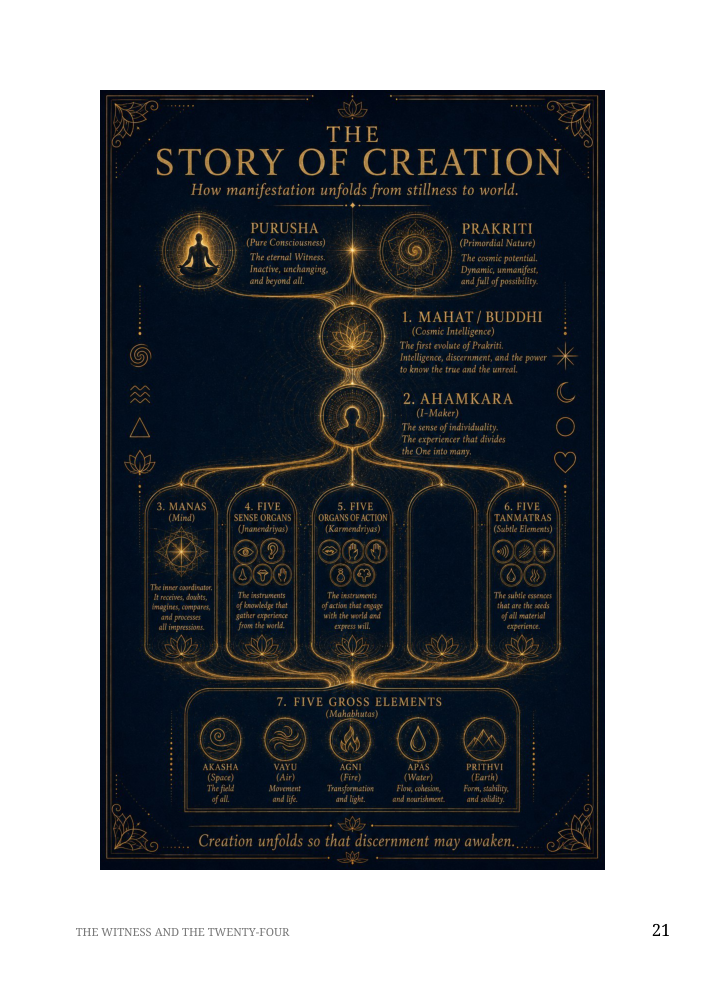
Here is the simplest possible picture of what Sankhya describes:
PURUSHA — The Pure Witness. Never acts. Never changes. Simply sees.
PRAKRITI — All of nature: your body, your mind, your thoughts, your emotions, the world
↓ Prakriti unfolds into 24 Tattvas (principles)
Buddhi (Intellect): The part of you that decides, discerns, says 'this is right, this is wrong.'
Ahamkara (Ego / I-maker): The part of you that says: I am this person. These are my things. This is my story.
Manas (Lower Mind): The part of you that scrolls, plans, worries, doubts, desires.
5 Sense Organs: Eyes, ears, nose, tongue, skin — your receivers of the world.
5 Action Organs: Hands, feet, voice, and the rest — your ways of acting on the world.
5 Subtle Elements: The pure potential of sound, touch, form, taste, smell — before they become physical.
5 Gross Elements: Space, Air, Fire, Water, Earth — the physical building blocks of everything.
Read that table slowly. Everything downward — every single item — is Prakriti. Everything that can change, be named, be observed. Everything that comes and goes.
The item at the top — Purusha — is the only thing that never changes, never acts, never comes or goes.
You are Purusha. You have simply forgotten.
PRACTICE: Before Reading Further — Before you read Chapter 1, take one breath. As you inhale, say silently: 'I am about to read a map of what I am not.' As you exhale: 'And in that negation, I may rest as what I am.' This small ritual aligns your intention.
ONE-MINUTE SUMMARY
Purusha = The Witness. Prakriti = Everything else.
Suffering = forgetting you are the Witness. Liberation = remembering.
You already know the witness. You have lived it in three ordinary moments.
Your morning waking is a complete replay of the entire cosmic creation story.
The movie theater: You are the screen. Prakriti is the movie. The screen remains untouched.