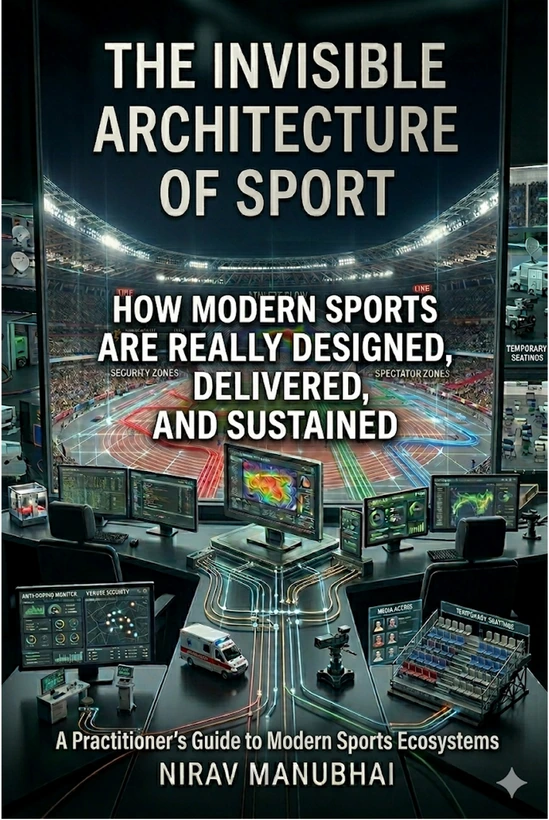
Sport does not fail because of lack of effort. It fails because it is misunderstood.
The lights flickered at 8:17 PM. The engineer in the basement saw the voltage drop. He radioed the control room. No response. He was on Channel 7. They were on Channel 3. At 8:22 PM, half the stadium went dark. In the control room, five people were speaking at once. No one was deciding. This is not a story about power failure. It is a story about a system that was never designed to decide. This is what a crisis looks like when the architecture is invisible.
1.1 The Event Illusion
For decades, sport has been described, planned, and sold as an event. An event has a start date, an end date, a venue, a program, and a success metric tied to attendance or broadcast.
This mental model is convenient. It is also dangerous.
When sport is treated as an event, preparation becomes linear, responsibility becomes fragmented, and failure is always described as “unexpected.” In reality, most failures in sport are not unexpected at all - they are structural outcomes of incorrect framing.
An opening ceremony does not begin a sporting event. It merely reveals whether the ecosystem was designed correctly.
1.2 Why the Event Mindset Persists
The event mindset survives because it aligns with marketing calendars, sponsorship cycles, political announcements, and media narratives. These stakeholders benefit from visibility, not continuity.
However, the professionals responsible for delivery - operations heads, venue managers, government liaisons, safety officers - do not operate in moments. They operate in systems.
A match lasts 90 minutes. Its consequences can last years.
1.3 Sport as an Ecosystem: A Necessary Reframe
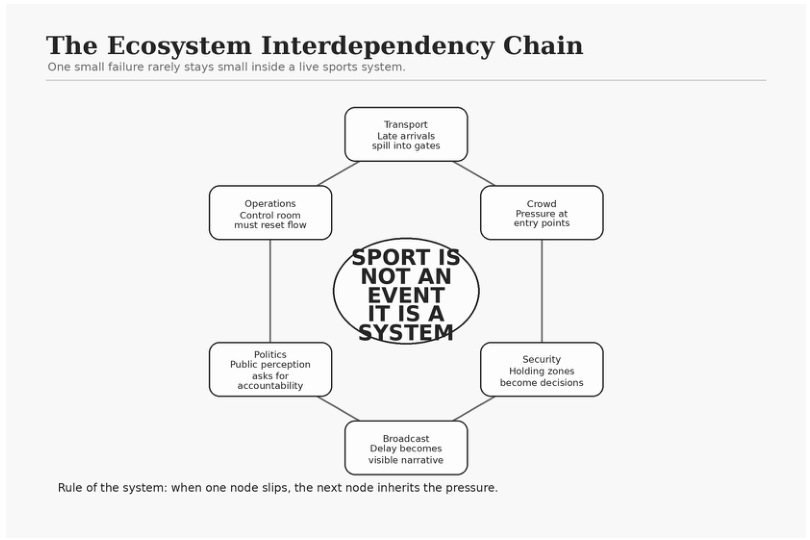
An ecosystem is defined by interdependence, feedback loops, cascading consequences, and delayed impact. Modern sport exhibits all four.
Consider even a “simple” stadium match:
- Transport systems affect crowd arrival
- Crowd arrival affects security posture
- Security posture affects broadcast schedules
- Broadcast schedules affect political visibility
- Political visibility affects future permissions
No single stakeholder controls this chain. Yet every stakeholder is affected by it.
In an event, failure is local. In an ecosystem, failure propagates.
1.4 The Myth of the Isolated Failure
Post-event reviews often include phrases like “This issue occurred unexpectedly” or “It was an isolated incident.”
In ecosystems, isolated incidents do not exist.
Every visible failure has a silent precursor, an ignored signal, a delayed decision, and an unclear authority line. The ecosystem mindset trains professionals to look upstream, not backward.
Instead of asking “Who made the mistake?” the ecosystem thinker asks “Which system allowed this to reach visibility?”
1.5 The Professional Consequence
Professionals who think in events react quickly, speak loudly, fix visibly, and escalate unintentionally.
Professionals who think in ecosystems anticipate quietly, design redundancies, prevent visibility, and earn long-term trust.
Sport does not reward urgency. It rewards prepared calm.
1.6 The Divine Invisible Force
There is a transformation that happens in Indian events that no manual describes.
Around Day 3 or Day 4 of a long tournament, the disparate teams stop being separate. The transport people have eaten with the security people. The volunteers have solved problems together. The functional area heads have spoken to each other, dealt with each other, had meals together. Suddenly, everyone acts as if this is their own personal event.
Passion becomes dedication. Camaraderie builds. Confidence rises.
Call it what you want - camaraderie, ownership, the divine invisible force. It is real. It is powerful. And no one in a control room should pretend it does not exist.
But also no one should rely on it alone. Systems are for when the magic does not show up.
I have seen this time and again. This is that divine, invisible force which makes the event successful. But sadly, no one sees this or articulates it at the right level or forum. I mention this to the highest levels - but then the event is over and everyone is celebrating in their own personal world.
Field Takeaway - Chapter 1
Tomorrow, name one system in your event that is currently invisible. Write it down. Assign an owner. If you cannot name it, you do not have it.
Closing Reflection
The shift from events to ecosystems is not semantic. It is foundational. Until this shift occurs, no amount of technology will help, no number of volunteers will stabilize delivery, and no branding will protect reputation.
You cannot manage an ecosystem with an event mindset. That is where most failures begin.
Chapter 1 Diagnostic
Before moving on, ask yourself three questions:
- What is the one principle from this chapter you will apply at your next event?
- What assumption does this chapter challenge in your current practice?
- Who on your team needs to read this chapter?